Share this link via:

The global intracranial hypertension market size was valued at USD 1.6 billion in 2025 and is estimated to reach USD 1.74 billion in 2026, expanding to USD 3.2 billion by 2034, growing at a CAGR of 7.9% during the forecast period (2026-2034).
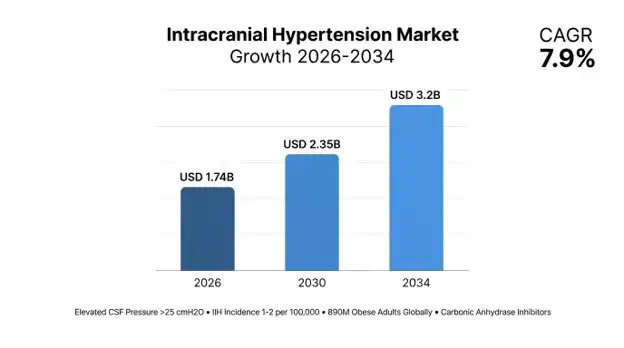
Intracranial hypertension is a neurological syndrome characterized by sustained elevation of cerebrospinal fluid pressure within the cranial vault, usually greater than 25 cmH₂O on lumbar puncture performed in the lateral decubitus position, resulting in a clinical picture of chronic headache, visual disturbance due to papilledema, and pulsatile tinnitus, which, if untreated, may progress to permanent optic nerve damage and irreversible vision loss. It is generally divided into idiopathic intracranial hypertension (IIH), which was previously called pseudotumor cerebri, a condition without a known cause that is far more common in obese women of reproductive age; and secondary intracranial hypertension caused by recognized structural, vascular, infectious, and pharmacologic causes, such as cerebral venous sinus thrombosis, space-occupying brain tumors, traumatic brain injury, meningitis, and pharmacologic causes such as those associated with increased concentrations related to drugs, including tetracyclines and vitamin A derivatives.
The therapeutic environment of intracranial hypertension has progressed from a primarily invasive cerebrospinal fluid diversion approach to a multidisciplinary treatment regimen that includes pharmaceutical suppression of CSF, minimally invasive endovascular correction of venous outflow obstruction, and continuous ICP monitoring. First-line pharmacotherapy is based on carbonic anhydrase inhibitors, particularly acetazolamide, which inhibit production of CSF at the choroid plexus and may be combined with loop diuretics and topiramate and/or short-course corticosteroids in certain secondary presentations. If medical management fails to achieve adequate control of pressure, or vision is still threatened, the clinician will resort to surgical or endovascular treatment options, such as ventriculoperitoneal and lumboperitoneal cerebrospinal fluid shunting; direct protection of the optic nerve with optic nerve sheath fenestration; and, in the past few years, increasingly, transverse venous sinus stenting for those with a clearly noted pressure gradient across an affected segment of a stenotic dural sinus.
The commercial application of the market is not limited to the pharmaceutical product but also includes neurosurgical shunts, programmable valve systems, dedicated cerebral venous stents, and invasive and non-invasive intracranial pressure monitoring platforms, in addition to the diagnostic imaging system that must enable precise identification and follow-up over time. The overall incidence of idiopathic intracranial hypertension is around 1-2 cases per 100,000 people each year in the general population and is increasing rapidly, in keeping with global adult obesity, which affects more than 890 million people. Because clinically significant elevation of ICP that requires acute monitoring and intervention accounts for a significant proportion of TBI cases, secondary intracranial hypertension contributes significantly to the burden of disease; an estimated 69 million individuals experience TBI annually. Idiopathic intracranial hypertension is chronic and relapsing; it often lasts for years and requires frequent testing of the visual field and follow-up optical coherence tomography and long-term drug therapy or repeated procedures, leading to a significant and persistent lifetime cost per patient.
| Report Coverage | Details |
|---|---|
| Base Year | 2025 |
| Base Year Value | USD 1.6 Billion |
| Forecast Value | USD 3.2 billion |
| CAGR | 7.9% |
| Forecast Period | 2025-2034 |
| Historical Data | 2022-2025 |
| Largest Market | North America |
| Fastest Growing Market | Asia Pacific |
| Segments Covered | By Disease Type, Treatment Type, Drug Class, Diagnostic Modality, End-User |
| Region Covered | North America, Europe, Asia Pacific, Middle East & Africa, Latin America |
| Countries Covered | US, Canada, Mexico, UK, Germany, France, Italy, Spain, China, Japan, India, Australia, South Korea, Brazil, Argentina, UAE, Saudi Arabia, South Africa |
| Key Market Playes | Medtronic plc, Integra LifeSciences, B. Braun (Aesculap), Sophysa SA, Teva Pharmaceutical Industries, Stryker Corporation, Novo Nordisk A/S |
Get more details on this report - Request Free Sample
The major structural factor behind the market for intracranial hypertension is the growing trend towards obesity around the world and its direct connection with idiopathic intracranial hypertension. Since the occurrence of this condition correlates with rising body mass index and more than 890 million people all over the world are now obese, the pool of those at risk increases gradually, especially in the case of females of reproductive age from North America, Europe, and, increasingly, the Asia Pacific. The increase in intra-abdominal pressure because of weight gain leads to an increase in intracranial venous pressure, which inhibits the absorption of cerebrospinal fluid due to transfer through the epidural venous plexus; apart from that, hormonal changes due to obesity are considered to affect the dynamics of cerebrospinal fluid. It also accounts for the effect of losing 5% – 10% of body weight in the form of reduced intracranial pressure.
Key Performance Metrics:
The increase in availability of high-resolution MRI and MRA has revolutionized the diagnostic process of intracranial hypertension, where identification of radiological signs like empty sella, optic nerve sheath distention, globe flattening, and transverse sinus stenosis can be made without using invasive lumbar puncture. The use of optical coherence tomography in neuro-ophthalmic practice provides a non-invasive method to quantify the progression of optic disc swelling and retinal nerve fiber layer thickening to measure treatment efficacy before any irreversible damage to the visual fields occurs. With an increased awareness among general practitioners and emergency medicine specialists regarding the fundoscopic features of papilledema, there is a decline in the misdiagnosis of papilledema as migraine or tension headache.
Key Performance Metrics:
The relatively high rate of complications and revisions involved in the surgical management of intracranial hypertension is a primary hindrance in the growth of the market. Even though cerebrospinal fluid shunting is needed among fast-progressing patients and those who are unresponsive to medication, it causes mechanical obstruction, catheter dislocation, excessive drainage, and infection. The revision rate within the first two to three years of placing the device has been estimated at around 30-50%. The delay in opting for surgical treatment due to the complications of surgery and the threat of blindness is a result of the above-mentioned issues. Even though optic nerve sheath fenestration is comparatively safe, it may sometimes lead to revisions as well as conversions into shunts because of the possibility of transient diplopia and low longevity among some patients.
A substantial opportunity in the ongoing development of venous sinus stenting among patients suffering from idiopathic intracranial hypertension with an identifiable pressure gradient through a stenosed transverse or sigmoid sinus, a group of patients that is believed by some researchers to comprise most medically unresponsive individuals. Venous sinus stenting provides a solution for the obstruction in venous flow that contributes to the onset of the disease by providing an effective pressure reduction in one session compared to pharmacotherapy and repeat shunt revisions required with other methods. Currently, the technique uses the stents that were designed for use in coronary or peripheral arterial applications off-label in the hemodynamically different cerebral venous sinuses; hence, there is an opportunity to develop specific venous sinus stent technology for this purpose.
Intracranial hypertension management is becoming more consolidated to a dedicated clinic with various specialties such as neurology, neuro-ophthalmology, neurosurgery, endocrinology, and weight management within one pathway. The approach ensures consistency in visual examinations, facilitates decision-making on surgical/endovascular intervention, and incorporates lifestyle and metabolic modification interventions in the treatment process. The development is more prevalent in academic centers of North America and Western Europe, with signs of spreading into large private hospital groups in the Asia Pacific region.
North America
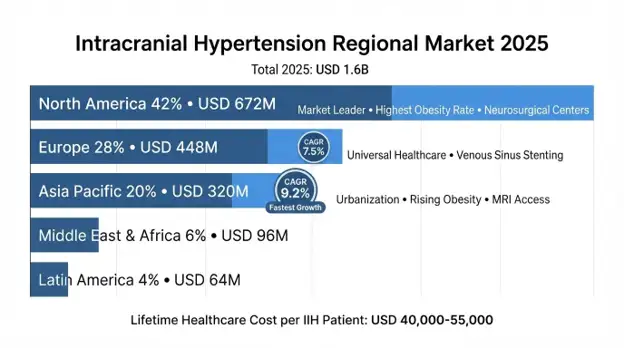
North America represents the largest regional market owing to an extensively developed pool of neurology and neuro-ophthalmology specialists, broad insurance coverage for neuroimaging, drugs, and surgical/endovascular interventions, as well as one of the highest obesity prevalence rates worldwide, thus directly supporting a large pool of patients suffering from idiopathic intracranial hypertension. The United States is responsible for most of the regional market, driven by the presence of a developed pool of neurosurgical centers specializing in cerebrospinal fluid shunting as well as an increasing number of centers specializing in venous sinus stenting and patient advocacy groups, which have contributed to increasing primary care recognition of papilledema.
Europe
Europe represents the second largest regional market and is aided by comprehensive public healthcare systems, established programs for neurology and ophthalmology, and the increasing popularity of venous sinus stenting in dedicated facilities in countries such as the United Kingdom, Germany, and France. Health technology assessment programs in certain markets have considerable sway over the reimbursement rate of new technologies, thus slowing down their implementation compared to North America despite the increased need caused by obesity in the region.
Asia Pacific
The Asia Pacific region is the fastest-growing regional market, owing to an increased number of obese people due to urbanization, especially in China and India; an increase in neurologists and neurosurgeon specialists in tier one and tier two cities; and improved accessibility of magnetic resonance imaging, which has gradually helped bridge the past under-diagnosing gap. In the Asia Pacific region, China accounts for the highest percentage of market demands, driven by the quick development of tertiary neurology centers. India is experiencing increased private hospital facilities and healthcare service uptake among its middle class.
The cases of idiopathic intracranial hypertension make up the largest proportion of chronic/long-term managed cases due to its prevalence amongst women of working age groups, the long period that it takes to use pharmacologic treatment, and the frequent requirement of visual field examination as well as escalation to surgery or endovascular procedures. Cases of secondary intracranial hypertension, which include traumatic brain injury, brain tumors, cerebral venous sinus thrombosis, meningitis, and medication-induced cases, are found predominantly in acute care units and intensive care units, where the management focuses on pressure monitoring and cerebrospinal fluid diversion.
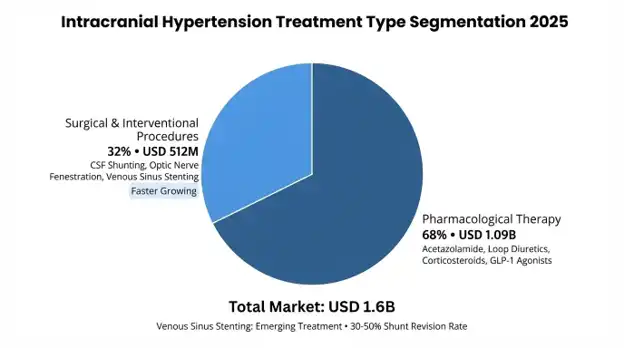
Pharmacotherapy continues to be the mainstay of treatment both in the short run and in the long run for most patients using carbonic anhydrase inhibitors, mainly acetazolamide, loop diuretics, or even corticosteroids/migraine prophylaxis drugs. The latter is advantageous due to widespread prescription experience and insurance coverage. Interventions and surgical treatments, such as cerebrospinal fluid shunts, optic nerve sheath fenestration, and venous sinus stenting, account for a smaller market share but a relatively more rapidly growing one, thanks to increased use of stenting and development of programmable shunt valves to avoid over drainage and revisions.
Hospitals and neurosurgery centers constitute the largest end-user segment given their concentration of neuroimaging infrastructure, neurosurgical expertise, and capacity to manage both elective and emergency presentations. Neurology and neuro-ophthalmology clinics represent the fastest-growing end-user category, reflecting the broader shift toward dedicated outpatient, multidisciplinary management pathways emphasizing long-term pharmacological therapy, structured visual monitoring, and coordinated weight-management support outside the hospital setting.
The global intracranial hypertension market exhibits a moderate level of fragmentation involving generic drug producers providing basic drugs like acetazolamide, neurosurgical device providers offering shunts, programmable valves, and intracranial pressure monitoring devices, and neurovascular device makers offering specialized stents and catheters for venous sinus treatment. Competitive positioning within the industry is influenced mainly by the reliability of devices and reduction in revision frequency; quality of clinical data for emerging treatment modalities such as venous sinus stenting; and capability to provide an integrated set of solutions in diagnostics, monitoring, and treatment to support a multidisciplinary treatment approach.
August 2026: Acandis received regulatory approval in Germany to initiate the SONIC pivotal clinical investigation evaluating the SILANCE® Stent for patients with idiopathic intracranial hypertension and symptomatic cerebral venous sinus stenosis.
July 2026: Long-term four- to five-year follow-up data from the River Study demonstrated sustained clinical benefits of venous sinus stenting in patients with idiopathic intracranial hypertension, supporting the growing role of minimally invasive interventional treatment.
March 2026: Serenity Medical received U.S. regulatory approval for the River™ Stent for the treatment of severe, refractory idiopathic intracranial hypertension, marking an important advancement in device-based treatment options.
February 2026: Pharmaceutical development activity continued to expand, with emerging therapies targeting underlying cerebrospinal fluid regulation and disease mechanisms progressing toward mid-stage clinical evaluation for idiopathic intracranial hypertension.
January 2026: Healthcare providers increasingly adopted advanced non-invasive diagnostic and monitoring technologies, including MRI, MR venography, optical coherence tomography, and ultrasound-based approaches for earlier diagnosis and disease monitoring.
By Disease Type:
By Treatment Type:
By Diagnostic Modality:
By End-User:
By Region:
You'll get the sample you asked for by email. Remember to check your spam folder as well. If you have any further questions or require additional assistance, feel free to let us know via-
+1 724 648 0810 +91 976 407 9503 sales@intellectualmarketinsights.com
17 Sep 2026
Intellectual Market Insights Research © 2026. All rights reserved.