Share this link via:

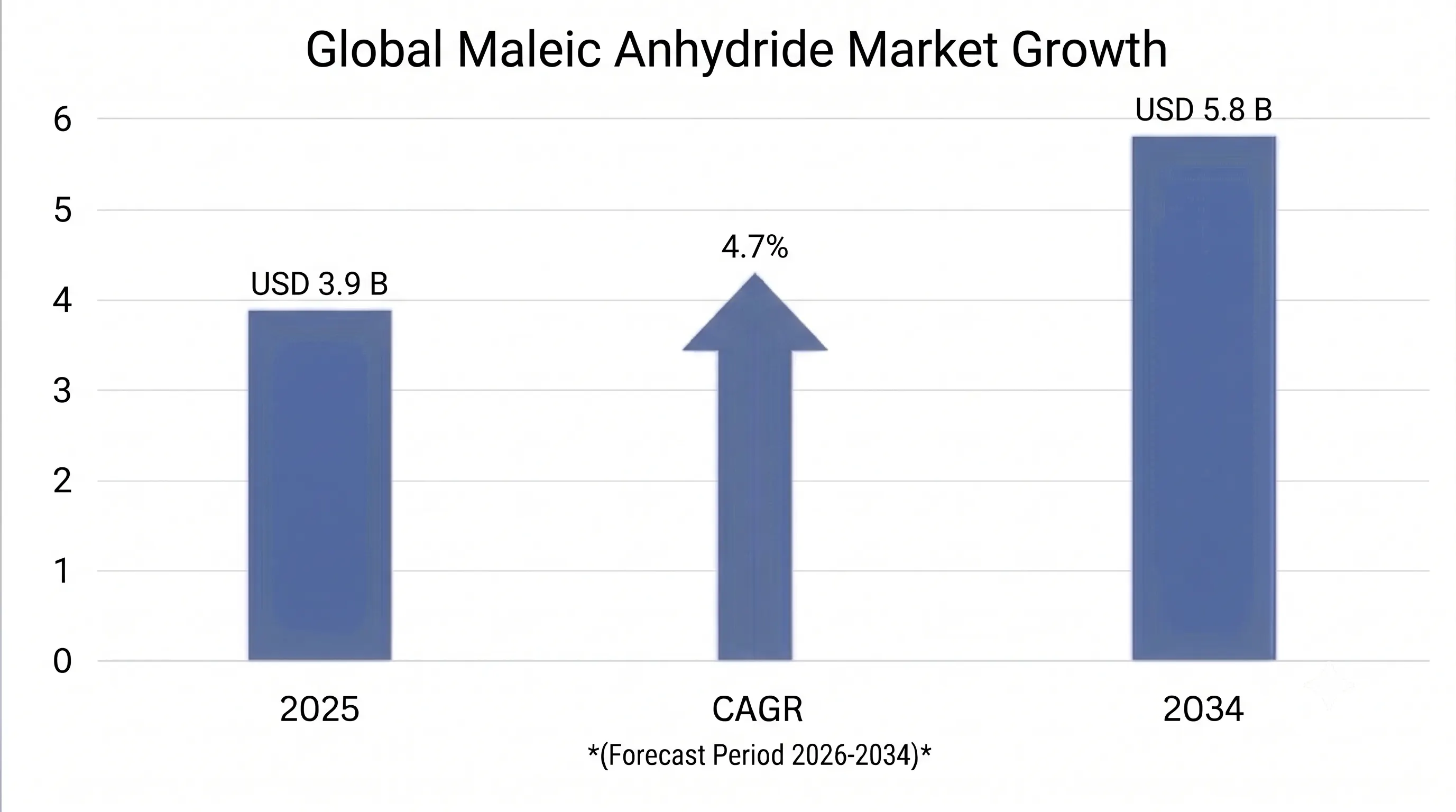
The global maleic anhydride market size was valued at USD 3.9 billion in 2025 and is projected to reach USD 4.1 billion in 2026, expanding to USD 5.8 billion by 2034, growing at a CAGR of 4.7% during the forecast period (2026-2034).
Maleic anhydride represents a critical industrial chemical intermediate with the molecular formula $$C_4H_2O_3$$, serving as a foundational building block for numerous downstream derivatives across diverse manufacturing sectors. The compound’s exceptional versatility stems from its unique molecular structure containing both a reactive carbon-carbon double bond and an anhydride functional group, enabling it to participate in a wide range of chemical reactions including polymerization, esterification, hydration, and Diels-Alder cycloadditions. This reactivity profile makes maleic anhydride indispensable for synthesizing unsaturated polyester resins, engineering plastics precursors, agricultural chemicals, food additives, and specialty copolymers.
The industrial production of maleic anhydride has undergone a fundamental transformation over the past three decades, shifting from the traditional benzene oxidation process to the more economically and environmentally sustainable catalytic oxidation of n-butane. This transition has been driven by stringent environmental regulations regarding benzene handling and emissions, superior feedstock economics of natural gas liquids, and improved process safety profiles. The n-butane oxidation route, which now accounts for approximately 80% of global production capacity, utilizes catalytic vapor-phase oxidation over vanadium-phosphorus oxide catalysts at temperatures of 380-420°C, achieving maleic anhydride selectivity of 70-75% while generating significantly lower toxic emissions compared to benzene-based processes.
The commercial significance of maleic anhydride is anchored primarily in its role as the principal raw material for unsaturated polyester resins, which consume approximately 50-55% of global production. These thermosetting resins serve as matrix materials in fiber-reinforced plastic composites extensively used in construction panels, marine vessel hulls, automotive components, and wind turbine blades due to their excellent strength-to-weight ratios, chemical resistance, and durability characteristics. Beyond resins, maleic anhydride serves as a critical feedstock for 1,4-butanediol production, which cascades into engineering plastics, spandex fibers, and biodegradable polymers, as well as for agricultural chemicals, lubricating oil additives, and food-grade organic acids including fumaric and malic acid.
The market’s growth trajectory is intrinsically linked to global infrastructure development, automotive lightweighting trends, and the expanding adoption of composite materials across multiple industries. The ongoing shift toward sustainable construction materials, electric vehicle component lightweighting, and renewable energy infrastructure development creates sustained demand for maleic anhydride-derived products. Additionally, emerging applications in biodegradable polymers, driven by global plastic waste reduction initiatives and circular economy mandates, are creating new growth vectors for maleic anhydride consumption through the polybutylene succinate and polybutylene adipate-co-terephthalate production pathways.
| Report Coverage | Details |
|---|---|
| Base Year | 2025 |
| Base Year Value | USD 3.9 Billion |
| Forecast Value | USD 5.8 Billion |
| CAGR | 4.7% |
| Forecast Period | 2025-2034 |
| Historical Data | 2022-2025 |
| Largest Market | Asia Pacific |
| Fastest Growing Market | Asia Pacific |
| Segments Covered | By Raw Material, Application, End-Use Industry, Region |
| Region Covered | North America, Europe, Asia Pacific, Middle East & Africa, Latin America |
| Countries Covered | US, Canada, Mexico, UK, Germany, France, Italy, Spain, Netherlands, China, Japan, India, South Korea, Australia, Brazil, Argentina, UAE, Saudi Arabia, South Africa |
| Key Market Playes | Huntsman Corporation, LANXESS AG, Polynt-Reichhold Group, Mitsubishi Chemical Corporation, Nippon Shokubai Co. Ltd., Thirumalai Chemicals Ltd., BASF SE |
Get more details on this report - Request Free Sample
The primary structural driver propelling the maleic anhydride market expansion is the sustained global demand for unsaturated polyester resins in construction and infrastructure applications, which consumed approximately 2.1-2.3 million metric tons of maleic anhydride in 2025. Unsaturated polyester resins serve as the matrix material in fiber-reinforced plastic composites used extensively in construction panels, roofing systems, pipes, tanks, and prefabricated building components due to their superior corrosion resistance, lightweight properties, and design flexibility compared to traditional materials like steel and concrete.
Global construction industry activity remains structurally elevated, particularly across emerging economies in Asia Pacific, the Middle East, and Latin America, where rapid urbanization, population growth, and government-led infrastructure investment programs are driving sustained demand for composite building materials. The global construction market was valued at approximately $$ ext{USD 13.9 trillion}$$ in 2025 and is projected to reach $$ ext{USD 19.2 trillion}$$ by 2034, as fiber-reinforced plastic composites continue to gain market share due to their superior durability, lower maintenance requirements, and favorable strength-to-weight ratios.
The wind energy sector represents a particularly high-growth application segment, with global wind turbine installations reaching 117 GW of new capacity in 2025. Modern wind turbine blades, which are manufactured almost exclusively from glass fiber-reinforced composites using unsaturated polyester or epoxy resin matrices, consume substantial volumes of maleic anhydride-derived resins. As blade lengths increase to improve energy capture efficiency, with modern offshore blades now exceeding 100 meters, resin volumes per turbine installation have grown correspondingly, creating direct demand linkage between renewable energy expansion and maleic anhydride consumption.
The second major growth driver is the expansion of global 1,4-butanediol production and its derivatives, which accounted for approximately 20-22% of global maleic anhydride consumption in 2025. The 1,4-butanediol pathway serves as a precursor for tetrahydrofuran, gamma-butyrolactone, polybutylene terephthalate engineering plastics, and increasingly important biodegradable polymers including polybutylene succinate and polybutylene adipate-co-terephthalate.
The accelerating global transition toward biodegradable and compostable plastics is creating substantial incremental demand for maleic anhydride through biodegradable polymer production pathways. These materials are increasingly mandated or preferred in packaging, agricultural films, and disposable food service applications as governments worldwide implement single-use plastic restrictions and extended producer responsibility frameworks. The European Union’s Single-Use Plastics Directive, China’s national plastic ban policies, and similar regulations across 127 countries as of 2025 are collectively accelerating substitution of conventional polyethylene and polypropylene with biodegradable alternatives.
The global 1,4-butanediol market was valued at approximately $$ ext{USD 8.3 billion}$$ in 2025, with maleic anhydride-based production routes competing effectively with alternative technologies through established process economics, high selectivity, and compatibility with existing petrochemical infrastructure. The automotive and electronics sectors drive substantial demand for polybutylene terephthalate engineering plastics, while the textile industry’s growing spandex fiber consumption supports tetrahydrofuran demand.
The most significant constraint affecting the stability of the maleic anhydride market is the inherent exposure to crude oil and natural gas price volatility, as both primary feedstocks—n-butane and benzene—are petrochemical derivatives whose pricing directly determines production economics and end-product competitiveness. N-butane, which constitutes the feedstock for approximately 80% of global maleic anhydride capacity, is a natural gas liquid whose price fluctuates with natural gas markets, seasonal demand patterns, and refinery output configurations.
Between 2020 and 2025, n-butane prices experienced volatility ranging from $$ ext{USD 0.28 to USD 0.74 per kilogram}$$, creating corresponding maleic anhydride production cost swings of $$ ext{USD 180-420 per metric ton}$$ that significantly compressed producer margins during peak feedstock price periods. This volatility is particularly challenging for smaller producers with limited feedstock hedging capabilities and contract structures that prevent rapid pass-through of cost increases to downstream customers. The energy intensity of maleic anhydride production, requiring substantial heat for catalytic oxidation reactions and product purification, adds additional sensitivity to natural gas and electricity price fluctuations.
Environmental regulations governing benzene storage, handling, and emissions continue to pressure legacy benzene-based maleic anhydride production facilities, particularly in regions with stringent air quality standards and occupational health requirements. Benzene’s classification as a known human carcinogen necessitates extensive safety infrastructure, specialized handling procedures, and continuous emissions monitoring that increase operational complexity and compliance costs compared to n-butane-based processes.
The regulatory environment is becoming increasingly restrictive regarding benzene exposure limits, with occupational exposure standards tightening in major producing regions including the European Union, North America, and parts of Asia Pacific. These regulatory pressures are accelerating the retirement of older benzene-based facilities and creating market consolidation as smaller producers face prohibitive compliance upgrade costs.
A significant emerging opportunity exists in developing bio-based maleic anhydride production from renewable feedstocks including furfural derived from agricultural residues, levulinic acid from lignocellulosic biomass, and other bio-based platform chemicals. Bio-based production routes align with growing corporate sustainability commitments, circular economy mandates, and green chemistry principles that are increasingly demanded by downstream customers in automotive, construction, and consumer goods sectors.
Several companies and research institutions have demonstrated technical feasibility of bio-based maleic anhydride production at pilot scale, with conversion efficiencies approaching commercial viability thresholds. The commercial appeal extends beyond environmental credentials to potential feedstock cost advantages in regions with abundant agricultural residue availability, including Brazil, India, and Southeast Asia where biomass-derived precursors provide economically attractive starting materials.
The global bio-based chemicals market is projected to grow at 11.2% annually through 2034, and maleic anhydride represents an attractive target for bio-based transition investment due to its high-volume consumption and broad derivative utility across multiple industries.
Maleic anhydride’s exceptional reactivity as a co-monomer enables synthesis of specialty copolymers with precisely engineered properties for demanding technology applications including lithium-ion battery binders, water treatment chemicals, oilfield applications, and electronic materials. Styrene-maleic anhydride copolymers serve as compatibilizers in engineering thermoplastic blends, while maleic anhydride-grafted polyolefins function as coupling agents in natural fiber composites.
The expanding electric vehicle battery manufacturing industry represents a particularly promising growth avenue, with maleic anhydride-derived binders and electrode coatings under active development for next-generation battery architectures. Advanced water treatment applications, driven by global water scarcity concerns and stringent discharge regulations, create additional specialty market opportunities for maleic anhydride-based scale inhibitors and dispersants.
The global maleic anhydride industry continues to consolidate around n-butane-based production technology as environmental regulations tighten restrictions on benzene handling and as n-butane feedstock economics remain favorable in most major producing regions. New capacity additions in North America, the Middle East, and India are exclusively n-butane-based, while legacy benzene-based facilities face increasing pressure to convert or retire as environmental enforcement intensifies.
The transition is accompanied by continuous catalyst development programs improving n-butane conversion efficiency, selectivity toward maleic anhydride, and catalyst lifetime. Leading catalyst systems now achieve maleic anhydride yields of 72-78% on a molar basis compared to 60-65% in earlier generations, while reducing byproduct formation and energy consumption per unit of output.
Maleic anhydride producers and downstream manufacturers are increasingly integrating circular economy principles through development of chemically recyclable unsaturated polyester resin formulations and depolymerization processes that recover maleic anhydride derivatives from end-of-life composite materials. The construction and marine sectors, which generate substantial volumes of fiber-reinforced plastic waste at end of service life, represent priority targets for chemical recycling technology development.
Advanced recycling technologies including glycolysis and hydrolysis-based depolymerization are being developed to recover maleic anhydride-derived intermediates that can re-enter the production value chain, reducing virgin feedstock requirements and supporting circular economy objectives across the composite materials industry.
Asia Pacific dominates the global maleic anhydride market with approximately 60-62% of global consumption in 2025, valued at approximately $$ ext{USD 2.4 billion}$$, driven by China’s massive unsaturated polyester resin manufacturing industry, India’s rapidly expanding construction sector, and Southeast Asia’s growing automotive and marine composite manufacturing base. China alone accounts for approximately 45% of global maleic anhydride consumption and hosts the world’s largest concentration of production capacity.
The region benefits from integrated petrochemical complexes providing feedstock advantages, established downstream manufacturing infrastructure, and proximity to major consuming industries including construction, automotive, and electronics. China’s construction industry, supported by urbanization trends and infrastructure investment programs, represents the single largest demand driver for maleic anhydride globally.
India recorded the fastest growth within Asia Pacific, with maleic anhydride consumption increasing at approximately 8.9% annually between 2020 and 2025, driven by infrastructure investment under the National Infrastructure Pipeline program and expanding automotive composite adoption. The Indian market benefits from domestic production capacity expansion reducing import dependence.
North America represents approximately 18-20% of global maleic anhydride consumption, with the United States benefiting from abundant and cost-competitive n-butane supply from shale formations that provide structural feedstock cost advantages. The regional market is characterized by high-value specialty applications including 1,4-butanediol production, agricultural chemicals, and advanced composite materials.
The region’s market profile emphasizes specialty and high-performance applications rather than commodity unsaturated polyester resins, with strong demand from aerospace, automotive lightweighting, and renewable energy sectors. Established regulatory frameworks and environmental standards drive adoption of advanced n-butane-based production technologies and sustainable chemistry initiatives.
N-butane feedstock dominates global maleic anhydride production at approximately 80% of capacity, growing at 5.2% CAGR as new investments exclusively adopt this technology pathway. The n-butane oxidation process offers superior economics, environmental performance, and safety profiles compared to benzene-based alternatives, driving continued market share expansion.
Benzene-based production retains approximately 20% of global capacity, concentrated primarily in China and other Asian markets where existing infrastructure and local feedstock availability support continued operation. However, this share is declining as facilities face retirement pressure from environmental regulations and unfavorable feedstock economics.
Unsaturated polyester resins represent the largest application segment at 50-55% of global maleic anhydride consumption, valued at approximately $$ ext{USD 2.0-2.2 billion}$$ in 2025, growing at 4.8% CAGR through 2034. This segment encompasses construction, marine, automotive, and wind energy applications where composite materials offer superior performance characteristics.
The 1,4-butanediol segment accounts for 20-22% of consumption at approximately $$ ext{USD 800-900 million}$$ in 2025, growing at 6.2% CAGR through 2034, driven by engineering plastics demand, spandex fiber production, and expanding biodegradable polymer applications. This segment demonstrates the highest growth trajectory among major applications.
Agricultural chemicals and food additives collectively represent 8-10% of consumption, serving specialized markets where regulatory approval and established safety profiles support premium pricing and stable demand growth.
The construction industry represents the largest end-use segment at approximately 35-40% of global maleic anhydride consumption through unsaturated polyester resin applications in building panels, roofing systems, and infrastructure components. Growth is driven by global urbanization trends and infrastructure investment programs.
Automotive and transportation account for approximately 18-20% of consumption through composite component applications, engineering plastics, and lightweighting initiatives supporting fuel efficiency improvements and electric vehicle development.
Chemical manufacturing, encompassing derivative production and specialty applications, represents 15-18% of consumption with stable growth supported by diverse downstream demand patterns.
The global maleic anhydride market exhibits moderate concentration with the top six producers controlling approximately 45-50% of global production capacity through large-scale facilities benefiting from feedstock integration, process optimization, and established customer relationships. Competitive differentiation centers on feedstock cost advantages, economies of scale, product quality consistency, and technical service capabilities that support downstream application development.
The market structure includes global integrated producers with multi-regional operations alongside numerous regional players concentrated primarily in Asia Pacific markets. Consolidation trends continue as environmental regulations and capital requirements favor larger, technologically advanced operations over smaller commodity producers.
March 2026: Huntsman Corporation announced a 120,000 metric ton per year capacity expansion at its Port Neches, Texas facility, representing a $$ ext{USD 180 million}$$ investment targeting growing 1,4-butanediol and biodegradable polymer feedstock demand. The expansion utilizes advanced n-butane oxidation technology with improved energy efficiency and emissions performance.
February 2026: BASF SE completed pilot-scale demonstration of bio-based maleic anhydride production utilizing furfural derived from agricultural residues, achieving 68% conversion efficiency and targeting demonstration-scale operations by 2028 as part of the company’s commitment to 25% bio-based feedstock share in core intermediates by 2035.
January 2026: Thirumalai Chemicals commissioned a new 50,000 metric ton per year maleic anhydride plant in Gujarat, India, representing an investment of approximately $$ ext{USD 85 million}$$ and utilizing state-of-the-art n-butane oxidation technology to serve domestic construction and automotive markets.
December 2025: Polynt-Reichhold Group completed acquisition of a specialty resin manufacturer in Germany for $$ ext{EUR 145 million}$$, strengthening vertical integration from maleic anhydride production through specialized resin formulation and expanding presence in European wind energy and automotive composite markets.
November 2025: LANXESS AG received regulatory approval for a novel maleic anhydride-based water treatment copolymer, expanding addressable markets in industrial water management applications experiencing growth driven by water scarcity concerns and discharge regulations.
You'll get the sample you asked for by email. Remember to check your spam folder as well. If you have any further questions or require additional assistance, feel free to let us know via-
+1 724 648 0810 +91 976 407 9503 sales@intellectualmarketinsights.com
01 Jul 2026
Intellectual Market Insights Research © 2026. All rights reserved.