Share this link via:

The global multiple myeloma treatment market size was valued at USD 24.5 billion in 2025 and is projected to reach USD 26.6 billion in 2026, expanding to USD 50.6 billion by 2034, growing at a CAGR of 8.4% during the forecast period (2026-2034).
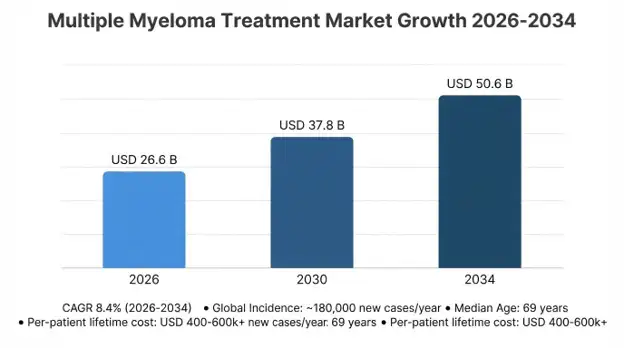
Multiple myeloma is one type of plasma cell neoplasm that is characterized by the proliferation of an abnormal population of plasma cells in the bone marrow, resulting in excessive production of abnormal monoclonal immunoglobulin proteins, called M-protein, and the progressive inhibition of normal hematopoiesis. The unrestricted growth of this malignant clone leads to the typical constellation of end-organ damage (hypercalcemia, renal insufficiency, anemia, osteolytic destruction of bone), signifying that a new stage of the disease, once it has occurred, must be treated with a drug. Multiple myeloma is estimated to be responsible for close to 1% of all cancer cases diagnosed worldwide, with an estimated 180,000 new cases being diagnosed and about 120,000 cases of MM being fatal each year, this number will continue to increase as the world's population ages, and diagnostic detection improves.
It is primarily a disease of older people, with a median age of about 69 years, and with a very high and disproportionate burden in people over the age of 65; it is often preceded by either a monoclonal gammopathy of undetermined significance (MGIS) in 3–4% of older adults, or a smoldering myeloma (SM) in a smaller group who have a significant increase in the annual risk of developing the disease. Multiple myeloma is highly genetically heterogeneous with some specific abnormalities, such as translocations of the immunoglobulin heavy chain, deletion of chromosome 17p, gain of 1q and hyper diploid karyotypes, defining the risk categories, with each class of drug affecting the disease differently and with clonal evolution of resistant subclones under sequential therapeutic pressure being inevitable causing the relapsing and remitting disease course in the vast majority of patients.
The therapeutic approach has radically changed over the last twenty years, from using traditional chemotherapy with melphalan and prednisone to highly effective triplets and more often quadruplet combination treatments of immune-modulatory drugs, proteasome inhibitors, anti-CD38 monoclonal antibodies and a corticosteroid backbone, which are followed by high dose melphalan and stem cell transplantation in suitable patients and prolonged maintenance treatment afterwards. Chimeric antigen receptor T-cell (CAR-T) therapies and off-the-shelf bispecific T-cell engaging antibodies targeting B-cell maturation antigen (BCMA) and other surface targets have brought unprecedented depth and durability of response to heavily treated and triple-class exposed patients with very limited therapeutic options and poor survival prospects in the relapsed and refractory setting.
The management of MM is characterized by repeated use of non-cross-resistant regimens over successive relapses, resulting in significant cumulative healthcare costs of hundreds of thousands of dollars per patient in developed countries, and often exceeding the cost of living for the individual patient. Multiple myeloma is one of the highest per-patient value disease segments in the global oncology pharmaceutical market, as it is the focus of increased scrutiny by payers and is becoming increasingly personalized by multiple myeloma treatment lines and value-based pricing models between payers and manufacturers, all of which are made possible by novel and premium priced biologic and cellular drugs.
| Report Coverage | Details |
|---|---|
| Base Year | 2025 |
| Base Year Value | USD 24.5 Billion |
| Forecast Value | USD 50.6 Billion |
| CAGR | 8.4% |
| Forecast Period | 2026-2034 |
| Historical Data | 2022-2025 |
| Largest Market | North America |
| Fastest Growing Market | Asia Pacific |
| Segments Covered | By Drug Class, Therapy Type, Line of Therapy, Transplant Eligibility, End-User, Region |
| Region Covered | North America, Europe, Asia Pacific, Middle East & Africa, Latin America |
| Countries Covered | US, Canada, Mexico, UK, Germany, France, Italy, Spain, Netherlands, China, Japan, India, South Korea, Australia, Brazil, Argentina, Saudi Arabia, UAE, South Africa |
| Key Market Playes | Johnson & Johnson, Bristol Myers Squibb, Amgen Inc., Sanofi S.A., Takeda Pharmaceutical, AbbVie Inc., GlaxoSmithKline plc |
Get more details on this report - Request Free Sample
The basic drive for growth in the market is the increasing cases of multiple myeloma, which is a disease with the probability of occurrence that is directly correlated to aging. Individuals over the age of 65 have a four-fold greater probability of being affected by this disease, and since there are currently more than 800 million individuals over this age around the world and the figure is expected to increase to over 1.6 billion by 2050, the number of patients in need of treatments will grow significantly even without any further increases in the incidence probability of the disease. Improvements in diagnostic technologies, such as serum protein electrophoresis, free light chain testing, and whole-body MRI, PET-CT, are allowing early detection of not only the symptomatic multiple myeloma but also high-risk smoldering myeloma.
The inclusion of anti-CD38 monoclonal antibodies such as daratumumab and isatuximab in quadruplet induction therapy regimens in both transplant-eligible and transplant-ineligible patients has raised the level of standard of care to a completely different level while at the same time driving up the cost of per-patient drugs in the most high-revenue first-line treatment setting. However, the regulatory approval and subsequent adoption of BCMA-targeted chimeric antigen receptor T-cell therapies as well as bispecific antibodies in relapsed and refractory patients has paved the way for cellular and T-cell engagement-based immunotherapy as a paradigm-shifting treatment approach capable of eliciting profound responses, with clinical trials assessing potential movement to the second- and even first-line treatment settings.
The most critical factor inhibiting market penetration is the unusually high cost of currently available therapies to treat multiple myeloma, with conventional frontline quadruplets costing more than USD 250,000 in the first year of therapy in the United States, list prices of USD 450,000 to USD 500,000 for each infusion for CAR-T therapies excluding hospitalization and toxicity management expenses, and bispecific antibodies being dosed indefinitely at annual costs often exceeding USD 250,000. Such pricing models create a complex process of reimbursement negotiations with payers in the United States, cause negative health technology assessments in the European Union, and make these therapies unaffordable in developing countries without specific oncology reimbursement policies.
An important commercial opportunity exists in expanding upon the already proven cell and antibody therapies that have been traditionally used in relapsed and heavily pretreated patients to the new frontline patient population as well as at-risk smoldering multiple myeloma prior to any end-organ dysfunction. The ability to achieve deep minimal residual disease negativity in early treatment is directly linked with progression-free and overall survival, which provides the promise of a function cure for many patients, while a frontline indication has tremendous commercial implications due to the healthier patient population and longer treatment duration.
Regimens for Four-Drug Induction Therapy Emerging as the New Standard: The mounting body of clinical evidence for the use of four-drug induction therapies, which include a CD38 monoclonal antibody, a proteasome inhibitor, an immunomodulatory agent, and a corticosteroid as a backbone, in transplant-eligible new patients is propelling progressive replacement of the earlier triplet regimen as the standard of care, being one of the most prominent near-term sources of first-line sales growth as adding a monoclonal antibody significantly raises yearly cost of medications per patient.
Personalized Minimal Residual Disease-Based Therapy: Clinical and regulatory recognition of the value of minimal residual disease negativity as a surrogate endpoint for progression-free and overall survival is stimulating personalized minimal residual disease-based treatment approaches, such as the reduction of treatment intensity for deep responders and its intensification for persistent MRD-positive patients after induction, trends that at the same time are creating a growing demand for highly sensitive minimal residual disease testing tools along with the drugs themselves.
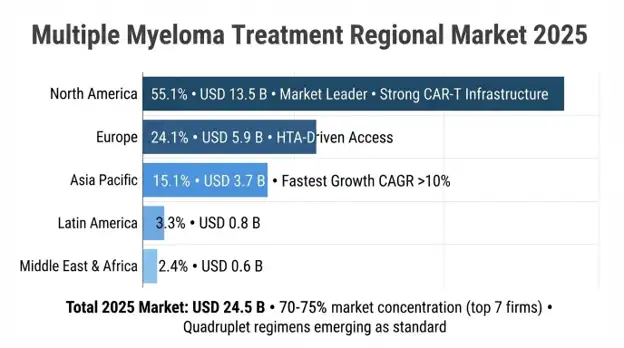
North America had the biggest share in the market, which was around USD 13.5 billion in 2025, owing to the highest number of patients receiving active treatment globally, extensive Medicare and commercial payer coverage for novel biologics and cell-based therapies, dense presence of specialized cancer centers with availability of CAR-T and bispecific antibodies, and presence of top pharmaceutical innovators behind the development of global pipelines; the United States makes up the significant chunk of revenues from the region. Europe came in next, generating revenues of around USD 5.9 billion in 2025, due to the systematic process of national health technology assessment, which leads to different timelines for reimbursement of drugs among member states, with Germany, France, and the United Kingdom being among the first to receive reimbursement for the novel agents.
Asia Pacific market is valued at USD 3.7 billion in 2025 and stands out as the fastest-growing regional segment with CAGR expected to surpass 10% from 2025 to 2034 due to a rapidly aging population in China, Japan, and South Korea, development of hematological-oncology facilities in key urban areas, increasing inclusion of new myeloma therapies under national formularies for reimbursement, and growing in-house capabilities for the manufacturing of cellular therapies, especially in China. The combined contribution of the Middle East & Africa and Latin America regions is estimated at USD 1.4 billion in 2025 with growth occurring in Brazil, Mexico, Saudi Arabia, and the United Arab Emirates, owing to the development of oncology facilities and gradually increasing insurance coverage.
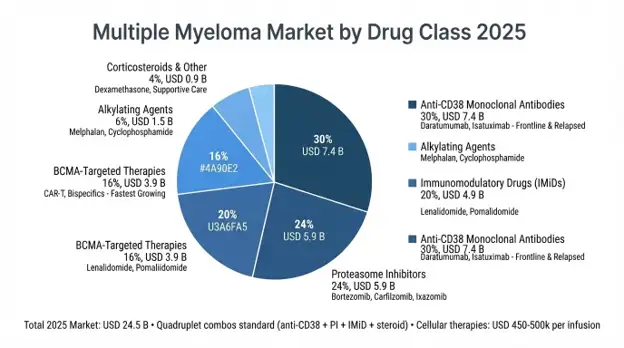
By drug class, the highest share is contributed by anti-CD38 monoclonal antibodies (about 30%, USD 7.4 billion in 2025) due to their fundamental importance in both initial as well as relapse conditions, followed by proteasome inhibitors with an approximate share of 24% (USD 5.9 billion), immunomodulatory agents with about 20% (USD 4.9 billion), BCMA targeted cell and bispecific therapies accounting for 16% (USD 3.9 billion) being the fastest growing category, while alkylating agents, corticosteroids, and other supportive medicines contribute the remaining 10% (USD 2.4 billion).
By therapy type, targeted therapy takes the lead with approximately 42% of the market share (USD 10.3 billion), including proteasome inhibitors, immunomodulatory agents, and monoclonal antibodies that make up the core of current therapies, immunotherapy, which consists of CAR-T cell therapy and bispecific antibodies, takes 16% (USD 3.9 billion), as the fastest growing category, chemotherapy makes up 18% (USD 4.4 billion), stem cell transplantation comprises 16% (USD 3.9 billion), and corticosteroids support regimens comprise the remaining 8% (USD 2.0 billion).
By line of therapy, relapsed and refractory disease makes up 56% of the total revenue (USD 13.7 billion), due to the overall cost incurred in the treatment line per individual, while newly diagnosed multiple myeloma makes up the remaining 44% (USD 10.8 billion).
By end-user, hospitals and academic medical centers lead with an approximate 58% share (USD 14.2 billion) owing to the complex case load and cellular therapy certifications, followed by specialty cancer centers, which take 28% (USD 6.9 billion), and ambulatory care centers taking the remaining 14% (USD 3.4 billion).
The global multiple myeloma therapy market is moderately to highly consolidated with the top seven firms having control over 70-75% of the total market size based on a diversified product portfolio covering several drug classes and therapy options. Johnson & Johnson enjoys the market leadership position thanks to the firm’s proteasome inhibitor portfolio and the blockbuster monoclonal anti-CD38 antibody daratumumab along with BCMA-targeted CAR-T cell therapy, while Bristol Myers Squibb enjoys the competitive advantage based on the company’s immunomodulator drug portfolio and rival CAR-T cell therapy. Competitive differentiators include response depth and durability, MRD negativity rates, reliable manufacturing capabilities of cell therapies, and overall survival benefit shown to be effective within the payers’ strict value frameworks.
April 2026: Johnson & Johnson provided encouraging long-term results of the PERSEUS trial of the daratumumab-based quadruplet induction, transplant, and maintenance in newly diagnosed multiple myeloma patients eligible for transplantation, confirming quadruplet treatment regimens as the emerging global standard of care.
February 2026: Bristol Myers Squibb received an extended indication for its BCMA-targeting CAR-T cell therapy in a relapsed setting after one previous line of therapy, significantly increasing the eligible patient population.
December 2025: Pfizer received further regional approvals for its BCMA-CD3 bispecific antibody for relapsed and refractory multiple myeloma, stepping up the rivalry in the ready-made immunotherapy category.
October 2025: Sanofi released updated results from Phase III studies showing increased rates of minimal residual disease negativity for its anti-CD38 antibody in combination with standard therapies as frontline therapy in transplant eligible new diagnosis patients.
August 2025: GlaxoSmithKline took forward its BCMA-targeting antibody-drug conjugate through further confirmatory combination studies based on efficacy and safety update results in relapsed and refractory multiple myeloma.
• Proteasome Inhibitors
• Immunomodulatory Drugs
• Anti-CD38 Monoclonal Antibodies
• BCMA-Targeted Therapies (CAR-T Cell Therapy, Bispecific Antibodies, Antibody-Drug Conjugates)
• Alkylating Agents
• Corticosteroids
• Chemotherapy
• Targeted Therapy
• Immunotherapy
• Stem Cell Transplantation (Autologous, Allogeneic)
• Newly Diagnosed / First Line
• Relapsed & Refractory (Second-Line, Third Line & Beyond)
• Transplant-Eligible Patients
• Transplant-Ineligible Patients
• Hospitals & Academic Medical Centers
• Specialty Cancer Centers
• Ambulatory Care Centers
• North America
• Europe
• Asia Pacific
• Middle East & Africa
• Latin America
You'll get the sample you asked for by email. Remember to check your spam folder as well. If you have any further questions or require additional assistance, feel free to let us know via-
+1 724 648 0810 +91 976 407 9503 sales@intellectualmarketinsights.com
12 Aug 2026
Intellectual Market Insights Research © 2026. All rights reserved.


