Share this link via:

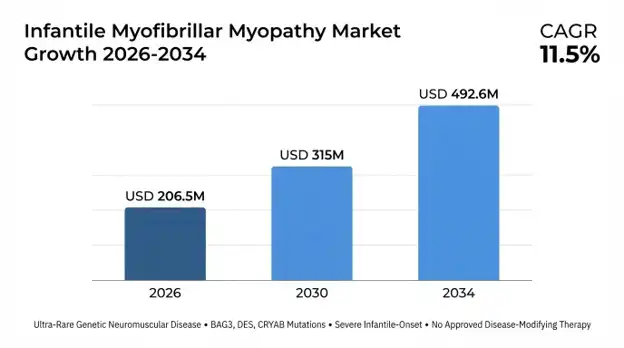
The global infantile myofibrillar myopathy (MFM) market was valued at USD 185.2 million in 2025 and is projected to reach USD 206.5 million in 2026, expanding to USD 492.6 million by 2034, growing at a CAGR of 11.5% during the forecast period (2026-2034).
The term “myofibrillar myopathy” is applied to a genetically and clinically diverse group of inherited diseases affecting muscles and characterized by a similar histological abnormality that is a progressive breakdown of the Z-disk of sarcomeres, abnormal organization of muscle fibers, and accumulation within the muscle cells of degraded proteins associated with the cytoskeleton that appear as specific deposits in muscle biopsy samples. It is caused by mutations in genes responsible for the structure of proteins of the Z-disk and other cytoskeletal components, such as BAG3, DES (desmin), CRYAB (alpha-B crystallin), MYOT (myotilin), LDB3/ZASP, and FLNC (filamin C).
Although most cases of myofibrillar myopathy develop in adults, an infantile form of the disease occurs that is characterized by a more rapid onset and progression than adult-onset forms. The infantile forms of the disease have been mostly linked to dominant de novo mutations in the BAG3 gene and less commonly to early-onset forms of DES and CRYAB. The presentation of infantile myofibrillar myopathy usually occurs in infancy, and it is marked by progressive proximal muscle weakness and atrophy, severe hypotonia, restrictive respiratory insufficiency, peripheral sensorimotor neuropathy, and either dilated or hypertrophic cardiomyopathy.
No pharmaceutical treatment exists for infantile MFM that is licensed anywhere in the world, and all current treatments remain purely supportive and consist of an integrated multidisciplinary approach encompassing neurology, cardiology, pulmonology, and rehabilitation medicine. Treatment focuses on addressing the various clinical presentations in MFM, including respiratory failure, cardiac arrhythmias/heart failure, feeding problems, and musculoskeletal problems such as joint contractures and scoliosis. The absence of any curative or disease-modifying treatment, coupled with the clear genetic basis for the disease, has made MFM one of the prime candidates for orphan gene replacement, RNA silencing, and small molecule chaperone therapies being investigated.
From a commercial perspective, the childlike MFM patient population will be characterized not by numbers but rather by the demanding nature of lifetime multidisciplinary therapy, increasing patient catchment through genomic sequencing, and the likely arrival of highly valuable ultra-orphan gene therapies that are eligible for regulatory exclusivity, priority review rewards, and premium pricing that has already been set in other neuromuscular diseases like spinal muscular atrophy and Duchenne muscular dystrophy.
| Report Coverage | Details |
|---|---|
| Base Year | 2025 |
| Base Year Value | USD 185.2 Million |
| Forecast Value | USD 492.6 Million |
| CAGR | 11.5% |
| Forecast Period | 2025-2034 |
| Historical Data | 2022-2025 |
| Largest Market | North America |
| Fastest Growing Market | Europe |
| Segments Covered | By Mutation Type, Therapy Type, Route of Administration, End-User, Region |
| Region Covered | North America, Europe, Asia Pacific, Middle East & Africa, Latin America |
| Countries Covered | US, Canada, Germany, UK, France, Italy, Spain, China, Japan, India, Australia, South Korea, Brazil, UAE, Saudi Arabia |
| Key Market Playes | Sarepta Therapeutics, Ultragenyx Pharmaceutical, Astellas Gene Therapies, Solid Biosciences, PTC Therapeutics, Ionis Pharmaceuticals |
Get more details on this report - Request Free Sample
The key structural factor behind the increasing number of identified cases of infantile MFM patients is the fast adoption of next-generation sequencing, whole-exome sequencing, and comprehensive neuromuscular gene panels in the field of pediatrics. Babies with signs of unexplained hypotonia, respiratory failure, or early cardiomyopathy have been classified previously under broad terms like "congenital myopathy" or "idiopathic dilated cardiomyopathy," often without undergoing molecular verification. With the decreased price and testing time of genetic panels for genes such as BAG3, DES, CRYAB, MYOT, LDB3/ZASP, and FLNC, it is possible to get a clear-cut diagnosis in just weeks, thus increasing the group eligible for therapy and participation in natural history registries, which in turn becomes necessary for orphan drug development. Advocacy for the inclusion of severe neuromuscular gene targets in the panel of neonatal screenings, following the trend established with the screening programs for spinal muscular atrophy, should also shorten the diagnostic journey even further.
The global regulatory framework around rare pediatric diseases, covering orphan drug designation, rare pediatric disease priority review vouchers, extended market exclusivity, and accelerated approval pathways from the FDA and EMA, has largely mitigated the economic risks of developing treatments for rare conditions like infantile MFM. On the one hand, the successful launch of gene replacement therapies and RNA-based therapeutics for spinal muscular atrophy and Duchenne muscular dystrophy has proved that genetic drugs can be delivered to the skeletal and cardiac muscles, provided a manufacturing framework for adeno-associated viruses (AAVs), which is now available to smaller biotech firms at cheaper prices, and paved the way for the acceptance of multimillion-dollar-priced single-administration drugs by payers. On the other hand, these precedents have guided the development and financing of new BAG3- and DES-targeting gene therapies and antisense oligonucleotide programs.
The fundamental restricting MFM market development in infants is, firstly, the low prevalence of disease coupled with significant genetic heterogeneity, where every one of the causative genes, and in some cases each mutation, has been described in very few infants in the world. Such a situation poses serious difficulties in the formation of sample sizes necessary for well-powered randomized control trials, leaving drug developers no choice but to employ multinational trials with natural history control and/or single-arm registration strategies, which need to be carefully evaluated on a case-by-case basis. Phenotypic differences even among patients with identical mutations make it hard to select clinically relevant and regulator-acceptable endpoints due to a fast, multi-organ progression associated with infantile forms. Ethical issues related to conducting interventional studies in critically ill neonates and infants, together with a lack of disease-specific biomarkers validated to date, prolong development time, increase per patient trial cost, and make it likely for even promising scientific projects to fail because of feasibility problems.
The monogenic character of infantile MFM makes it an ideal target for targeted genetic treatment. For rare cases of recessive or haploinsufficiency, AAV gene replacement therapy is a straightforward approach for addressing dysfunctional protein in skeletal and cardiac muscles. For many dominant and gain-of-function mutations causing infantile-onset BAG3, DES, and CRYAB conditions, allele-specific antisense oligonucleotide treatments, small interfering RNAs, and newly developed base editing technologies may be employed to silence or repair the detrimental mutated allele without affecting the function of the healthy protein encoded by the wild-type gene. Since cardiomyopathy accounts for the most common cause of early death in patients with BAG3- and desmin-associated infantile MFM, the development of AAV serotypes that effectively transduce heart tissue after intravenous administration would be a high-priority target with the capacity of halting or reversing cardiac dysfunction if addressed prior to irreversible fibrosis developing. Following the experience of other ultra-rare neuromuscular diseases, the companies managing to obtain FDA approval for mutation-specific treatments may enjoy premium prices because of the value they bring.
The emergence of international patient registries and natural history consortia, organized via neuromuscular reference networks in North America and Europe, which systematically collect longitudinal genetic, clinical, cardiac, and respiratory data on the relevant infants, is one of the key trends revolutionizing the landscape of infantile MFM. Such registries are beginning to define progression patterns of disease linked to genotypes, detect rapid predictors of respiratory or cardiac deterioration, and develop natural history data needed in assessing the regulatory submissions of gene therapy for ultra-rare conditions using single-arm studies. In parallel, efforts are being made to validate non-invasive biomarkers, such as serum creatine kinase, cardiac biomarkers, and quantitative muscle imaging, as means of minimizing dependence on invasive muscle biopsy and increasing sensitivity of treatment response detection, an ability viewed as crucial in accelerating the approval pathway for the first generation of MFM-modifying drugs expected to be developed in this decade.
North America commanded the highest market share, which was estimated to be approximately USD 79.6 million in 2025, with well-established tertiary pediatric neuromuscular and cardiac genetic centers, significant penetration of genomic sequencing, and a rare pediatric disease regulatory framework based on the FDA priority review voucher scheme. The US has several advantages, such as large amounts of funding by the National Institutes of Health for research on neuromuscular and cardiomyopathies genetics; a rare diseases venture capital environment; and patient advocacy organizations that encourage registry enrollment and clinical trials enrollment.
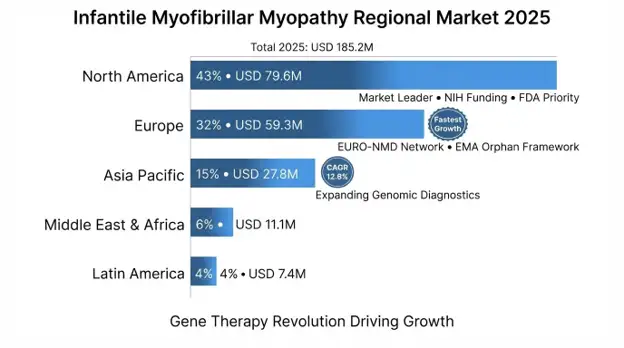
The Europe region will be the fastest-growing region, achieving USD 59.3 million by 2025. It will witness growth above the global average until 2034. It is driven by the EURO-NMD network of centers of excellence, coordination of testing procedures, provision of clinical know-how, and recruiting for multinational trials along with well-organized academic programs for neuromuscular disease research in countries like France, Germany, and the UK. EMA orphan drug designation policies, in addition to increasing receptivity of health technology assessment systems for advanced therapies in different countries, are other contributing factors.
Asia Pacific, Latin America, and the Middle East and Africa constitute a relatively small but constantly growing share of the market that is evaluated at USD 46.3 million in 2025 due to the increasing availability of genomic diagnostics in China, Japan, and India, as well as involvement in international natural history studies and gradual development of health insurance for rare pediatric genetic disease management.
The MFM associated with BAG3 accounts for the highest market share of about 30% in 2025, which is a consequence of the fact that it is the most frequent and well-defined reason for causing childhood-onset severe myofibrillar myopathy, mostly because of recurrent dominant missense mutation and its impact on cardiac, pulmonary, and peripheral neuropathic diseases. The MFM associated with DES is the second-largest market share. The MFM associated with CRYAB, FLNC, MYOT, and LDB3/ZASP forms constitute small segments of MFM market shares.
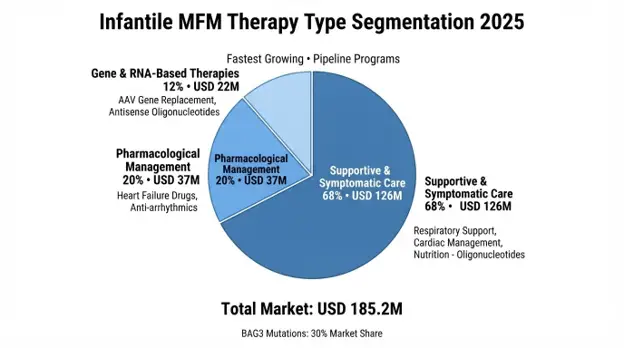
The segment of Supportive and Symptomatic Care has the leading position in terms of therapy types in the market, holding around 68% of market value in 2025 due to the lack of an available disease-modifying therapy now and the consequent use of respiratory support, pharmacological treatment of heart problems, nutrition management, and physiotherapy. The segment of gene and RNA-based therapies currently holds only a minor part of market revenue; however, it is the fastest growing one since many programs in the preclinical and clinical stages of development aim at treating BAG3 and DES mutations.
Hospitals & Specialty Clinics is the largest end-user group because of the intensive care needs of the severely affected babies, which include mechanical ventilation and heart monitoring. The fast-growing end-user market group consists of Neuromuscular Referral Centers and Academic & Research Institutes due to their significance in genetic testing, long term treatment, and execution of genetic therapies clinical trials.
The competitive environment in the infantile MFM industry continues to be fragmented and pre-commercial, with no company having an approved disease-modifying treatment yet. Competition revolves around obtaining intellectual property rights for mutation-specific gene therapy and RNA silencing approaches, building partnerships with neuromuscular reference centers and patient registries to gain access to the narrow patient population, and developing manufacturing capacity for AAV vectors and oligonucleotide therapies. The first company to win regulatory approval for a genotype-specific infantile MFM treatment stands a good chance to dominate the market owing to high unmet medical need.
March 2026: A specialty gene therapy developer announced initiation of IND-enabling preclinical studies for an AAV-based BAG3 gene replacement approach targeting infantile-onset cardiomyopathy and skeletal myopathy.
January 2026: The FDA granted Rare Pediatric Disease Designation to an investigational antisense oligonucleotide targeting a dominant desmin mutation, creating priority review voucher eligibility upon potential future approval.
November 2025: An international neuromuscular research consortium published a multi-country natural history dataset characterizing progression patterns across BAG3-, DES-, and CRYAB-related infantile MFM, establishing candidate endpoints for future regulatory submissions.
September 2025: The European Reference Network for Neuromuscular Diseases established a dedicated infantile MFM working group to standardize diagnostic protocols and coordinate registry data collection across member centers.
You'll get the sample you asked for by email. Remember to check your spam folder as well. If you have any further questions or require additional assistance, feel free to let us know via-
+1 724 648 0810 +91 976 407 9503 sales@intellectualmarketinsights.com
Intellectual Market Insights Research © 2026. All rights reserved.