Share this link via:

The size of the opsoclonus-myoclonus syndrome global market was valued at US $245 million in 2025 and is forecasted to reach US $264 million by 2026 while growing to US $480 million by 2034 in a CAGR of 7.8% from 2026 to 2034.
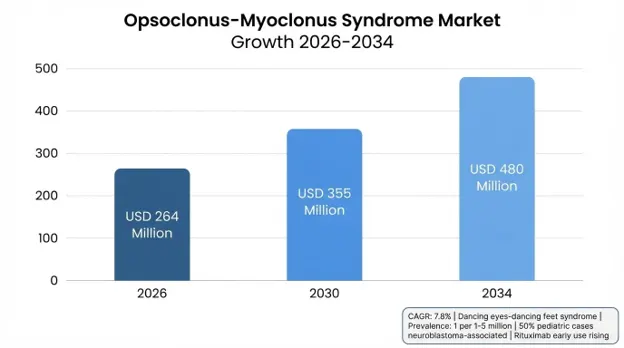
Opsoclonus myoclonus syndrome, also known historically as dancing eyes, dancing feet syndrome, and eponymously, Kinsbourne syndrome after it was first described in 1962, is a super rare neuroinflammatory disorder defined by a cardinal triad of opsoclonus, an unending series of chaotic, multidirectional, involuntary saccadic eye movements with no inter-saccadic pause; myoclonus, or rapid, brief, shock-like muscle contractions that may occur in various body regions and trunk; and cerebellar ataxia, a type of instability with severe trunk and gait disturbances. Extreme irritability, sleep abnormalities, significant regression of gained milestones for children, and relapsing encephalopathic presentations for adults are typically seen to accompany this condition.
Mechanistically, the occurrence of OMS is triggered by a maladaptive immune response to cerebellar Purkinje cell and brainstem neuronal antigens, with evidence suggesting molecular mimicry between viral or tumor-derived proteins and neuronal surface receptors like glycine and glutamate. Antibodies to neuronal surface antigens, such as anti-Ri (ANNA-2 with breast and gynecological malignancies) and anti-Hu (ANNA-1 with small cell lung cancer), were shown to aid in tumor identification in paraneoplastic cases in adults, but a significant fraction of both childhood and adult cases are seronegative in current diagnostic assays, suggesting a continued reliance on clinical presentations over a readily available and definitive biomarker.
Etiologically, OMS can be broken down into two major groups, paraneoplastic and non-paraneoplastic (idiopathic or parainfectious). In children (majority of cases, 1-3 years of age), approximately 50% of OMS cases are paraneoplastic, originating from an occult neuroblastoma or ganglioneuroblastoma, and 2-3% of all neuroblastoma cases go on to develop OMS. In adults, small cell lung carcinoma, breast carcinoma, and ovarian teratoma account for most paraneoplastic OMS, and parainfectious or idiopathic origins are most commonly found in both pediatrics and adults in cases following exposure to Epstein-Barr virus, enterovirus, and more recently SARS-CoV-2 since 2020.
Clinically and commercially, the OMS market is interesting, as despite the minute size in absolute numbers, there are exceedingly high costs associated with the treatment of each patient over their lifetimes, the developmental importance associated with any misdiagnosis or delayed diagnosis in children, and a burgeoning pipeline of orphan-designated immunotherapies attracting biopharmaceutical interest even with such rare occurrences.
| Report Coverage | Details |
|---|---|
| Base Year | 2025 |
| Base Year Value | USD 245 Million |
| Forecast Value | USD 480 Million |
| CAGR | 7.8% |
| Forecast Period | 2025-2034 |
| Historical Data | 2022-2025 |
| Largest Market | North America |
| Fastest Growing Market | Asia Pacific |
| Segments Covered | By Type, Treatment, Diagnosis, Patient Demographics, End-User, Region |
| Region Covered | North America, Europe, Asia Pacific, Middle East & Africa, Latin America |
| Countries Covered | US, Canada, UK, Germany, France, Italy, Spain, Japan, China, India, Australia, South Korea, Brazil, UAE, Saudi Arabia, South Africa |
| Key Market Playes | F. Hoffmann-La Roche Ltd., CSL Behring, Grifols S.A., Takeda Pharmaceutical, Octapharma AG, Novartis AG, Biogen Inc., and argenx SE |
Get more details on this report - Request Free Sample
Improving Clinical Recognition and Expansion of Autoantibody and Neuroimaging Diagnostics
Once masked by its uncommonness and overlap with other pediatric ataxias and adult-onset movement disorders, OMS is better understood under comprehensive autoimmune neurology, including pediatric oncology. The recent proliferation of widespread commercial neuronal antibody profiles, replacing single autoantibody panels, and the use of high-resolution MRI and/or MIBG (iodine-131 metaiodobenzylguanidine) scintigraphy for hidden tumors are currently reducing previous diagnostic delay by significant amounts.
Shift Toward Early, Aggressive Multi-Agent Immunotherapy Anchored by Rituximab
The growing body of evidence that combined, early immunotherapy comprising corticosteroids or ACTH, IVIG, and rituximab is superior to standard steroid monotherapy with respect to neurocognitive outcomes and relapses is prompting a major change in standard frontal attack treatment regimens for the pediatric and adult populations away from just high-dose steroids to include early B-cell targeting.
The primary limitation for the development of any sort of OMS market revolves around the condition’s exquisite rarity, which renders classical randomization impractical and yields a therapeutic landscape built on off-label indications. There is currently no marketed therapeutic with any official regulatory indication in a first-world nation. This translates to uncertain reimbursement for costly biologics (e.g., IVIg and rituximab) in nonacademic settings. Diagnosis-based delays worsen the situation: The initial presentation, often with ataxia and irritability, is easily mistaken for post-infectious cerebellitis or a functional movement disorder often managed by community neurologic services rather than the academic referral services best equipped to institute aggressive early immunotherapy.
A significant opportunity lies in developing targeted immunomodulatory drugs focused on various mechanisms driving OMS pathogenesis: next-generation anti-CD20 antibodies, plasma cell-targeted therapies, neonatal Fc receptor blockers for hastening autoantibody clearance, and complement inhibitors. The US & EU orphan drug designation pathways (market exclusivity extension and rapid review process), while requiring some clinical OMS development activity (as part of an omnibus OMS basket study linked to broader anti-autoimmune encephalitis programs, etc.), will serve as a viable commercialization incentivizing factor for dedicated OMS players. Additionally, biomarkers, global patient registries, and digitally mediated neurocognitive and motor rehabilitation platforms for OMS children are all concurrent and thus meaningful opportunities.
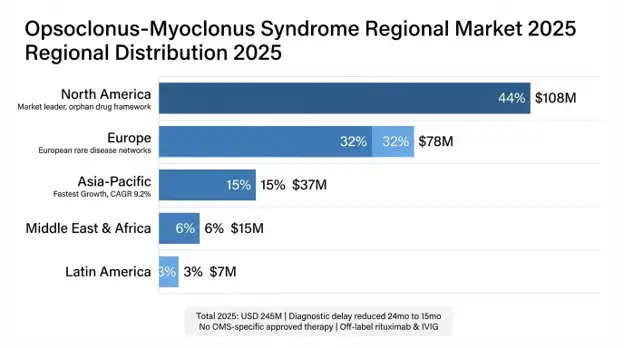
North America is expected to hold the largest share within the global OMS market size due to the following: Concentrated capabilities in pediatric neuroimmunology and oncology within academic medical centers Extensive regulatory framework for orphan drugs Extensive patient advocacy networks that promote patient awareness and registry efforts The USA leads the region in generating the highest revenue due to broad commercial insurance coverage for off-label indications of rituximab and IVIG. Comprehensive involvement in global collaborative studies European Market: A well-developed and research-oriented market of novel therapies is likely to be dominated by academic institutions having specialization in neurology and pediatrics oncology in the U.K., Germany, France, and Italy. Due to a robust healthcare system, accessibility to cutting-edge immunotherapies and sophisticated diagnostics is likely to be improved. Europe leads the other regions in establishing cross-country collaborative networks (European Reference Network for rare neurological diseases), which aim towards creating uniform standards in diagnosis and registry infrastructure. APAC Market
The fastest growing market, the APAC region, is attributable to the burgeoning development of infrastructure facilities for pediatrics, neurology, and oncology in China, India, Japan, South Korea, and Australia; increasing pediatrician awareness regarding rare autoimmune neurological disorders; and increased availability and awareness of autoantibody testing and sophisticated imaging tools in case of neurological indications. Japan’s heavily funded rare disease research ecosystem, along with Australia’s collaborative networks for rare disorders, enables the development of reasonable sample sizes despite relatively low overall case counts for various OMS across the region.
Type Insights: Paraneoplastic OMS is the most clinically relevant type segment given its strong association with neuroblastoma in children, requiring combined oncology and immunological management. Idiopathic/post-infectious OMS is significant in adults and a notable portion in pediatric cases but requires equally aggressive immunomodulatory treatment without a tumor.
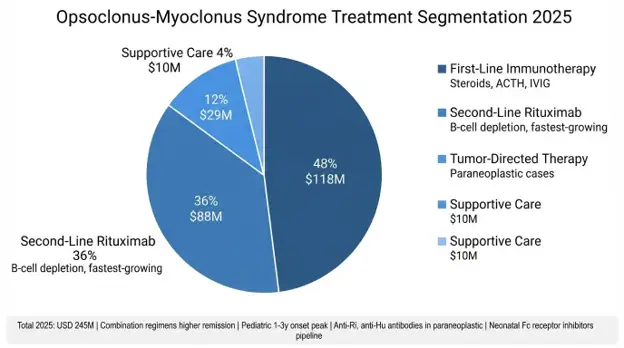
Treatment Insights: First-line immunotherapy, comprising steroids, ACTH, and IVIG, comprises the highest volume treatment segment, while second-line & refractory immunotherapy targeting rituximab and cyclophosphamide represents the highest growth and value per patient given its rising early use for B-cell-depleting therapy. Tumor-directed therapy remains crucial in paraneoplastic cases, whereas symptomatic & supportive care like antimyoclonic agents and rehabilitation services aid in long-term functional recovery.
Diagnosis Insights: Clinical & neurological assessment remains the core diagnostic principle in the absence of a clear biomarker, while neuroimaging & tumor screening are essential in paraneoplastic, & CSF analysis is recommended to rule out infection. Antibody & paraneoplastic panels are the fastest-growing diagnostic segment due to increasing commercial panel availability.
Patient demographics insights: Pediatric OMS accounts for the largest demographic segment, given that onset occurs mainly in early childhood and these developing patients require comprehensive and long-term therapeutic and rehabilitative treatments, while adult OMS patients account for a smaller but challenging group with probable malignant associations and thus potentially poor prognostic outcomes.
End-user Insights: Hospitals & academic medical centers are the largest end-user segment; these patients require long-term management, specialized care, and initiation of immunotherapy. Specialty neurology and oncology clinics are managing maintenance therapy; diagnostic labs capture the rising trend of antibody panel tests; and rehabilitation centers fulfill the latter motor and cognitive rehabilitation needs.
The OMS market’s highly fragmented competitive landscape underscores a vacuum in approved disease-specific treatment, with much therapy driven by off-label applications of therapies developed for different diseases. Currently, rituximab (Roche) plays a key role in the typical course of treatment, while companies focused on IVIG therapies like CSL Behring, Grifols, Takeda, and Octapharma are often called upon in various neuro-immunological syndromes; these producers generally enjoy broad applicability. Emerging sources of competitive differentiation come from within various neuro-immunology specialty biotechs such as argenx, Alexion, and Horizon Therapeutics, many of which are considering broad trial basket indications overlapping OMS and other autoimmune encephalitis conditions to help build a rationale and investment case for formally entering into development in this ultra-rare patient group.
2026 - The International Pediatric Neurology Consortium released revised consensus guidelines formalizing rituximab-containing combinations as preferential first-line treatment for moderate-to-severe pediatric OMS.
2026 - Clinical-stage biotech advanced Phase II basket trial evaluating neonatal Fc receptor inhibitor for several autoimmune encephalitis indications, including OMS (orphan designation).
2025 - The European rare-disease network launched a multinational OMS patient registry across several countries, creating a significantly enlarged prospective natural history cohort to be used for interventional trial enrollment.
2025 - The pediatric neurology research group published outcome results demonstrating improved long-term neurological outcomes with early initiation compared to late use of rituximab, providing continued data support for aggressive early immunotherapy.
2025 - The diagnostics company expanded the testing panel for neural antibodies, including additional antigens that may prove to be more useful in previously non-reactive cases of OMS.
You'll get the sample you asked for by email. Remember to check your spam folder as well. If you have any further questions or require additional assistance, feel free to let us know via-
+1 724 648 0810 +91 976 407 9503 sales@intellectualmarketinsights.com
26 Aug 2026
Intellectual Market Insights Research © 2026. All rights reserved.