Share this link via:

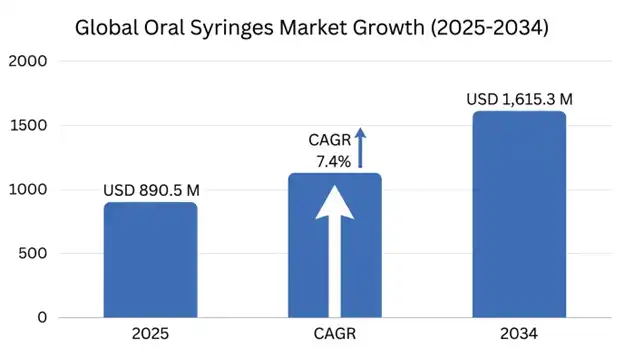
The global oral syringes market size was valued at USD 890.5 million in 2025 and is projected to reach USD 965.2 million in 2026, expanding to USD 1,615.3 million by 2034, growing at a CAGR of 7.4% during the forecast period (2026-2034).
Oral syringes are precision-engineered medical devices designed to accurately measure and deliver liquid medications, nutritional supplements, and therapeutic formulations into the oral or enteral route, and incorporate critical safety features that prevent accidental connection to intravenous or parenteral delivery systems. Unlike hypodermic syringes, oral syringes are intentionally designed not to be compatible with Luer locking and come in various tip designs, such as eccentric, slip-tip and ENFit-compatible, which eliminate the historically documented risk of wrong-route medication administration errors that have caused patient deaths worldwide in healthcare settings.
The functional architecture includes transparent barrel materials that allow direct visual confirmation of medication volumes, precisely calibrated graduated markings that enable accurate dose measurement, as small as 0.1 mL for neonatal use, and ergonomically designed plungers that ensure smooth and controlled delivery of liquid medications, and child-resistant and tamper-evident features for home healthcare applications. Together, these design features meet the basic clinical need for accurate, safe and repeatable liquid medication delivery for patients from premature neonates, with a need for microgram level accuracy in dosage, to elderly patients managing multiple medications in home-care environments.
Beyond simply measuring, the commercial value is complex and includes full medication safety systems, regulatory compliance, and patient care delivery systems. Modern oral syringes are essential tools in the fight against medication errors, impacting thousands of patients each year due to liquid medication dosing errors, and play a vital role in the global movement towards standardized oral to parenteral connection systems in compliance with ISO 80369-3 ENFit standards, ensuring no risk of misconnection between the two delivery methods.
| Report Coverage | Details |
|---|---|
| Base Year | 2025 |
| Base Year Value | USD 890.5 Million |
| Forecast Value | USD 1,615.3 Million |
| CAGR | 7.4% |
| Forecast Period | 2026-2034 |
| Historical Data | 2022-2025 |
| Largest Market | North America |
| Fastest Growing Market | Asia Pacific |
| Segments Covered | By Product Type, Material, Capacity, Application, End-User |
| Region Covered | North America, Europe, Asia Pacific, Middle East & Africa, Latin America |
| Countries Covered | US, Canada, Mexico, UK, Germany, France, Italy, Spain, Netherlands, China, Japan, India, Australia, South Korea, Brazil, Argentina, UAE, Saudi Arabia, South Africa |
| Key Market Playes | BD (Becton, Dickinson and Company), Cardinal Health, Baxter International, B. Braun Melsungen AG, Terumo Corporation, Medline Industries |
Get more details on this report - Request Free Sample
The primary factor driving oral syringe market growth is the expanding vulnerable patient population is the increasing vulnerable patient population, which requires accurate liquid medication formulations, particularly patients below 15 years and above 65 years of age, accounting for the largest users of liquid medicines worldwide. The therapeutic windows of pediatric patients are narrow, with a 15-20% deviation from the correct dose causing either therapeutic failure or clinically significant toxicity, and household measuring devices are therefore considered unsuitable for safe medication administration.
In 2025, more than 680 million children in the world will need liquid medication administration, with neonatal intensive care units being one of the most challenging settings where patients as light as 500 grams may need to be administered medication to the microgram level. Studies evaluating caregiver medication administration accuracy have shown that the use of purpose-designed oral syringes results in a significantly lower rate of medication errors (4.8%) compared to that of household measuring spoons (39.6%), thereby providing strong clinical justification for incorporating oral syringes in medication administration protocols for children.
At the same time, the world's elderly population (aged 65 and over) was 771 million in 2025 and is expected to be over 1.6 billion by 2050, with the prevalence of dysphagia estimated at 13-22% in community-dwelling elderly and 68% in residents of nursing homes. Among community-dwelling elderly populations, 36-39% of people are taking multiple medications, resulting in complex medication administration situations where liquid formulations and accurate measurement devices are crucial for safe therapeutic delivery.
Key Performance Metrics:
The adoption of ISO 80369-3 ENFit connector standards represents a paradigm-shifting regulatory catalyst which will generate a systematic replacement market for compliant oral syringe products in the global healthcare sector. The ENFit standardization initiative aims to tackle documented cases of patient deaths due to wrong-route administration of oral medicines being accidentally administered into intravenous lines, prompting coordinated international regulatory action.
In the United States, the Joint Commission and other accrediting bodies have added ENFit compliance as a requirement for facilities to meet during inspections, and similar organizations around the world have followed suit. The transition timeline differs by region – North America and Europe are on track to be 70-85% ENFit compliant by 2025, and emerging markets have plans for a phased transition to ENFit by 2030.
Beyond the connector standardisation, the regulatory environment also covers all device performance specifications, such as graduation marking accuracy, material biocompatibility specifications, plunger seal integrity specifications, labelling requirements, etc., which set minimum quality requirements and drive procurement toward premium engineered products from well-known manufacturers who have validated compliance documents.
ENFit Transition Metrics:
Demographic aging and healthcare cost containment efforts have driven the shift towards decentralized healthcare delivery, creating significant growth opportunities for oral syringe applications in home healthcare, where increasingly complex medication administration protocols are controlled by patients and caregivers. In developed markets, home healthcare spending rose by 8.4% per year from 2020-2025, and liquid medication administration was a key service area, where reliable and user-friendly dosing devices are essential.
The use of liquid formulations to allow dose titration, combination therapy delivery, and administration in patients who have swallowing difficulties is an important new development in chronic disease management programs such as those for diabetes, cardiovascular disease, neurological disorders, and oncology. The shift from institutional to community-based care generates demand for oral syringes that are packaged with prescription medications and/or dispensed through retail pharmacy channels, which extends beyond the traditional clinical procurement to consumer and caregiver purchases.
Home Healthcare Growth Indicators:
Single-use polypropylene oral syringes contribute to substantial amounts of medical plastic waste, which is increasingly the subject of regulatory and institutional attention and is also starting to encounter market-side competition in the context of the move towards the reduction of medical plastic waste, and the preference for environmentally preferable products. EU-wide restrictions on single-use plastics in the EU, as well as the environmental, social and governance reporting requirements of healthcare institutions, influence procurement decisions with sustainability credentials towards the manufacturers.
Infection control requirements and waste reduction demands create complex policies that may hinder market growth, particularly in the presence of competing demands from infection control professionals who seek to use single-use devices and sustainability professionals who are required to meet plastic waste reduction targets in healthcare institutions. Innovation is needed in biodegradable materials, proven reprocessing processes, or bio-based polymer materials that have a similar clinical performance and are environmentally friendly.
A significant opportunity is emerging in oral syringe design and digital health infrastructure, with connected devices that integrate dose verification sensors, electronic administration records, and caregiver notification systems, to tackle medication adherence challenges in home healthcare environments. There is the potential for measurable adherence improvements that would support a premium price for smart oral syringe platforms coupled with electronic health records and pharmacy dispensing systems, while at the same time creating high switching barriers for healthcare providers and therefore favoring adoption.
The veterinary medicine field is a high growth, less price sensitive market opportunity, due to the rising number of pet owners and increased willingness to spend on high-tech veterinary services. Oral syringes with long tips, ergonomic handles and dosage ranges better suited for veterinary use are needed for precise liquid dosing of animals when administering antibiotics, pain management and chronic disease treatment.
The oral syringe market has been systematically changing as some of the biggest healthcare systems are approaching full ENFit connector standardization, not just a change in the type of connector, but a redefinition of the product specification, manufacturing requirement and quality standard throughout the industry. Organizations that have completed ENFit changes are finding fewer cases of wrong route administration and improved regulatory audit outcomes, improved operational efficiency for nurses and smoother clinical processes.
Environmental pressures are driving manufacturers to accelerate material innovation efforts to examine bio-based polymers, post-consumer recycled content and product design optimization using less material while maintaining the same performance. The most commercially viable alternative, which has similar mechanical properties, is bio-based polypropylene (BPPP), produced from renewable feedstocks, but with much lower lifecycle GHGs.
North America: Market Leadership Through Regulatory Infrastructure and Safety Standards
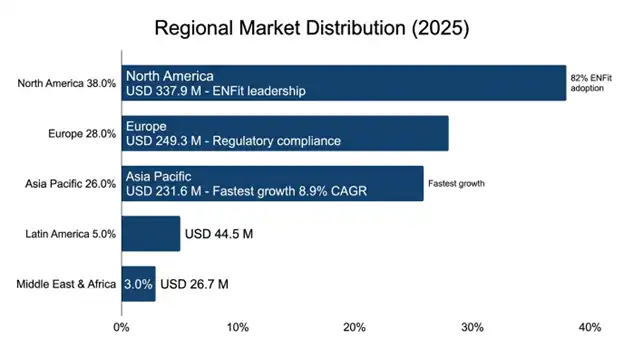
North America was the largest market in 2025, valued at USD 337.9 million and is expected to have a CAGR of 6.8% till 2034. Regional dominance is due to the presence of comprehensive regulatory and accreditation frameworks, ensuring consistent product quality; high per-capita spending on healthcare services, allowing for the use of premium products; advanced home healthcare infrastructure, providing retail demand for the products; and high concentration of pediatric specialty centers, which require high-precision devices..
The United States accounts for 84% of the regional market value because Joint Commission accreditation standards include medication safety requirements, FDA regulation of oral syringes as medical devices, along with extensive liability protections that provide institutional incentives for implementing safety-engineered devices. Home healthcare contributes to growth in the growing elderly care market, with provisions in Medicare and Medicaid reimbursement models for supplies.
Regional Performance Indicators:
Asia Pacific: Fastest Growth Through Population Scale and Healthcare Infrastructure Development
Asia Pacific is estimated to be the fastest-growing region, with an expected CAGR of 8.9% and will grow to USD 231.6 million by 2025. The key factors responsible for the regional expansion are the huge pediatric population size creating base demand, the rapid growth of healthcare infrastructure, improving healthcare service quality, the cost-cutting nature of domestic manufacturing, and the increased awareness of medication safety protocols among healthcare professionals.
This growth is primarily driven by healthcare reform efforts in China which are improving hospital standards, growing specialty networks for pediatrics and a domestic pharmaceutical industry, with the country claiming 41% of the region's market share. India shows great potential with the development of hospital facilities, a developing pharmaceutical compounding industry, and government health initiatives that enhance the availability of medicines in rural areas where liquid formulations are practical for people who lack healthcare literacy.
Regional Growth Metrics:
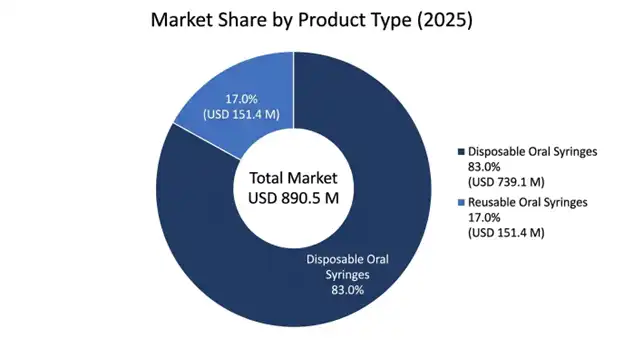
Disposable oral syringes accounted for 83% of the market value in 2025 and are expected to see 7.6% CAGR till 2034. This segment is led by infection control requirements in the clinical environment, regulatory preference for single-use devices, convenience of home users, reduction of reprocessing costs and risk of cross-contamination. The segment includes commodity syringes as well as devices designed for neonatal use, which are 0.1 mL graduated, and feature ENFit-compatible connectors.
Reusable oral syringes are expected to hold 17% market share in 2025, valued at USD 151.4 million, and will be used in applications where durability and cost-effective reprocessing over multiple uses and environmental factors are considered. This segment shows strength in individual patient care, long-term care facilities that have established procedures for cleaning, and veterinary applications where chemical resistance and measurement accuracy over repeated use are valuable.
The 1-5 mL segment has the largest capacity share at 46% market share, worth USD 409.6 million in 2025, and is designed for a wide range of liquid medicine doses, used for both pediatric and adult patients across a wide range of prescribed liquid medications. It is widely used throughout healthcare systems and accommodates a broad range of standard pediatrics antibiotic doses, liquid analgesics, anticonvulsants and most compounded preparations.
At USD 258.4 million in 2025, the Up to 1 mL segment is expected to grow at a CAGR of 8.7% between 2025 and 2034, reaching a market share of 29%., as it is the fastest growing segment due to the increasing demand for neonatal intensive care, high potency medications that demand sub-milliliter precision, and specialized applications in pediatric oncology that demand precise doses.
The largest end-user market segment is hospitals and clinics, accounting for 54% market share valued at USD 480.9 million in 2025, which includes acute care hospitals, pediatric centers, neonatal intensive care units and ambulatory clinics. This segment is fuelled by the need for high quality, regulatory compliant devices that are ENFit compliant, have high graduation accuracy and perform robustly in high volume clinical conditions.
Home healthcare is also the fastest-growing market, accounting for 22% of the overall market, and is expected to see a 9.8% CAGR till 2034, driven by the changing landscape of chronic disease management in the community, caregiver administered pediatric programs, and elderly medication management. This expansion is bolstered by an emerging retail pharmacy distribution network and direct-to-consumer sales.
The market for oral syringes is moderately concentrated, with the top manufacturers accounting for around 52-58% of the market value, supported by well-developed distribution channels, a regulatory framework, and a broad product range across various capacities and specialties. Competitive differentiation is based on ENFit compatibility and transition services, graduation accuracy and readability for precision applications, ergonomic design for elderly and caregiver populations, sustainability credentials such as bio-based materials and recyclable components.
The competitive landscape consists of well-known medical device manufacturers competing based on safety and regulatory attributes, and local manufacturers, mainly on price competitiveness in cost sensitive markets. Premium positioning demands clinical performance, all-inclusive quality documentation and embedded customer support initiatives for medical institution changeovers to compliant devices.
List of Key Players in Global Oral Syringes Market
Global Oral Syringes Market Segments
By Product Type:
By Material:
By Capacity:
By Application:
By End-User:
By Region:
You'll get the sample you asked for by email. Remember to check your spam folder as well. If you have any further questions or require additional assistance, feel free to let us know via-
+1 724 648 0810 +91 976 407 9503 sales@intellectualmarketinsights.com
14 May 2026
Intellectual Market Insights Research © 2026. All rights reserved.