Share this link via:

The global orofaciodigital syndrome (OFD) market was valued at USD 210 million in 2025 and is expected to grow to USD 227 million in 2026, expanding to USD 420 million by 2034 at a CAGR of 8.0% (2026-2034).
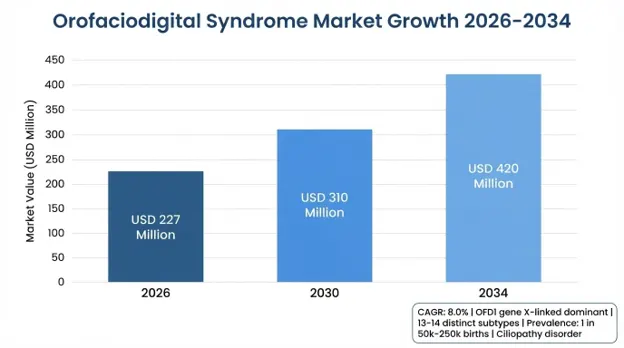
Orofaciodigital syndrome (OFD) is an ultra-rare, genotypically heterogeneous family of disorders of developmental origin characterized by the combination of oral cavity, facial, and digital anomalies, often with associated central nervous system malformations, as well as, in many OFD subtypes, progressive renal cystic disease. Between thirteen and fourteen distinct OFD types are now recognized, characterized by their respective combinations of clinical features, patterns of inheritance, and genetic causes, all firmly located within the larger group of conditions commonly known as human ciliopathies; these are disorders caused by mutations affecting the structure or function of the primary cilium—a conserved, nonmotile, microtubule-based organelle crucial for embryonic patterning, tissular differentiation, and intracellular signaling cascades.
OFD Type I, designated Papillon-Lage-Psaume syndrome, is the commonest and best-studied OFD subtype, caused by mutations in the X-linked gene encoding OFD1; this is a fatal X-linked dominant condition in most hemizygous males, and it thus predominantly presents exclusively in females, with features such as a lobulated/bifid tongue, multiple oral frenula, cleft lips and palate, hypodontia and dental malposition, hypertelorism, a broadly based nasal dorsum, and varying digital malformations (polydactyly, syndactyly, brachydactyly, and clinodactyly); a significant proportion develop progressive polycystic kidney disease, which is the most important determinant for long-term outcome. Type II, Mohr syndrome, follows autosomal recessive inheritance and involves tibial hypoplasia in addition to other facial and digital abnormalities. With additional ciliogenic genes such as CPLANE1, TMEM107, SCLT1, C2CD3, TCTN3, et al. having recently been implicated in the less common forms of OFD, the relationship between the OFDs and those other genetically similar ciliopathies with CNS and/or renal involvement such as Joubert syndrome, Meckel-Gruber syndrome, nephronophthisis, and Bardet-Biedl syndrome is strengthened.
No current disease-modifying pharmacological treatments for OFD exist. Management is inherently multi-disciplinary and mainly surgical and palliative and includes a range of oral and maxillofacial and hand and foot surgery procedures to correct skeletal abnormalities; long-term dental and orthodontic treatments to manage dental abnormalities; and long-term monitoring by nephrologists for evidence of renal involvement and, in severe cases, chronic dialysis and kidney transplantation. Treatment, management, and diagnostic techniques are integrated under orphan disease regulation frameworks, which promote pharmaceutical and diagnostic investment and the development and use of a range of treatments even when based on the very small numbers of afflicted people worldwide.
| Report Coverage | Details |
|---|---|
| Base Year | 2025 |
| Base Year Value | USD 210 Million |
| Forecast Value | USD 420 Million |
| CAGR | 8.0% |
| Forecast Period | 2025-2034 |
| Historical Data | 2022-2025 |
| Largest Market | North America |
| Fastest Growing Market | Asia Pacific |
| Segments Covered | By Disease Type, Treatment Modality, Diagnostic Approach, End-User |
| Region Covered | North America, Europe, Asia Pacific, Middle East & Africa, Latin America |
| Countries Covered | US, Canada, Mexico, UK, Germany, France, Italy, Spain, China, Japan, India, Australia, South Korea, Brazil, Saudi Arabia, UAE, South Africa |
| Key Market Playes | Illumina Inc., Centogene N.V., Invitae Corporation, GeneDx Holdings Corp., Stryker Corporation, Medtronic plc, Otsuka Pharmaceutical Co. Ltd., Travere Therapeutics Inc. |
Get more details on this report - Request Free Sample
Expanding Genetic Diagnosis and Growing Molecular Characterization of OFD Subtypes: Throughout much of the 20th and early 21st centuries, an OFD diagnosis was entirely clinical, with significant opportunities for diagnostic error in similar-appearing conditions or related oral-digital, craniofacial syndromes with overlapping phenotypes. The ubiquitous advent of next-generation sequencing, whole-exome sequencing, and, in some instances, targeted ciliopathy gene panels is changing the OFD landscape by providing the molecular confirmation for cases that are diagnostically challenging or atypical. New OFD-associated genes discovered by extensive international efforts have expanded the OFD gene pool and now allow for implications for diagnosis, surveillance, and counseling that contribute to increasing referrals for these specialized diagnostic services.
Ciliopathy-focused next-generation sequencing panels now cover dozens of genes associated with primary ciliary dysfunction, meaningfully improving diagnostic yield in previously unresolved cases.
Multidisciplinary Surgical and Long-Term Care Requirements Driving Sustained Healthcare Utilization: The chronic, intensive, and lifelong demand generated by OFD is facilitated by the multisystemic nature of the diagnosis. Cleft and craniofacial anomalies require repeated surgical stages from birth to adolescence (e.g., cleft repair, frenulectomy, and lingual reconstruction) followed by years of dental therapy and orthodontics to correct the resultant hypodontia and malocclusion, while skeletal anomalies necessitate orthopedic therapy. Digits require orthopedic correction, and renal disease will require consistent nephrology monitoring and, in the case of progressive disease, dialysis or transplant. Long-term markets generated by the multispecialty approach span decades beyond the initial diagnosis.
Growing Ciliopathy Research Momentum Creating Therapeutic Pipeline Spillover: There is rapid and mounting science and both academic and commercial interest in mechanistically closely linked disorders: Joubert syndrome, nephronophthisis, and Bardet-Biedl syndrome, providing us with tools (molecules and animal models) and candidate treatments that will take a little extra to test in OFD. Given the use of an inhibitor of the mammalian target of rapamycin (mTOR) signaling in some of the renal issues within tuberous sclerosis complex, it provides a logically mechanistically linked approach to explore this same pathway in a cystic renal disease of the OFD setting.
Extreme Rarity and Phenotypic Heterogeneity Constraining Clinical Research and Commercial Scale: Of all subtypes, Type I of OFD occurs most frequently; it's estimated to have a frequency of roughly 1:50,000 to 1:250,000 live births, whereas each of the other subtypes, alone, is much rarer, even sometimes reported in just a few families worldwide. Also, phenotypic and genotypic heterogeneity among subtypes renders any trial design to be more complex; a meaningful clinical outcome in type I is quite different from what it is in individuals exhibiting predominantly skeletal or neural features; thus, it makes it impossible to support evidence sufficient to achieve comparable efficacy values or justify the set-up of commercial infrastructure.
Absence of Disease-Modifying Pharmacotherapy and High Financial Burden of Specialized Care: Management OFD is currently purely medical, only surgery, and has become a treatment directed not at structural abnormalities and other sequelae but at the primary cause, i.e., ciliary deficiency. This leads not only to limited market pharmaceutical products but also to the treatment and medical assistance services, including the diagnostics of them. The high lifetime cost associated with the repeated staged reconstructions, lengthy orthodontic tooth straightening, and ongoing surveillance for neurological and kidney complications, along with dentistry, is rarely covered by medical insurance, not only for these but also medically and cosmetologically.
No approved drug currently modifies the underlying ciliary defect or reverses established structural malformations in OFD.
Gene Therapy and Molecular Correction Approaches Targeting OFD1 and Related Ciliary Genes: The X-linked dominant nature of OFD Type I, together with the detailed understanding of the OFD1 protein’s functions in centriole and cilia biogenesis, has revealed a unique molecular target for gene addition or correction strategies that could restore ciliary function in the involved tissues. Although postnatal gene therapy has limited potential to reverse prenatal structural abnormalities, there are clear opportunities for gene-directed approaches aiming to prevent or retard their progression (e.g., renal cystic disease and neurological degeneration). These strategies are already being tested in preclinical ciliopathy models.
mTOR Pathway Inhibition and Drug Repurposing for Renal Cystic Disease: Evaluation of existing renal cystic disease treatment strategies to test for efficacy in treating renal manifestations of OFD represents a near-term, medically addressable opportunity. Everolimus, for example, has regulatory precedence as a treatment for renal angiomyolipomas in tuberous sclerosis, as has tolvaptan for managing cyst growth and preventing associated renal complications in ADPKD, both of which are forms of ciliopathies. Given the long development cycles of novel molecular entities and the difficult economic landscape for the development of treatments for ultra-rare conditions, repurposing approved drugs represents an approach with the potential for quicker development, less capital investment, and reduced development risk than developing new agents from novel starting points.
Established mTOR inhibitors and vasopressin receptor antagonists approved for other cystic kidney conditions offer a mechanistically plausible repurposing pathway for OFD-associated renal disease.
International Patient Registries and Digitally Enabled Craniofacial Care: Continued Investment and Advances in Data Collection: Increased investment in patient registries, natural history studies, and international collaboration groups will build and maintain an epidemiological and clinical evidence base to facilitate future development and regulatory dialogue and establish the natural history benchmark where controlled trials may not be practicable in due course. At the same time, the technology available to perform 3D medical modeling and digitally assisted, as opposed to manufactured, dentistry—such as intraoral cameras, cone-beam CT technology, and CAD/CAM—is now more widely available to produce tailored orthodontic appliances and operative guides used for treating the complex dental/craniofacial features found in OFD, in turn improving both the aesthetics and function while minimizing intraoperative delays.
North America: The market in the North American region has the largest share because of the ecosystem to approach for genetic testing; it consists of genetic and craniofacial centers, orphan drug incentives, and insurance programs covering access to specialized high-cost treatments. The US contributes mostly to this regional revenue by adopting comprehensive genetic testing with high volume in the majority of cases. It features expertise from big academic medical centers, strong infrastructure for newborn and prenatal testing, and strong advocacy groups dedicated to helping rare disease patients join study registries and databases for further study.
Asia Pacific: In the Asia Pacific, it is one of the fastest-growing regions in this market as it features a large population base, leading to high absolute numbers of patients even though there is a comparatively low relative occurrence with the growth of infrastructure for genetic testing and strengthening of the rare diseases-related policies in China, Japan, India, and South Korea. While Japan has well-established infrastructure to support orphan drug development, with growing newborn screening and pediatric genetic test infrastructures, the number of undetected ciliopathy patients is declining gradually, and increased access to high-level pediatric surgery and care helps decrease delayed diagnoses and, hence, increase in demand.
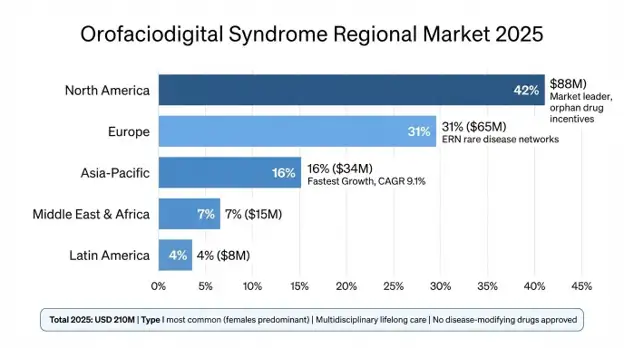
Europe, Latin America, ME&A: European countries hold the second largest position because of their developed genetic disorder-related research frameworks, a number of different rare genetic and craniofacial disease European reference networks, and an array of pathways that promote pan-European coverage of such specialized care. The LATAM region and the Middle East and Africa represent small and developing markets due to the development of tertiary referral centers in many countries in these regions, like Brazil, SAARC, and South Africa, and a progressive alignment with global standard practices in terms of management approaches. However, it remains a challenge to offer equitable distribution of high-quality genetic test facilities across LATAM and ME&A countries, as well as provide multidisciplinary specialist care.
Disease Type Insights: OFD Type I has the largest market share due to being the most common and researched subtypes, hence contributing to a majority of diagnostic tests, specialist visits, surgery operations, and nephrology monitoring. OFD Type II, along with other more rare subtypes, forms the minority part of the market but continues to increase as new molecular testing methods permit more formerly undetermined cases to be identified as either OFD Type II or specific subtypes.
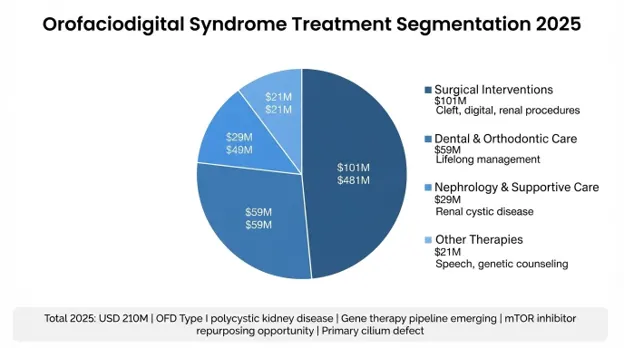
Treatment Modality Insights: Surgery has the biggest treatment contribution, including procedures for cleft palate and lips, digital correction operations, and renal cases—especially in more severe types and even eventually for transplants because the symptoms are primarily structural. Orthodontics/dentistry is another major and growing field given that most patients who survive require, and will need, a lifetime decades of dental rehabilitation in the majority of cases. Renal supportive and nephrology care is a gradually increasing proportion of lifetime cost among type I patients with progressive cystic renal disease.
Diagnostic Approach Insights: Imaging and Radiological Imaging (particularly renal ultrasound in adults & imaging; renal ultrasound/MRI in infants) & Genetic/Molecular Testing As is shown, genetic & molecular imaging are fast-growing, a trend bolstered by growing adoption of next-generation sequencing and a growing demand in clinical practice to establish molecular subtypes that affect prognosis & provide information to a patient's family for family genetic counseling/therapy planning for future family members.
End-User Insights: Because OFD management involves numerous health professionals and complex processes, specialty craniofacial centers/rare disease centers, pediatric hospitals, and academic medical centers are the primary providers of OFD care. Diagnostic labs are becoming an increasing end-user category, with molecular diagnosis often occurring prior to or coinciding with referral to a specialist, and nephrology/transplant centers are an emerging group because the number of adults with OFD (and related kidney problems) is on the rise.
The OFD market exhibits low commercial concentration among the disease-specific drugs, as there are currently no available pharmaceutical treatments for the disease with prevalent use of surgical and diagnostic management. Market competition exists primarily between genetic testing companies within the diagnostic space, competing on panel diversity, testing turnaround, and quality of variant calling; and within the craniofacial device segment (including associated surgical planning tools), on the level of precision, material biocompatibility, and compatibility with 3D surgical planning technology. A few larger pharma companies specializing in rare renal indications are examining OFD’s contribution to cystic renal disease, and existing academic ciliary disease research consortiums are leading early gene therapy and biologic research for OFD-related cystogenesis.
March 2026: An international ciliopathy research group released updated genotype-phenotype correlation information across OFD types I-VI, providing well-defined clinical endpoints to inform future therapy development.
February 2026: The European Reference Network for Rare Craniofacial Diseases created the first OFD patient registry with a specific module collecting data on multiple countries in a standardized, longitudinal way across sites.
January 2026: A study on a mouse model of OFD1 found partial restoration of OFD1 protein expression and normalized ciliogenesis function using adeno-associated virus–based gene delivery.
December 2025: An investigator-led study for the use of an approved cystic kidney disease drug in OFD type 1 patients with progressive renal involvement. The program follows the use of this approved drug to treat similar renal disease in other ciliopathies.
November 2025: The International Society for Craniofacial Surgery (ISCFS) releases new guidelines regarding the multidisciplinary staged approach for oral and digital findings in OFD. Type 1.
You'll get the sample you asked for by email. Remember to check your spam folder as well. If you have any further questions or require additional assistance, feel free to let us know via-
+1 724 648 0810 +91 976 407 9503 sales@intellectualmarketinsights.com
26 Aug 2026
Intellectual Market Insights Research © 2026. All rights reserved.