Share this link via:

The global market for osteogenesis imperfecta was valued at $1.2 billion in 2025 and is projected to be worth $1.35 billion by 2026, while further growing to $3.0 billion by 2034, at a CAGR of 10.5 percent during the projection period (2026-2034).
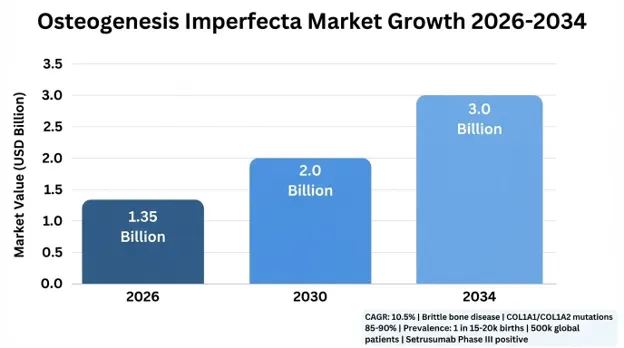
Osteogenesis Imperfecta (OI), widely recognized as brittle bone disease, is a rare, heritable connective tissue disorder characterized by fragile bones that are prone to breaking, recurring low-trauma fractures, progressive skeletal deformation, and reduced bone mineral density.
An estimated 85-90% of clinically diagnosed OI cases are due to mutations in the autosomal dominant COL1A1 or COL1A2 genes, which encode the chains that form the triple helix of type I collagen, which serves as the major structural protein of bone, tendon, skin, and sclera. The identified mutations result in impaired production of structurally normal collagen chains, typically defining the milder Type I form of OI, or the generation of structurally abnormal collagen chains that are capable of forming triple helices and inhibiting those of normal chains via a dominant-negative mechanism leading to moderate to severe OI, including the perinatally lethal Type II form and the progressively deforming Forms III and IV.
The remaining 10-15% of OI cases are defined as non-collagenous OI, as they result from mutations within genes encoding collagen processing and maturation factors, such as IFITM5 and SERPINF1, and typically follow an autosomal recessive or X-linked inheritance pattern. The disease impacts an estimated 1 in 15,000 to 20,000 live births, which equates to an estimated worldwide patient population of 500,000, and there is no strong predilection for sex or ethnic group. Besides skeletal features, patients often exhibit blue sclerae, dentinogenesis imperfecta, joint hypermobility, hearing loss, and potential cardiopulmonary compromise with increasingly severe disease phenotypes, which all contribute to the need for a lifelong, multidisciplinary approach to managing the disease.
For almost 3 decades, pharmacologic management of OI has principally involved off-label administration of anti-resorptive bisphosphonates, including intravenous pamidronate and zoledronic acid as well as oral alendronate and risedronate to varying extents, which function by inhibiting osteoclast-mediated bone resorption and increasing bone mineral density, while leading to approximately 30-40% reduction of vertebral fracture incidence and vertebral compression fractures in growing children as compared to untreated historical control groups; however, these drugs do not correct the underlying collagen abnormality, demonstrate limited benefits in adults or in preventing long-bone fractures, and risk blunting bone turnover during long-term treatment.
Therefore, there is a decisive movement towards mechanism-targeted, anabolic biologics—most notably anti-sclerostin monoclonal antibodies that promote osteoblast-mediated bone formation via unblocking Wnt/beta-catenin signaling and which, along with experimental anti-RANKL agents and anti-TGF-β antibodies targeting pathologically increased activity of the pathway in OI bone tissue, are shifting treatment paradigms in OI. The greatest transformative future long-term potential lies in gene silencing, gene editing, and mesenchymal stem cell therapies that aim to overcome or correct the dominant-negative collagen defect at its source, rather than indirectly acting on bone metabolism.
Commercially, OI is moving from a low-value, heavily genericized therapeutic landscape, characterized by inexpensive bisphosphonates, toward a higher-value orphan drug market, fueled by promising targeted biologics as they approach regulatory approval and warrant the higher prices commensurate with rare pediatric disease status with its associated orphan drug designation, priority review voucher programs, and the extended market exclusivities afforded to them. The chronically progressive, lifelong nature of the disease, typically requiring pharmacologic and orthopedic management from childhood to adulthood, and an increased awareness of the previously untreated population of adult patients with OI, contribute to the projected long-term potential of revenue for the market through the forecast period.
| Report Coverage | Details |
|---|---|
| Base Year | 2025 |
| Base Year Value | USD 1.2 Billion |
| Forecast Value | USD 3.0 Billion |
| CAGR | 10.5% |
| Forecast Period | 2025-2034 |
| Historical Data | 2022-2025 |
| Largest Market | North America |
| Fastest Growing Market | Asia Pacific |
| Segments Covered | By Disease Type, Treatment Type, Route of Administration, Patient Type, End-User |
| Region Covered | North America, Europe, Asia Pacific, Middle East & Africa, Latin America |
| Countries Covered | US, Canada, Mexico, UK, Germany, France, Italy, Spain, Netherlands, China, Japan, India, Australia, South Korea, Brazil, Argentina, UAE, Saudi Arabia, South Africa |
| Key Market Playes | Mereo BioPharma, Ultragenyx Pharmaceutical, Amgen Inc., Novartis AG, UCB S.A., Eli Lilly and Company, Sanofi Genzyme |
Get more details on this report - Request Free Sample
OI diagnosis was traditionally carried out by clinical fracture history, radiographic evaluation, and biochemical analysis of collagen in skin fibroblast culture, a laborious and specialized process that has traditionally led to delayed diagnoses, especially in mild Type I cases, which are sometimes mistakenly attributed to non-accidental injury and IJO. Gene panels and WES being so commonly used in pediatric genetic clinics have rapidly advanced the accuracy of OI diagnoses, allowing confirmation by molecular evaluation, distinguishing between OI and similar skeletal dysplasias, and discovering non-collagenous variants that allow for appropriate type-specific therapy choices. Increasing awareness from foundations such as the OI Foundation has led to drastically reduced diagnostic delays and an increasing treatment pool as diagnosed prevalence comes to meet true prevalence.
The most significant driver of the overall market is an upcoming wave of more impactful anabolic treatments that shift beyond anti-resorptive bisphosphonates towards biologics that are active bone builders targeting pathways that are fundamentally altered in OI. Setrusumab is an anti-sclerostin antibody, which is in late-stage development. It has proven effective at reducing annualized fracture rates on a statistical and clinically meaningful basis while increasing bone mineral density in pediatric/young adult OI patients, suggesting it will likely be the first drug approved for the indication on a first-in-class basis.
Average annual bisphosphonate therapy in the approximately $167,000 average household income for US patients ranges from approximately USD 8k to 22k/year, as opposed to a predicted $150k-$300k annual charge for approved anabolic biologics.
This is even in the absence of the significant gains in diagnosed patient populations.
The sheer range of phenotypes encountered within OI—from ambulatory, brittle-bone to immobile individuals suffering with severe deforming limb contractures and pulmonary disability—poses considerable challenges when it comes to clinical trial designing and endpoint setting, as well as subject stratification, and will continue to do so. Adult OI is vastly more common than pediatric, and historically the key drug trials targeting bone fracture rates and other primary indications have excluded the vast numbers of adult OI sufferers. It’s remarkable not that there’s no drug specifically approved for adults but that no one anywhere has been granted approval for adults on the strength of any application.
“In the first-in-many-places category,” noted one consultant for a European biopharma company, “the small numbers, the scattering of populations across international centers (all competing for the same patient pool at sub-centers), and the ethical difficulties of enrolling children into placebos make for protracted clinical study cycles.
These are, on average, nine years old between bringing a promising new investigational drug and finding a company ready to submit.
The largest transformative opportunity appears to lie within therapeutics targeting the genetic root defect instead of downstream bone metabolism. The dominant-negative mechanism underlying the majority of moderate-to-severe OI (a single mutant chain of collagen impairs proper triple helix formation) could conceptually be countered via allele-specific silencing using antisense oligonucleotide or siRNA technologies in which a defective COL1A1 or COL1A2 allele is “silenced” while the normal allele is expressed, with an acceptable approach already demonstrated in animal models (using cell culture or murine models). Bone marrow transplantation of mesenchymal stem cells, tested clinically in some small academic groups (some affiliated with Baylor College of Medicine), has shown incremental improvement in growth velocity and decrease in rate of fracture frequency in patients with the most severe form of OI, providing “proof of principle for cell replacement." The precise targeting afforded by the new CRISPR-based base and prime editing technologies could allow for direct correction of dominant-negative missense point mutations; a significant challenge will be delivery of such an editing system to osteoblasts, but a successfully translated system could be considered a first-in-class, very expensive (perhaps one-time) biologic.
OI management is more commonly centered in multidisciplinary specialized centers focused around the collaboration among metabolic bone physicians, orthopedic surgeons trained in intramedullary rodding, physical therapists, geneticists, and pulmonologists and will be coordinating throughout Europe through the European Reference Network for Rare Bone Diseases (ERN BOND) and in North America through centers such as Shriners Hospitals for Children, who will establish and monitor natural history data collection registries, providing regulatory data to support regulatory submission and the development of standards of care to be delivered. Meanwhile, the treating approach is also evolving from the administration of intravenous bisphosphonates to intravenous application in hospitals to self-subcutaneous injections with biologic agents administered at home by caregivers to limit patients, reduce school and employment deferment, and increase compliance and patients' long-term compliance.
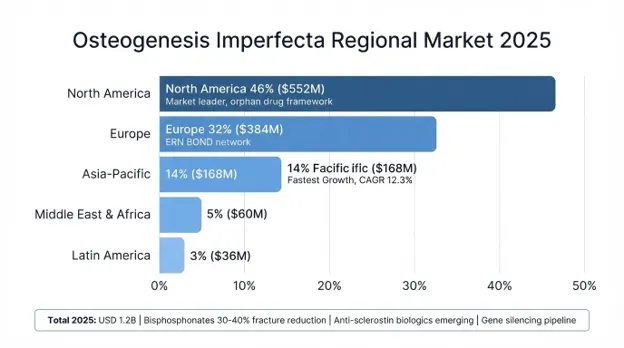
North America holds the largest OI market share driven by the highest concentrations of OI-specific treatment facilities, robust rare-disease insurance infrastructure, orphan drug and rare pediatric priority review vouchers, and a healthy trial infrastructure through organizations such as Shriners Hospitals for Children and the Osteogenesis Imperfecta Foundation. Within this largest segment, the United States provides the largest share of revenue by country due to private & government-supported insurance, which is driving the use of bisphosphonate infusions and provides an effective backdrop in terms of readiness to adopt premium pricing by emerging biologics soon to receive clearance. Europe claims the second largest OI market, where multiple specialist centers based out of the UK, Germany, France & Italy are aligned under an ERN BOND to establish standardized protocols for diagnosis & shared research infrastructure to enable trials.
These are underpinned by universal healthcare, which permits access to known therapies in a broad manner, while the same insurance frameworks typically require significant negotiation for novel orphan drugs and will usually only permit uptake of novel biologics at prices much lower than in the US.
Asia Pacific is the fastest-growing regional market with improvements in genetics diagnostic coverage & improved awareness, supplemented by expanded reimbursement frameworks within Japan, Korea & Australia. China and India are large markets with significant opportunities due to total population volumes; however, with both low levels of specialist access & relatively poor rare diseases care infrastructure at present, actual patient volumes are currently less than 1% of true prevalence, and expansion will remain restricted to low rates during the forecast period before accelerated growth later. Latin America & the Middle East & Africa remain much smaller markets where access remains basic, but improvement may take place from progress on respective regional rare disease approaches to basic bisphosphonates.
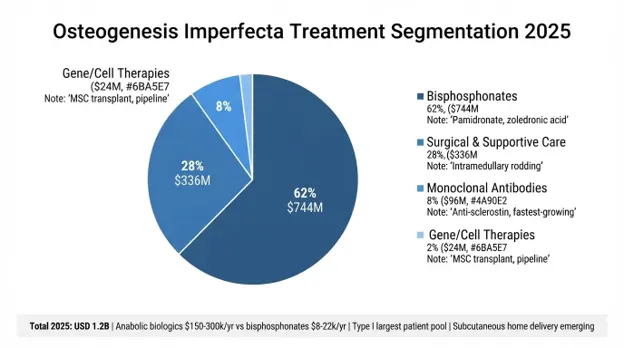
Treatment Type Insights: Bisphosphonates currently dominate the market in terms of treatment volume and are buoyed by a long history of use in the pediatric population. However, monoclonal antibodies and targeted biologics are expected to experience the strongest growth as anti-sclerostin agents transition into market entry and impact the value mix over the forecast period. Surgical interventions (especially intramedullary rodding) will be a crucial component of managing severe deformity, with gene & cell-based therapies forming a smaller but strategically vital segment of the pipeline.
Drug Class Insights: Bisphosphonates (pamidronate, zoledronic acid, alendronate, and risedronate) account for the current market based on well-established safety data and cost considerations. Anti-sclerostin antibodies are expected to be the fastest-growing class due to bone-building capabilities and orphan drug pricing, while anti-RANKL and TGF-inhibitors will have complementary use in non-responders.
Disease Type Insights: Type I OI represents the largest patient market with its milder manifestation and lifespan similar to that of the general population. Type III and IV patients demonstrate higher levels of treatment intensity on a per-patient basis and the greatest unmet need, representing a focal area for biologic and cell-based innovative therapies. Type II remains a minimal commercial segment, as it is usually perinatally lethal.
Route of Administration Insights: The IV route is dominant today, primarily associated with institutional protocols in pediatric centers using bisphosphonates; however, subcutaneous is expected to undergo significant growth in correlation with the upcoming self-administered subcutaneous mAb pipeline, which supports homecare applications.
End-User Insights: Hospitals and Specialty Orthopedic Centers represent the largest segment in current sales, influenced by complicated infusion, surgical, and clinical trial coordination procedures. Home healthcare and specialty pharmacies are predicted to emerge as the fastest-growing segments based on expanding usage of self-administered subcutaneous biologics.
The global OI market continues to be moderately fragmented, consisting of established pharmaceutical giants utilizing an antiresorptive or anabolic drug for bone-health franchises compared to niche rare-disease biotechnology companies progressing an OI-targeted biologic and gene-therapy agent(s). The competitive landscape differs based on the quality of the clinical data, approved indication range in pediatric and adult patients, and route of delivery, as well as pipeline maturity for advanced anabolic and gene-editing treatment types, with collaborations remaining key to successfully navigating small patient populations and encouraging rapid trial recruitment in the rare disease space.
March 2026: Mereo BioPharma and Ultragenyx Pharmaceutical have presented positive topline data from a Phase III study of setrusumab for the treatment of pediatric and young adult patients with OI, which demonstrated statistically significant annualized fracture rate reductions and improved bone mineral density sustained over time, moving to planned regulatory submissions later this year.
February 2026: Sanofi confirmed the advancement of clinical investigations of its investigational anti-TGF-antibody in children with moderate to severe OI as part of a multicenter trial conducted across a network of bone disease specialists in North America and Europe.
January 2026: A gene-silencing investigational therapy addressing dominant-negative COL1A1 mutations in individuals with OI has been granted Orphan Drug Designation and Rare Pediatric Disease Designation and is eligible for development incentives including the ability to obtain a priority review voucher on approval.
December 2025: A Baylor College of Medicine-affiliated academic group has reported new safety data and preliminary efficacy findings from a clinical trial of allogeneic MSC transplants in infants with severe OI showing better growth curves and fewer fractures.
November 2025: The European Reference Network for Rare Bone Diseases (ERN-BOND) expanded its international patient registry to encompass standard adult outcome measures.
You'll get the sample you asked for by email. Remember to check your spam folder as well. If you have any further questions or require additional assistance, feel free to let us know via-
+1 724 648 0810 +91 976 407 9503 sales@intellectualmarketinsights.com
26 Aug 2026
Intellectual Market Insights Research © 2026. All rights reserved.