Share this link via:

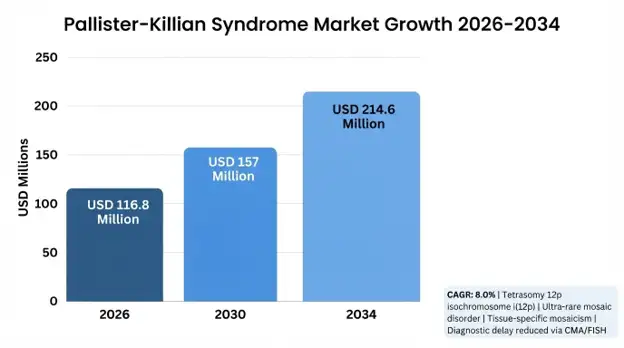
The global Pallister-Killian syndrome (PKS) market size was valued at US $108.5 million in 2025 and is expected to reach US $116.8 million in 2026 and is projected to grow to US $214.6 million by 2034, at a CAGR of 8.0% between the forecast period (2026-2034).
Pallister-Killian syndrome (PKS) is a very rare, sporadic non-heritable chromosomal disorder involving tetrasomy of the short arm of chromosome 12 due to a supernumerary isochromosome, i(12p), which is mosaic throughout bodily tissues. The disorder was independently reported by Philip Pallister and Philip Killian and colleagues, the first case appearing by Pallister's report in the late 1970s/early 1980s and the second by Killian and colleagues shortly after, and its pathogenic process is related to the mitotic instability of the extra isochromosome, which tends to be selectively lost from rapidly dividing cell populations, such as peripheral blood lymphocytes, over time and retained in a higher proportion at slower cell division rates, such as skin fibroblasts, buccal mucosa, and amniocytes. This characteristic of mosaicism across tissues is the most distinctive and clinically significant feature of this condition.
With a wide spectrum of signs and symptoms, this identifiable disorder is characterized by severe profound ID and marked neonatal and congenital hypotonia that can affect neonatal breathing drive and nutrition; facial findings characterized by reduced/absent anterior scalp hair, a prominent forehead, hypertelorism, a flat nasal bridge, and a wide mouth combined with skin findings that often follow a whorled pattern of Blaschko lines; as well as the common presence of seizures characterized mostly by infantile spasms that later become resistant complex multifocal epilepsy similar to Lennox-Gastaut syndrome.
These conditions are compounded by organ anomalies including VSD, ASD, AV canal, congenital diaphragmatic hernia, ocular malformations (strabismus and nystagmus), and hearing loss that contribute to high early mortality and multi-system problems at the severe end of the phenotypic spectrum.
The diagnostic problem for PKS is unusually complicated due to tissue-specific mosaicism; standard karyotyping of peripheral blood, the standard initial test on otherwise unexplained developmental delay, is often negative as the isochromosome has been selectively lost over time in the circulating blood cells, and confirmation usually relies on chromosomal microarray or fluorescence in situ hybridization on skin fibroblasts or buccal swabs or, during prenatal screening, on amniotic cells. While this need for an alternate type of testing for confirmation has led to misdiagnosis and prolonged diagnosis delay in the majority of patients, or forever incorrect diagnostic labeling as general ID, there are likely more affected individuals present in the population than reported. Most of these individuals are concentrated within regions of developed clinical genetic infrastructure capable of providing tissue-based testing, and only thousands with the disease are thought to exist worldwide.
There is no disease-specific therapy or cure currently approved for PKS anywhere in the world, and treatment is completely supportive care in large multidisciplinary teams encompassing neonatology, pediatric neurology, clinical genetics, cardiology, pulmonology, audiology, ophthalmology, orthopedics, GI surgery, and allied health professions like physiotherapy, occupational therapy, and speech therapy.
The current commercial contribution of the market involves the cost of long-term support and care, sophisticated cytogenetic testing, and off-label usage of antiepileptic therapy, but no dedicated pharmaceutical therapies for PKS are under development. New initiatives from regulatory bodies of the US, EU, and Japan include orphan drug incentives, which create regulatory and evidential advantages for later therapeutic development, while global patient registries and natural history studies supported by advocacy groups increase the groundwork to bring about new PKS therapies.
| Report Coverage | Details |
|---|---|
| Base Year | 2025 |
| Base Year Value | USD 108.5 Million |
| Forecast Value | USD 214.6 Million |
| CAGR | 8.0% |
| Forecast Period | 2025-2034 |
| Historical Data | 2022-2025 |
| Largest Market | North America |
| Fastest Growing Market | Asia Pacific |
| Segments Covered | By Diagnostic Modality, Disease Manifestation, Treatment Type, End-User, Region |
| Region Covered | North America, Europe, Asia Pacific, Latin America, Middle East & Africa |
| Countries Covered | US, Canada, UK, Germany, France, Italy, Netherlands, Spain, Japan, China, India, South Korea, Australia, Brazil, Mexico, UAE, Saudi Arabia |
| Key Market Playes | UCB S.A., Eisai Co. Ltd., Jazz Pharmaceuticals, LivaNova PLC, Novartis AG, Illumina Inc., Thermo Fisher Scientific |
Get more details on this report - Request Free Sample
Perhaps the most significant structural factor fueling PKS market growth is the incremental adoption of a chromosomal microarray and/or fluorescence in situ hybridization technique (specific for the organ/tissue) in lieu of peripheral blood karyotyping as a first-line diagnostic for the unexplained hypotonia, mental retardation, and dysmorphic features presenting primarily in infants and children. Since isochromosome i(12p) is lost only from blood lymphocytes through processes involving mitotic instability, it produces false negative results with chromosomal testing in a significant proportion of true PKS and has consequently remained underdiagnosed and delayed for years. However, the increased clinical use of sampling of non-invasive buccal swabs or skin fibroblasts once PKS is suspected and also the use of prenatal microarray analysis of the amniotic fluid (after imaging suggestive of fetal anomaly, e.g., diaphragm hernia, increased amniotic fluid, facial morphology, etc.) is greatly influencing detection and causing movement in diagnosis along the care pathway.
Neonatal intensive care improvements, congenital diaphragmatic hernia surgical repairs, and surgical correction of cardiac defects have produced significantly better survival rates among infants with PKS and prolonged the period for which an affected person requires intensive, costly multidisciplinary care. Growing survivorship supports demand for chronic antiepileptic drug therapy, orthopedic management of scoliotic and hypotonia-related contractures about the joint(s), and enteral nutritional support; continued rehabilitation and educational services are increasingly demanded over time. Increased clinical recognition of the PKS-specific epilepsy phenotype, which begins in many with infantile spasms and later manifests as intractable multifocal seizures refractory to medical therapy, is also leading to increased utilization of newer, more expensive antiepileptic medication regimens.
Extreme rarity of the PKS condition combined with a high level of tissue-specific mosaicism restricts, for example, the number of available well-documented PKS patients under active clinical management at any point in time and the ability to enroll them for investigational treatment protocols at many global centers to just a handful. Even highly specialized pediatric and neurology professionals only see a number of them during their whole career. In the aftermath, due to limited direct personal clinical experience, there will be a substantial underrepresentation of the diagnosis in clinical practices outside of major academic genetic centers—particularly if standard chromosomal and fibroblast analyses are unaffordable or simply not routinely used at a referral level (due to distance or costs to travel).
The problem in the case of tetrasomy 12p is that the increased expression of a large gene complex region rather than one specific actionable target makes standard small molecule- or antibody-based drug discovery inefficient and leads to a general lack of industry funding towards the condition—other than for symptomatic treatment repurposing that does not justify any large-margin “orphan drug" commercial proposition.
Care is fragmented and provided by different services, i.e., the local children’s department, secondary and tertiary centers in genetics, and community therapists, and information is not longitudinally collected by one central authority. This limits the value of cost and outcome modeling.
Another potential, albeit lower risk, commercial target for earlier development would be targeting therapies that exploit antiepileptic treatment specific to the PKS seizure phenotype that would not effectively treat, nor are the majority of currently marketed antiepileptic drugs indicated for treating other epilepsy syndromes that the treatments would target. Utilizing recently approved agents that employ the targeting of novel mechanisms such as the new generation CBD-based therapies & other NGs alongside SVNS-based device approaches in severe-refractory cases provides a workable route that does not require new molecular entities in this space. Longer term, as more is learned about the effects of increased dosage on other cellular mechanisms in PKS, the implications of these include deregulation in dose-sensitive gene functions and developmental pathways that are paving the way for early investigation into approaches targeting overexpression of 12p genes via RNA-based treatments and chromosome engineering targeting dosage balance. Though clearly early stage, these are conceptually positioning PKS as an ideal candidate for exploring novel structural chromosomal correction methodologies that, if proved successful, should achieve premium pricing in the orphan drug context due to exclusivity and market incentives in the most valuable regions.
The PKS field is currently at an important juncture in its natural history data infrastructure development with coordinated activities by patient advocacy groups, academic medical centers, and rare disease research networks in establishing thorough international registries that collect cross-disease progression, as well as a complete array of longitudinal, clinical, functional, and molecular information in all patients and in all disease severities. These registries are generating epidemiology and outcomes information with which to support future regulatory interactions, while the increasing incorporation of caregiver-defined outcomes that characterize behavioral burden, sleep problems, and functional autonomy is defining the endpoints that are suitable for individuals with severe intellectual disabilities.
NORTH AMERICA is the largest regional market, worth approx. $48.8 million in 2025 with approx. 7.7% CAGR through 2034. The regional dominance is attributed to the presence of robust, existing academic clinical genetics and pediatrics neurology centers; thorough insurance and Medicaid coverage for sophisticated cytogenetic testing and coordinated patient care in multidisciplinary teams; and the functioning infrastructure of patient advocacy bodies, with dedicated PKS family societies for registry setup and research funding.
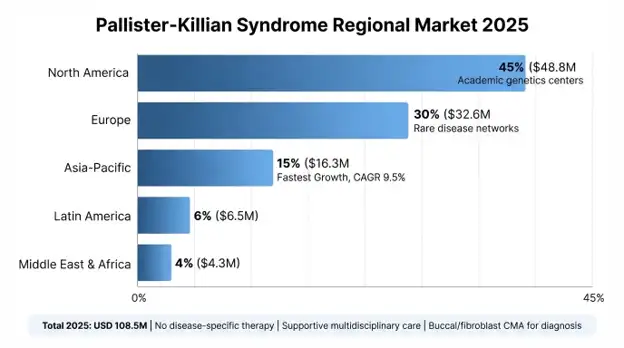
EUROPE is the second-largest market by value, worth approx. $32.6 million in 2025 owing to synchronized rare diseases reference networks; increased adoption of the chromosomal microarray analysis (CMA) test as the first-tier pediatric testing in the U.K., Germany, France, Netherlands, etc.; and the provision of structured public funds for longitudinal rehabilitation and educational programs. Asia Pacific is projected to be the most rapidly expanding region, at an approx. 7.7% CAGR through 2034, worth approx. $16.3 million in 2025. Growth factors include increased pediatric genetics infrastructure development across India, China, Japan, and South Korea; growing recognition by clinical genetics doctors of PKS as a specific diagnosis; and national rare disease policy support towards better access to diagnostic services.
Latin America and the Middle East & Africa together cater to remaining demand, marked by relatively inadequate genomics infrastructure and less knowledge, while gradual advancement in genetic diagnostic capabilities and collaborative partnerships with global centers of excellence will drive the region in the forecast timeline.
In diagnostic modality, chromosomal microarray analysis comprises the largest and growing portion because of high sensitivity in detecting mosaicism in non-blood tissues, whereas fluorescence in situ hybridization is primarily used for the targeted confirmatory testing; conventional karyotype is now used much less often for PKS in light of a very high false-negative rate, whereas it persists as a common initial test in resource-limited settings.
In terms of disease manifestation, neurodevelopmental disability and epilepsy management represent the largest share of cost cumulatively due to very long life spans for intensive rehabilitation, education, and anti-epileptic pharmaceutical management throughout a patient's life, whereas clinically significant congenital diaphragmatic hernia and structural congenital heart disease present significant neonatal surgical/ICU expenditure, whereas craniofacial/musculoskeletal and sensory problems contribute with smaller to modest but constant expenditures.
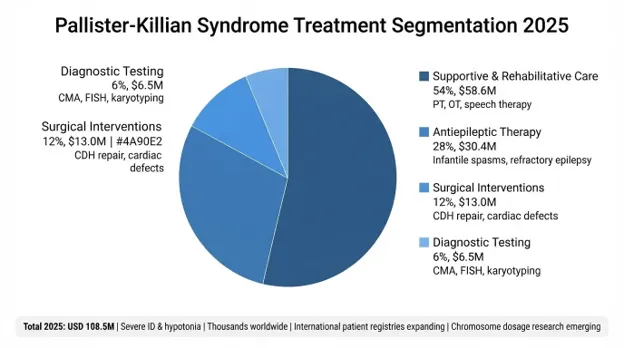
In terms of treatment modalities, supportive and rehabilitative care remain the largest modality since there is not yet an established disease-modifying agent, whereas antiepileptic therapy has the highest expense across pharmaceuticals, whereas surgical interventions, including CDH repair and surgical corrections of congenital heart disease, result in significant episodic costly expenses in neonates.
Academic medical centers and pediatric specialty hospitals present the largest portion, whereas rehabilitation and special education centers for rehabilitation and education services follow, as they represent a significant portion of total life-cycle cost through dominant lifelong supports for neurological and educational needs.
The PKS global market still only represents an embryonic stage of commercial pharmaceutical development, as there are no approved disease-specific therapies available, and as such, the market is driven more by repurposed antiepileptics, cytogenetic diagnostics, and supportive care services as opposed to direct branded pharmaceutical competition. Competitive positionings are dictated not by market share metrics but by expertise in managing rare disease epilepsy, sensitivity of diagnostic platforms on mosaic chromosomal diseases, and patient registry/patient group outreach more than branded pharmaceutical market share leadership. Rare disease epilepsy franchises should extend their antiepileptic pipeline into PKS-specific clinical applications as natural history and endpoint infrastructure are established, and cytogenetic diagnosticians will compete based on tissue-appropriate testing platform sensitivity.
2026 - The International PKS patient registries successfully expanded recruitment throughout North America, Europe, and Japan, integrating new standardized neurodevelopmental and caregiver-reported outcome measures designed to inform potential regulatory endpoint development for future clinical trials.
2025 - Multi-center PKS epilepsy natural history data were published from academic research consortium efforts in multiple therapeutic centers and identified specific epilepsy trajectory phenotypes relevant to next-generation antiepileptic target development in PKS patients.
2025 - Buccal swab-based chromosomal microarray was further established as a first-tier test in numerous rare pediatric rare disease centers, increasing the proportion of diagnoses of individuals with PKS and lowering the median age of diagnosis.
2024 - Preclinical programs were completed that characterized the impact of tetrasomy 12p molecular changes on developmental signaling pathways, which have generated early evidence to nominate candidate dosage-sensitive gene targets for potential future therapeutic investigation of PKS.
You'll get the sample you asked for by email. Remember to check your spam folder as well. If you have any further questions or require additional assistance, feel free to let us know via-
+1 724 648 0810 +91 976 407 9503 sales@intellectualmarketinsights.com
26 Aug 2026
Intellectual Market Insights Research © 2026. All rights reserved.