Share this link via:

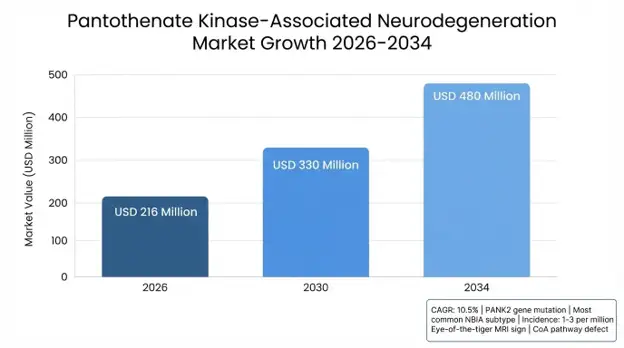
The global Pantothenate Kinase-Associated Neurodegeneration (PKAN) market, estimated to be worth $195 million in 2025, is expected to grow to $216 million in 2026 and reach nearly $480 million by 2034, exhibiting a CAGR of 10.5% during the forecast period (2026-2034).
PKAN is the commonest subtype of neurodegeneration with brain iron accumulation (NBIA) disorder, being responsible for almost half of all diagnosed NBIA cases. It is an ultra-orphan, autosomal recessive disorder due to biallelic loss-of-function mutations in the PANK2 gene on chromosome 20p13.3. The PANK2 gene encodes mitochondrial pantothenate kinase 2 (also known as coenzyme A kinase), the enzyme that catalyzes the first, rate-limiting step in the conversion of pantothenate (vitamin B5) to coenzyme A. Coenzyme A, a fundamental cofactor for many metabolic processes, including the synthesis of fatty acids, production of mitochondrial energy, and assembly of membrane lipids, cannot be effectively produced due to loss of PANK2 enzyme function. Lack of functional PANK2 activity leads to dysregulation of coenzyme A metabolism, with toxic consequences for the brain, including accumulation of cysteine-containing metabolites and pathologically iron-laden deposits in the globus pallidus interna, predominantly, and substantia nigra pars reticulata, to a lesser extent.
This iron deposition produces the highly specific "eye-of-the-tiger" MRI sign seen on T2-weighted images where a central zone of gliosis and neuronal loss is surrounded by a ring of iron.
Clinically, PKAN can be classified as either classic or atypical, with classic PKAN accounting for approximately 75% of all diagnosed cases. Classic PKAN manifests during early childhood (3-6 years) with rapid progression of gait disturbance, dystonia, rigidity, dysarthria, and pigmentary retinopathy, leading to the loss of independent ambulation within 10-15 years of symptom onset and premature death due to aspirations, severe contractures, or malnourishment. Atypical PKAN constitutes the remaining cases and typically presents with symptom onset during adolescence or adulthood, progressing more slowly with a characteristic manifestation of speech impairment, psychiatric symptoms (especially OCD-like behavior and impulsivity), and gradual onset of motor deterioration.
Currently there are no disease-modifying drugs with formal approval for PKAN treatment, and the management of the condition largely centers around symptom control. Standard treatments consist of a combination of oral antispasmodic and antidystonic drugs (baclofen and trihexyphenidyl) and botulinum toxin injections. In those patients who do not benefit from pharmacological interventions, deep brain stimulation (DBS) targeted to the globus pallidus interna may effectively alleviate dystonic symptoms and improve quality of life, although it does not impact the natural disease trajectory.
The main approach to disease modification that has been explored to date involves iron chelation with oral, blood-brain-barrier-penetrant deferiprone. The TIRCON (Treat Iron-Related Childhood-Onset Neurodegeneration) trial, a multi-center European study with many PKAN patients, demonstrated reduction in pallidal iron burden as measured by MRI but did not lead to statistically significant improvement in dystonia, shifting research efforts toward understanding and restoration of upstream Coenzyme A metabolic pathways.
With an estimated global incidence of 1 to 3 cases per million people, leading to a worldwide diagnoses or undiagnosed patient population of 8,000 to 24,000, the PKAN market firmly falls into the ultra-orphan disease model, where sales value is driven not by patient volume but by a high number of therapies per patient across management of symptoms, hardware/device costs for DBS therapy, and premium price expectations for novel disease-modifying agents and gene therapies in development.
As the PKAN therapeutic landscape advances from simple symptom management to mechanistic targeted coenzyme A restoration and gene therapies, the PKAN market is expected to experience a rate of growth significantly higher than that of typical neurology markets despite its small patient size.
| Report Coverage | Details |
|---|---|
| Base Year | 2025 |
| Base Year Value | USD 195 Million |
| Forecast Value | USD 480 Million |
| CAGR | 10.5% |
| Forecast Period | 2025-2034 |
| Historical Data | 2022-2025 |
| Largest Market | North America |
| Fastest Growing Market | Asia Pacific |
| Segments Covered | By Treatment Type, Route of Administration, Disease Form, Age Group, End-User, Region |
| Region Covered | North America, Europe, Asia Pacific, Middle East & Africa, Latin America |
| Countries Covered | US, Canada, UK, Germany, France, Italy, Spain, Netherlands, China, Japan, India, Australia, South Korea, Brazil, Mexico, UAE, Saudi Arabia, South Africa |
| Key Market Playes | Chiesi Farmaceutici, Medtronic plc, Abbott Laboratories, Boston Scientific Corporation, Travere Therapeutics, BridgeBio Pharma, Neurogene Inc. |
Get more details on this report - Request Free Sample
A core driver of the PKAN market is the increasingly universal access to molecular diagnostics, which has sequentially revealed an expanding patient population. Historically, many PKAN patients were misdiagnosed with cerebral palsy, primary dystonia, or another more typical movement disorder for an average of 4-8 years between onset and final confirmation by genetic testing in retrospective analysis. Increased routine inclusion of PANK2 into Next Generation Sequencing (NGS) panels for pediatric movement disorders/dystonia and increased clinician knowledge of the eye-of-the-tiger MR1 characteristic have shortened the average diagnostic odyssey in regions where advanced neurogenetic testing is available. Global patient registries, such as the TIRCON registry (run by the NBIA Disorders Association), have provided a crucial characterization of natural history, genotype-phenotype correlations, and trial-ready patient pools to mitigate recruitment risk.
Key Diagnostic Metrics:
Second, efforts have increased significantly on treatments that act on the upstream metabolic defect rather than the downstream ramifications. Understanding that iron accumulation may be secondary to defects in the CoA pathway (and not the instigator of neurodegeneration) is allowing studies to focus on the provision of pantothenate and pantethine, delivery of precursors for CoA synthesis, and small-molecule approaches aimed at evading the deficient enzymatic step. Orphan drug designations for several compounds in development by both the FDA and EMA have acknowledged the unmet need and can also offer extended market exclusivity to the developer, priority review by regulatory agencies, and reduced development costs, making the commercial prospects extremely favorable for development targeting this extremely small patient population.
Innovation Impact Metrics:
The rarity of PKAN has limitations on drug discovery and market size. Finding the statistically sufficient number of patients for randomized trials, for example, is almost insurmountable given the global population of only a few thousand individuals with a diagnosis. Multinational trial networks are necessary, which significantly increases the time and cost of the trial, exemplified by the Tircon deferiprone trial, which took many years and enrolled patients throughout various countries, demonstrating the resource cost of this small population study. Motor, speech, and psychiatric domains progress at various paces, which presents difficulty in setting consistent endpoint criteria between the classic and atypical phenotypes, and defining a sensitive, yet clinically meaningful, measure of outcome within a clinically acceptable trial length has been a persistent difficulty for regulators and drug companies.
At present, there is no disease-modifying treatment approved for PKAN, leading to standard care that treats the symptoms and limiting value perception over the longer term from such treatments in the hands of payors. High anticipated per-patient pricing will provide another headwind for upcoming potential disease-modifying/gene therapy candidates and a significant reimbursement challenge given a growing need for durable long-term outcomes in the area of function and quality of life among ultra-orphan conditions in the health technology assessment decision-makers' process. Finally, access limitations for specialized neurogenetic care and rare disease-specific reimbursement mechanisms may mean significant limitations for middle-income countries, thus creating potential constraints in the realizable commercial market beyond North America, Western Europe, and key emerging markets in the Asia Pacific.
The most impactful opportunity in PKAN will come from gene therapies, which seek to address the ultimate source of disease, a lack of effective PANK2 expression, in affected basal ganglia neurons, rather than the secondary downstream effects of the disorder. Given that PKAN is caused by a single gene with a well-defined genetic target in an anatomical region amenable to therapeutic delivery, with no current competitor therapies, the condition represents a strong potential candidate for gene therapy application. Studies underway utilizing AAV vectors delivered intrathecally via intracranial injection as well as intravenous administration with CNS penetrance will be entering preclinical and early clinical stages; it is anticipated that successful programs will warrant a similar high price point as other gene therapies for rare and ultra-rare neurological disorders due to their potential for long-term effect.
A complementary avenue involves biomarker validation for sensitive indicators of disease progression, such as quantitative susceptibility mapping to provide more accurate estimates of brain iron, CSF metabolic profiling for coenzyme A pathway intermediates, and digital wearable accelerometry markers of dystonic symptom severity—any of which could significantly decrease the required sample sizes and length of clinical trials. In parallel, improvements in DBS technology—such as steerable, unidirectional leads allowing for better targeting of electrical current within the GPa and responsive, closed-loop stimulation that can sense local field potentials and adjust parameters in real-time—will enable more personalized symptomatic treatments, contributing to continued incremental revenue increases even before a disease-modifying therapeutic becomes available.
Perhaps the most important emerging trend is the ongoing and increased study of using Coenzyme A precursor supplements, specifically pantethine, to circumvent the enzymatic defect caused by PANK2 deficiency. Pantethine, which can be converted into Coenzyme A by entering the pathway after the step catalyzed by PANK2, could bring back cellular levels of Coenzyme A to an acceptable point and wouldn't require a functional PANK2. It’s an attractive proposition for those in the development process in a very niche and narrow indication for which trial numbers will likely be severely limited, due to pantethine having a previously good safety profile in humans (it's found naturally in humans).
Maturation of the international rare disease infrastructure, led by Tircon, a European commission-sponsored consortium; the NBIA Disorders Association patient registry, etc., continues to advance and influence the PKAN market through further natural history characterization, improving genotype-phenotype correlation, and allowing international patient recruitment for trials. Such registries are developing a significant role in serving as synthetic control arms, as well as endpoints validation tools in single-arm or open-label trials—a necessity in a disease where conducting large, placebo-controlled studies is impossible—and continue to inform regulatory discussion regarding trial design and evidence standards for ultra-rare neurological diseases.
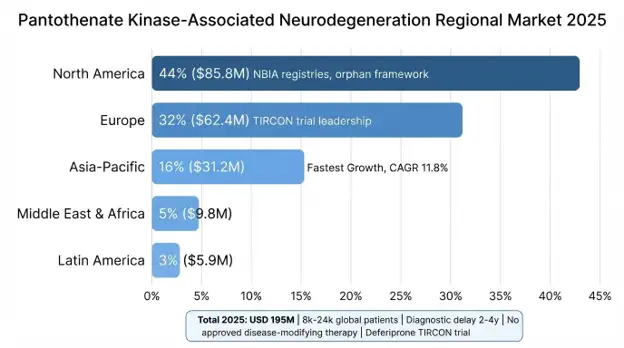
The PKAN market in North America is dominant and is driven by multiple factors, including the highest concentration of movement disorder and neurogenetic specialty centers with knowledge of the disease; existing rare disease reimbursement pathways; existing clinical trial infrastructure boosted by federal funding for research and rare disease foundations; and a favorable orphan drug regulatory climate with opportunities for expedited reviews and rare pediatric disease designation. Patient advocacy organizations domiciled in the region hold patient registries that aid international recruitment to clinical trials and the generation of natural history data critical for regulatory submissions.
Europe is the second largest market because it benefits from the existence of European Reference Networks to promote cross-border patient referral and sharing of data and the EMA orphan designation providing long marketing exclusivity. Germany, France, Italy, and the UK have the value of most of the European market, representing the main European academic movement disorder centers with PKAN diagnostic and treatment knowledge, and the European TIRCON project (the largest PKAN clinical trial to date and main European PKAN registry) illustrates the collaborative framework leading to Europe as a significant player in the development of new treatments.
North America and Southeast Asian countries also to grow faster The fastest-growing market is the Asia Pacific, with Japan, South Korea, China, and India witnessing high-growth next-generation sequencing-based diagnostic services that help screen for patients previously suffering from similar other movement disorders. Increased government expenditure for the accessibility of invasive treatment such as deep brain stimulation in the Asian region will contribute to substantial growth. China and India constitute major latent opportunities due to enormous population size along with a history of underdiagnosis of rare disease disorders, further expanding across.
The "Symptomatic Pharmacotherapy & Supportive Care" segment is by far the largest because there is no current approved disease-modifying therapy for HD patients, and most patients utilize oral antidystonic agents, botulinum toxin, and multidisciplinary rehabilitation. DBS is large in dollar share per procedure, and while it is only being utilized in a small fraction of the population, the market share is significant due to high hardware and surgical costs. Iron chelation therapy with deferiprone accounts for a portion of the market through ongoing off-label use. The "Coenzyme A Pathway Modulators" and "Gene Therapy" segments are currently small but will disproportionately grow in market share value as clinical trials progress and the first product launches occur.
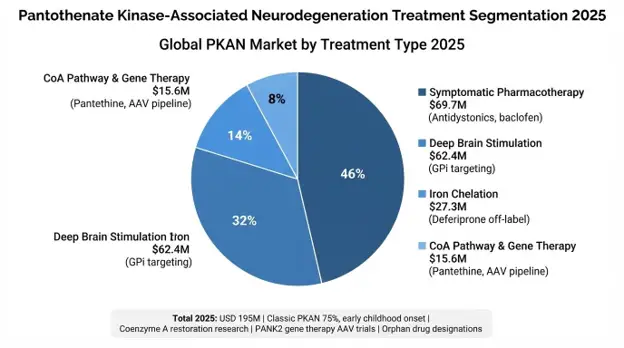
The majority of recorded diagnoses of classic PKAN is the primary driver for the highest healthcare cost given the severity and early childhood onset, which demands the need for more aggressive pharmaceutical treatments, early surgical interventions, and complex multidisciplinary supportive care in its management. The atypical presentation of PKAN has slower progression with later onset and contributes to lower but chronic costs, which are mainly driven by costs for managing speech and psychiatric symptoms in addition to movement disorders.
The majority (hospitals & specialty neurology centers) end-user segment includes patients referred by other physicians as well as in-house DBS implantation surgeries due to a substantial accumulation of the number of DBS procedures performed, complex patient management in multidisciplinary clinic and clinics,al trial-related patient pool present mostly within the larger academic & tertiary centers. Long-term medication adjustments and maintenance for outpatient patients form a considerable part of movement disorder centers, with home healthcare set for a gradual increase over the period of analysis.
The PKAN market is niche yet appears to be warming with respect to competition in the context of the extremely rare disease and historical lack of existing, FDA-approved treatments. Trading activity has primarily been concentrated on deferiprone (by ApoPharma, then by Chiesi Farmaceutici) and among the developers of devices for deep brain stimulation—Medtronic, Abbott, and Boston Scientific—systems that are applied for existing movement disorder indications in the population of people with PKAN disease. Emerging treatments are skewing towards gene therapies and enzyme-therapy developers centered on coenzyme A pathways (e.g., BridgeBio Pharma, Neurogene, and Passage Bio; most are rare-disease experts, using orphan status in development): there will need to be very clear evidence of clinical neurology effect, ideally validated biomarkers, and then market access for high costs when the pool size is so tiny.
February 2026: An academic-industry consortium presented interim results of a trial of a small-molecule inhibitor of the coenzyme A pathway for PKAN, demonstrating good tolerability and an initial stabilization of motor function in a subset of patients.
December 2025: A gene therapy developer announced first-cohort dosing completion of its phase I/II study of intracranial AAV-mediated delivery of the PANK2 gene. Initial biomarker data indicates biological activity in the trial population.
October 2025: Chiesi Farmaceutici presented long-term follow-up data from an extension study of deferiprone in pediatric PKAN, emphasizing its ability to reduce iron burden but underscoring the necessity of combined therapeutic approaches to address motor performance.
August 2025: Medtronic announced that it has received extended regulatory approval to market its next-generation directional, closed-loop deep brain stimulation system for pediatric inherited movement disorders, including PKAN, that is medically refractory to dystonia.
June 2025: An investigational agent that is a precursor to coenzyme A for PKAN was granted orphan medicinal product status by the European Medicines Agency, providing for up to 10 years of market exclusivity on approval.
You'll get the sample you asked for by email. Remember to check your spam folder as well. If you have any further questions or require additional assistance, feel free to let us know via-
+1 724 648 0810 +91 976 407 9503 sales@intellectualmarketinsights.com
Intellectual Market Insights Research © 2026. All rights reserved.


