Share this link via:

The global Pompe disease market size was valued at USD 1.85 billion in 2025 and is estimated to reach USD 2.05 billion in 2026, expanding to USD 4.48 billion by 2034, growing at a CAGR of 10.2% during the forecast period (2026-2034).
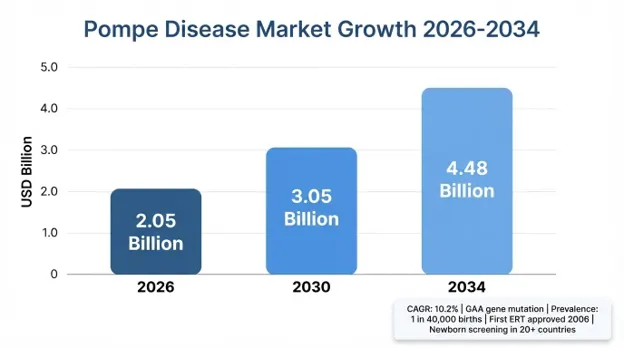
Pompe disease, alternatively termed glycogen storage disease type II or acid maltase deficiency, is a rare, progressive, and autosomal recessive lysosomal storage disease characterized by mutation in the GAA gene and subsequent impairment of the enzymatic action of acid alpha-glucosidase. Enzymatic deficiency causes the pathological accumulation of glycogen in lysosomes in many tissues; however, the most severely affected organs include skeletal muscle, heart muscle, and diaphragm and other respiratory muscles. The disease encompasses a broad range of phenotypes and includes the rapidly progressive infantile-onset type characterized by severe hypotonia, hypertrophic cardiomyopathy, cardio-respiratory failure that is usually fatal in the first year of life when untreated, and late-onset forms that present with slowly progressive proximal muscle weakness, exercise intolerance, and respiratory dysfunction throughout childhood and late adulthood. Worldwide, Pompe disease affects one in 40,000 newborns, yet its prevalence varies by race and geography, many patients have been misdiagnosed or have gone undetected for years because of their vague and gradually developing symptoms.
The treatment landscape of Pompe disease received a dramatic shift with the regulatory approval of alglucosidase alfa in 2006, the first enzyme replacement therapy that showed any significant benefit to life expectancy and function in the disease. Although the first-generation enzyme replacement therapy significantly increased survival rates in the infantile form of the disease and slowed down the progression in most of the late-onset cases, the tissue load remained unaltered in some cases because of the poor delivery of the enzyme to target tissues and the formation of neutralizing antibodies against the drug in some patients. This paved the way for the development of next-generation enzyme replacement therapies like avalglucosidase alfa, approved in 2021, and the cipaglucosidase alfa-miglustat combination therapy, approved in 2023.
In addition to enzyme replacement therapy, the market dynamics will also be driven by the growing number of gene therapies using adeno-associated viral vectors to deliver normal versions of the GAA gene into the liver or skeletal muscle, seeking to achieve long-term production of endogenous enzymes following a single dose administration without the need for bi-weekly intravenous injections throughout life. Some of the complementary treatment options being considered involve oral substrate reduction therapies that inhibit the production of glycogen above the enzyme deficiency point.
The commercial relevance of the Pompe disease market goes far beyond the revenues generated by drug sales into a broader rare disease landscape that includes newborn screening initiatives allowing for presymptomatic diagnosis, an infusion/homecare network providing chronic drug administration, immune tolerance induction regimens for antibody-positive infants, and real-world evidence collected from patient registries. Considering that the therapy used today is chronic and lifelong and the orphan nature of the disease, the value of therapy on a per-patient basis is exceptionally high, and the market is growing due to the expansion of the diagnosed patient pool.
| Report Coverage | Details |
|---|---|
| Base Year | 2025 |
| Base Year Value | USD 1.85 Billion |
| Forecast Value | USD 4.48 Billion |
| CAGR | 10.2% |
| Forecast Period | 2025-2034 |
| Historical Data | 2022-2025 |
| Largest Market | North America |
| Fastest Growing Market | Asia Pacific |
| Segments Covered | By Disease Type, Treatment Type, Route of Administration, End-User |
| Region Covered | North America, Europe, Asia Pacific, Middle East & Africa, Latin America |
| Countries Covered | US, Canada, Mexico, UK, Germany, France, Italy, Spain, Netherlands, China, Japan, India, Australia, South Korea, Taiwan, Brazil, UAE, Saudi Arabia |
| Key Market Playes | Sanofi (Genzyme), Amicus Therapeutics, Astellas Pharma, Genethon, Maze Therapeutics, and Bayer AG (AskBio) |
Get more details on this report - Request Free Sample
The primary structural driver for growth in the market is the increasing prevalence of Pompe disease screening worldwide, which is transforming the diagnostic paradigm from one traditionally marked by delays into one that is defined by presymptomatic diagnosis. In Taiwan, Pompe disease newborn screening was first implemented back in 2005, providing key insights regarding the clinical benefits of timely disease initiation, which led to the inclusion of the disease into the U.S. Recommended Uniform Screening Panel in 2015 and further successful implementation in all fifty U.S. states. Some European nations such as Germany, Austria, and the Netherlands have since included Pompe disease into their screening programs, with some selected regions in Japan, South Korea, and China gradually implementing such screening efforts. Earlier diagnosis by way of dried blood spot acid alpha-glucosidase activity test leads to earlier treatment before there is any permanent muscle and cardiac damage, which is highly correlated with higher survival rates among infantile-onset patients and better maintenance of mobility and pulmonary function among late-onset patients who were identified through screening or family cascade testing.
The commercialization of next-generation enzyme replacement therapies, such as avalglucosidase alfa and the cipaglucosidase alfa-miglustat combination, has resulted in the creation of a premium-priced therapy segment with clinical evidence showing improved enzyme uptake in muscle and respiratory and motor function outcomes compared to first-generation alglucosidase alfa, leading to the gradual shift towards more value-added options from both new and old patients. A growing list of gene therapy and oral substrate reduction therapies, designed to provide durable endogenous GAA production or reduced glycogen synthesis, is being developed at the preclinical and early mid stage of clinical trials, attracting significant investments in anticipation of a paradigm change.
The highest limiting factor that has an impact on the expansion of the market is the extremely expensive price of the chronic Pompe disease treatments, which can sometimes exceed hundreds of thousands of US dollars annually depending on the weight of the patient, the generation of the products, and the geographical market in question. These treatments fall under some of the most expensive chronic pharmaceutical interventions in medical practice, receiving considerable attention from the organizations conducting health technology assessments within the context of the frameworks developed for more common diseases. In many markets of Europe and the Asia Pacific, it takes quite a long time to negotiate the coverage because they usually require managed access and confidential pricing, but in poor countries without orphan drug reimbursement framework, it becomes extremely difficult for patients to receive the treatment.
The biggest transformational opportunity in the Pompe disease market will be the further development of gene therapies using AAV vectors for delivering sustainable correction of the GAA enzyme deficiency with a one-time injection. If programs such as those being undertaken by nonprofit companies such as Genethon and Maze Therapeutics are found to have sustainability and efficacy, it will drastically cut down the need for lifelong, biweekly infusions and will offer consistent enzyme production in the body. Such commercialization will certainly be able to sustain one-time premium pricing models based on lifelong enzyme replacement therapy expenses, as well as increase the patient pool.
An important trend that is becoming popular in Pompe disease treatment is the use of home infusion programs where stable patients can receive biweekly enzyme replacement therapy outside hospitals using special home-nursing services, portable infusion devices, and remote monitoring systems assessing their breathing abilities and infusion tolerance between visits. The home care treatment approach has been proven to be as safe as facility-based infusion but more satisfactory for patients.
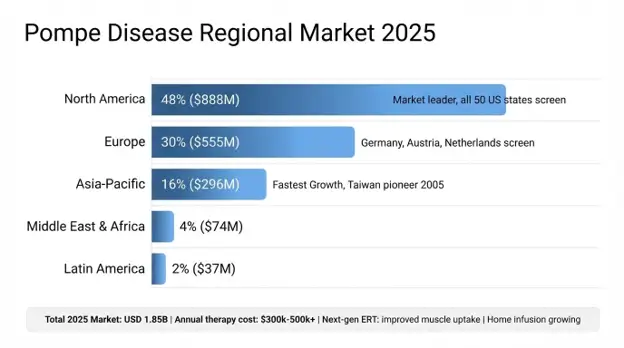
North America is the largest regional market supported by complete adoption of newborn screening programs in US states, the presence of dedicated centers for treating lysosomal storage disorders, and insurance coverage systems such as Medicare and Medicaid, which provide access to highly priced enzyme and gene replacement therapies. This region is also a prominent center for clinical trials due to orphan drug designation and rare pediatric disease programs available in the region.
Asia Pacific is expected to witness the fastest growth in terms of regional markets till 2034 due to increasing implementation of newborn screening programs in Japan, South Korea, Taiwan, and selected provinces of China; development of specialist metabolic disease facilities; and improved reimbursement scenarios, which include coverage of health insurance systems in Japan and inclusion of rare disease treatments into provincial insurance coverage in China. Long experience with screening the population in Taiwan dating back to 2005 made Taiwan a regional benchmark in managing diseases. Higher spending on healthcare is further increasing the pool of patients.
Late-onset Pompe disease is responsible for the largest percentage of diagnosed patients due to its wider age range of presentation and higher prevalence than infantile-onset Pompe disease. The group represents the market volume and will benefit significantly from newborn screening programs and cascade family testing to detect late-onset mutations without developing functional problems. Infantile-onset Pompe disease is represented by a smaller percentage of diagnosed patients, but each patient’s treatment represents high value per patient, as there are heavy dosing requirements in accordance with the body weight of fast-growing infants and the need for a wide spectrum of specialists involved in the management of severe heart and lung conditions.
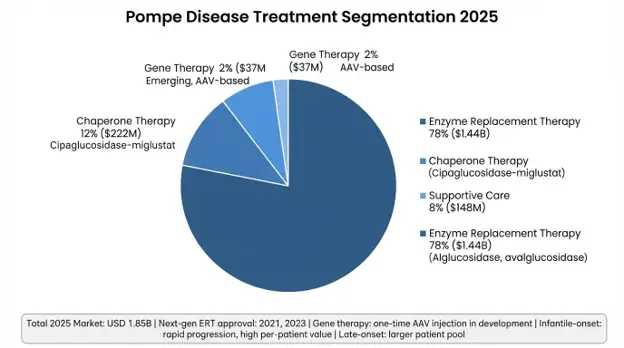
Enzyme replacement therapy still dominates the therapy landscape and includes first generation therapies alglucosidase alfa as well as next generation therapies, such as avalglucosidase alfa and the combination of cipaglucosidase alfa and miglustat. The gene therapy segment, although under clinical development and not being widely commercialized yet, is expected to grow at the highest rate towards the end of the forecast period due to its clinical differentiation from other segments.
The hospitals and metabolic disease centers segment constitutes the largest end-user segment due to the requirement for intravenous infusion in the current standard of care treatments. The home health care segment has emerged as the fastest-growing end-user segment owing to the increasing availability of home infusion therapies for stable patients and fewer visits to facilities.
The Pompe disease market is highly consolidated, with Sanofi occupying a dominant position due to its product range comprising enzyme replacement therapies from first-generation to next-generation drugs owing to its decades-long expertise in the field of Pompe disease and strong connection with the metabolic disease specialist community worldwide. Amicus Therapeutics forms the chief competitor in the commercial arena with its chaperone combination therapy that provides a unique mechanism targeting patients of late onset. The competitive landscape in the coming years will see an increasing number of firms with pipeline molecules for gene therapy and substrate reduction therapy.
You'll get the sample you asked for by email. Remember to check your spam folder as well. If you have any further questions or require additional assistance, feel free to let us know via-
+1 724 648 0810 +91 976 407 9503 sales@intellectualmarketinsights.com
24 Aug 2026
Intellectual Market Insights Research © 2026. All rights reserved.


