Share this link via:

The global Prader-Willi syndrome (PWS) market size was valued at USD 1.5 billion in 2025 and is projected to reach USD 1.65 billion in 2026, expanding to USD 3.4 billion by 2034, growing at a CAGR of 9.5% during the forecast period (2026-2034).
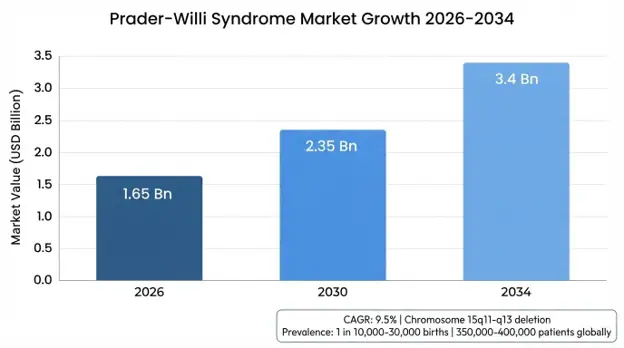
PWS is a rare, complex neurodevelopmental and multisystem genetic disorder due to a loss of function of paternally expressed imprinted genes on chromosome 15q11-q13. The condition occurs in three main ways: the critical region is deleted from the father in about 65-75% of cases; the critical region is uniparental, from the mother, in about 20-30% of cases; or there is a defect of the imprinting center in the remaining 1-3% of cases. PWS is estimated to affect 1 in 10,000 to 1 in 30,000 live births and is known to afflict some 350,000-400,000 people globally, making it one of the most clinically important genetic causes of severe childhood obesity and lifelong multisystem morbidity.
The clinical course of PWS is a characteristic biphasic one that is based on hypothalamic dysfunction. Infants are usually born with severe hypotonia, weak suck reflexes, and feeding problems, which often require tube feeding and extended neonatal hospitalizations. As affected children enter early to middle childhood, the phenotype shifts towards hyperphagia, an abnormal and excessive drive to eat, characterized by hypothalamic satiety signaling deficits and dysregulated ghrelin secretion, which, if left unchecked by a strict environment and diet, quickly results in serious obesity and associated cardiometabolic, respiratory, and orthopedic problems. Other characteristic features include growth hormone deficiency and short stature; universal hypogonadism resulting in delayed or incomplete puberty; mild to moderate mental retardation; and a unique behavioral phenotype, with emotional lability, rigidity, obsessive-compulsive tendencies, and skin picking, and individuals with the uniparental disomy subtype being more susceptible to psychosis and autism spectrum features.
Until now, management of PWS has been largely dependent on the use of recombinant human growth hormone (rhGH) therapy, which was first approved specifically for PWS-related growth failure in 2000; on the strict control of food access; on multidisciplinary behavioral support; and on treatment of associated endocrine, orthopedic, and psychiatric co-morbidities. This mainly symptomatic and supportive treatment paradigm is in the process of a paradigm shift (2025) with the approval of the first specific pharmacologic treatment for hyperphagia in PWS, the diazoxide choline-controlled release. This pivotal regulatory milestone has sparked a surge in investment in oxytocin analogs, melanocortin pathway modulators, and GLP-1-related candidates, moving from simply controlling the environment to precision neuroendocrine modulation.
The PWS market falls into a niche that is divided among rare disease medicines, pediatric endocrinology, metabolic medicine, and neuropsychiatry. Chronic rhGH therapy and hormone replacement continue to be the foundation of revenue, with the most dynamic growth anticipated in the hyperphagia therapeutics market, which targets orphan patient populations at a premium price, and an expanding pipeline of behavioral and psychiatric products, specifically tailored to the orphan population defined by this rare genetic disorder. The innovative therapy segment is expected to grow by double figures throughout the forecast period, driven by the orphan drug incentives, well-organized patient advocacy groups, and increased awareness among payers about the significant morbidity and burden of caregivers' lives caused by uncontrolled hyperphagia.
| Report Coverage | Details |
|---|---|
| Base Year | 2025 |
| Base Year Value | USD 1.5 billion |
| Forecast Value | USD 3.4 billion |
| CAGR | 9.5% |
| Forecast Period | 2025-2034 |
| Historical Data | 2022-2025 |
| Largest Market | North America |
| Fastest Growing Market | Asia Pacific |
| Segments Covered | By Treatment Type, Age Group, Route of Administration, End-User |
| Region Covered | North America, Europe, Asia Pacific, Middle East & Africa, Latin America |
| Countries Covered | US, Canada, Mexico, UK, Germany, France, Italy, Spain, China, Japan, India, Australia, South Korea, Brazil, UAE, Saudi Arabia, South Africa |
| Key Market Playes | Pfizer Inc., Novo Nordisk A/S, Sandoz Group AG, Soleno Therapeutics Inc., Rhythm Pharmaceuticals Inc., Levo Therapeutics Inc., Acadia Pharmaceuticals Inc. |
Get more details on this report - Request Free Sample
The increasing use of DNA methylation testing and chromosomal microarray testing as primary diagnostic tests for infants showing hypotonia without any known cause has reduced the diagnostic delay that was once associated with PWS by several years. Early diagnosis allows early treatment of the condition with rhGH, which gives better results when the treatment is started before age two. Diagnosed patients can benefit from early referral to appropriate multidisciplinary treatment programs. The population of treated individuals continues to increase.
The approval of diazoxide choline controlled-release treatment for hyperphagia in 2025 is the most groundbreaking growth factor for the PWS market during the forecast period, given that it marks the first-ever approved pharmacological solution to one of the most life-threatening and life-quality-compromising aspects of the disorder. Positive results from clinical trials in terms of the decrease in caregiver-measured scores for hyperphagia, as well as improvements in body composition, have created substantial demand on both doctors and caregivers. The approval has spurred concurrent development of oxytocin analogues and appetite pathway regulators.
The primary limitation for market growth in PWS is the condition’s extremely rare occurrence, which restricts the business scale and makes it difficult to support the development of a dedicated drug due to economic considerations. Treatment with rhGH per year costs from USD 25,000 to USD 50,000, while recently approved hyperphagia treatments have much higher prices, thus posing significant difficulties with payer acceptance due to the limited budget for treating rare diseases. European health technology assessment organizations are becoming stricter with cost-effectiveness requirements, while the treatment with rhGH for adults has inconsistent coverage across countries because of the lack of data about the benefits of such therapies. Additionally, the complex, multi-systemic character of PWS requires coordinated efforts of endocrinologists, psychiatrists, dietitians, and behavioral experts.
Apart from the first hyperphagia medication approved, there remains much room for development regarding drugs like oxytocin pathway agonists, GLP-1 receptor agonists, and melanocortin-4 receptor modulators that could further help reduce food seeking and related behavioral issues, including anxiety, rigidity, and temper dysregulation. Furthermore, weekly administered formulations of recombinant human growth hormone may offer a promising approach toward reducing the need for daily injections. In the long run, the genetically confirmed etiology of PWS can make this disease an interesting subject for early research regarding gene and epigenetic editing, aiming at reactivation of the inactive maternal gene.
Since there is an FDA-approved therapy for hyperphagia, the treatment of PWS patients is shifting from concentrating mainly on restricting their food intake and monitoring by guardians to medication and behavioral therapies together. This is in the context of a growing number of clinics for adults with PWS since the better treatment they have been receiving has made them reach adulthood.
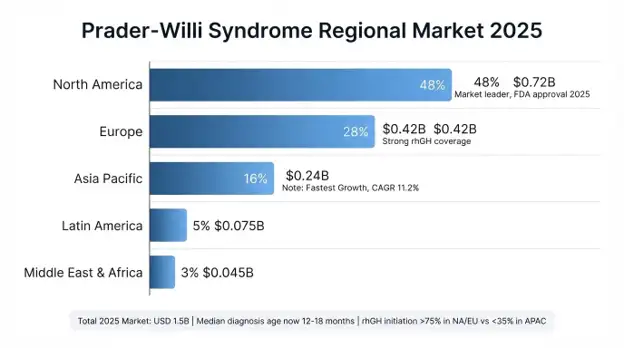
North America dominates the market share for PWS due to the existence of newborn screening programs that test the genetic makeup of babies at birth; rhGH reimbursements; the existence of rare disease treatment centers; and patient advocacy groups that have a role in shaping the conduct of clinical trials. The US is the home of most of the PWS clinical trials carried out globally and is also the first country to give regulatory approval to hyperphagia medication.
Asia Pacific is the fastest-growing region because of increased testing facilities, increased awareness about rare diseases amongst pediatricians, and good reimbursement structures. Inclusion of PWS in the rare disease list in China has hastened the process of access to testing and growth hormone reimbursement, whereas Japan continues to have an advanced system of rare disease management and participates in international clinical trials.
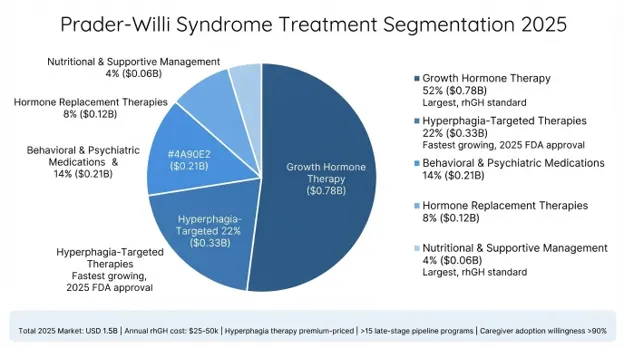
Treatment Type Insights: GHT still accounts for the largest portion of the market on the back of two decades of proven clinical data, familiarity with the treatment option, and growing biosimilar supply. HTA is the most rapidly growing portion of the market due to recent regulatory approval, large unmet need, and premium pricing opportunity. B&PM and HRT are also important segments, though mainly used as off-label treatments.
Age Group Insights: The pediatric segment accounts for the highest market share revenue due to early rhGH administration and high intensity of early intervention therapy. The adult segment represents the most rapidly growing market due to improved survival rates, expansion of adult care treatment, and need for hormone replacement therapy.
End-User Insights: Hospitals & Specialty Clinics make up the biggest end-user category, considering the need for multidisciplinary knowledge needed in diagnosing and treating, while home healthcare continues to grow, as there is a shift to home care for long-term rhGH therapy and management of chronic conditions.
The global PWS market is composed of mature growth hormone firms alongside an emerging group of biopharmaceutical firms specializing in treating rare diseases who are developing treatments for hyperphagia and behavioral disorders. Competitive differentiation will be centered on the quality of clinical evidence on subjective behavioral and appetite measures, regulatory designation, and the strength of relationships with PWS specialty clinics and patient advocacy groups that drive recruitment.
April 2026 – The European Marketing Authorization Application for Viokat® (diazoxide choline) submitted by Soleno Therapeutics to the European Medicines Agency (EMA) was withdrawn, putting a hold on the commercialization of the product in Europe, although VYKAT XR is still commercially available in the USA.
May 2026 – A full clinical hold on the Phase III ARD-101 program for Aardvark Therapeutics was issued by the U.S. FDA due to cardiac safety observations in healthy volunteers, putting development of an important emerging therapeutic for hyperphagia associated with PWS on hold.
June 2026 – Rhythm Pharmaceuticals announced positive interim Phase II results for setmelanotide in Prader-Willi syndrome patients at ENDO 2026, revealing clinically meaningful reductions in body weight, fat mass, hyperphagia, and anxiety scores, indicating further progression into Phase III development.
June 2026 – Soleno Therapeutics released new long-term VYKAT XR results at ENDO 2026 with data showing sustained efficacy on hyperphagia and behavioral symptoms out to 3 years.
You'll get the sample you asked for by email. Remember to check your spam folder as well. If you have any further questions or require additional assistance, feel free to let us know via-
+1 724 648 0810 +91 976 407 9503 sales@intellectualmarketinsights.com
24 Aug 2026
Intellectual Market Insights Research © 2026. All rights reserved.