Share this link via:

The global progressive supranuclear palsy market was valued at USD 231 million in 2025 and is projected to reach USD 313 million in 2026, expanding to USD 550 million by 2034, growing at a CAGR of 10.4% during the forecast period (2026-2034).
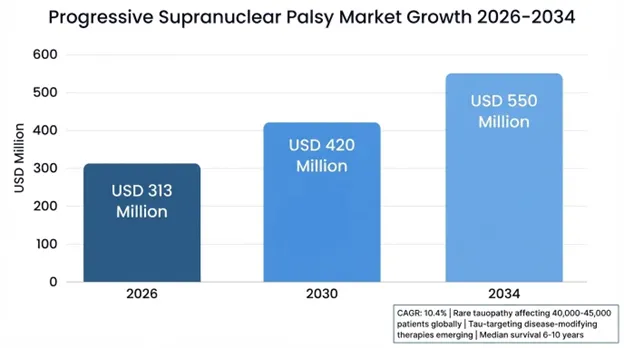
Progressive supranuclear palsy is a rare neurodegenerative disorder that affects the basal ganglia, midbrain and brainstem regions that regulate eye movements, motor coordination and cognition, and is characterized by the accumulation of abnormal tau protein in these areas. Clinical features include supranuclear vertical gaze palsy, which is a hallmark distinguishing PSP from Parkinson's disease and other atypical parkinsonian syndromes, progressive postural instability with falls occurring early (usually within 3 years after onset), motor slowing and rigidity causing difficulties with voluntary movement control, cognitive decline (executive dysfunction and behavioral changes), and dysarthria and dysphagia (alteration of speech and swallowing function control) as part of brainstem nuclei involvement. The disease is characterized by progressive neurotoxicity, and typically a person survives 6 to 10 years after the onset of symptoms, of which the most common is Richardson syndrome, which accounts for about 50% of the cases of PSP, featuring early supranuclear gaze palsy, frequent falls, and parkinsonism.
Current therapies for PSP include a range of potential treatments for underlying tau pathology and include symptom-directed treatments for progressive motor and cognitive symptoms. New emerging therapies for treatment of tau are disease-modifying therapies, including tau aggregation inhibitors (FNP-223) that prevent tau protein misfolding and its aberrant polymerization; antisense oligonucleotides (NIO752) that reduce pathological tau protein synthesis by selectively targeting RNA; O-GlcNAcase inhibitors (AZP-2006, ASN90) that enhance degradation of tau protein in the lysosomes; and monoclonal antibodies targeting pathological tau species. Palliative therapeutics targeting motor dysfunction include dopaminergic agents (levodopa), which have shown modest improvement in a subset of patients; anticholinergic agents, which modulate central cholinergic tone; amantadine, which has several actions on motor function; and neuroleptic agents, which help control behaviors. Various special interventions that are only applicable in selected patients, such as selective serotonin reuptake inhibitors for depression and behavioral dyscontrol; tricyclic antidepressants for anticholinergic effects as an adjunct to primary antiparkinsonian medications; botulinum toxin injection for dystonic features or speech impairments; and invasive surgical therapies such as deep brain stimulation, have shown promise for targeted symptom management.
The commercialization potential is not limited to pharmaceuticals but also to disease management systems that integrate biomarker-driven diagnostic approaches; cutting-edge neuroimaging such as tau positron emission tomography (PET) that provides visualization of pathological tau protein distributions; speech and physical rehabilitation; swallowing therapy for dysphagia complications; cognitive therapy for executive dysfunction; and psychosocial support for psychiatric manifestations. As the market tackles critical unmet medical needs in rare neurological diseases, fewer than 5% of PSP patients get access to disease-modifying therapeutics, presenting a large opportunity to move towards disease-modifying therapeutics that could significantly shift disease course with an estimated total of approximately 40,000 PSP patients worldwide.
| Report Coverage | Details |
|---|---|
| Base Year | 2025 |
| Base Year Value | USD 231 Million |
| Forecast Value | USD 550 Million |
| CAGR | 10.4% |
| Forecast Period | 2025-2034 |
| Historical Data | 2022-2025 |
| Largest Market | North America |
| Fastest Growing Market | Asia Pacific |
| Segments Covered | By Treatment Type, Drug Class, Route of Administration, Clinical Indication Subtypes, End-User |
| Region Covered | North America, Europe, Asia Pacific, Middle East & Africa, Latin America |
| Countries Covered | US, Canada, Mexico, UK, Germany, France, Italy, Spain, Netherlands, China, Japan, India, Australia, South Korea, Brazil, Argentina, UAE, Saudi Arabia, South Africa |
| Key Market Playes | Eli Lilly (FNP-223), Ferrer (ASN90, FNP-223), Ionis Pharmaceuticals (NIO752), Janssen Pharmaceuticals, Biogen, Axsome Therapeutics, AZP-2006 developers, academic medical centers with research programs |
Get more details on this report - Request Free Sample
The main structural factor behind the growth of the progressive supranuclear palsy market is the significantly better recognition and detection of the disease thanks to growing neurological knowledge and advanced criteria for diagnosing. Progressive supranuclear palsy is a highly underdiagnosed condition that was historically characterized by research proving that up to 40-50% of patients with PSP were initially misdiagnosed with Parkinson's disease before developing the characteristic features of the disease, including eye movement impairment and supranuclear vertical gaze palsy, differentiating PSP from Parkinson's disease, which is characterized by relatively good eye movement. The diagnostic criteria of the Movement Disorder Society defined in 2017 allowed creating reliable diagnostic tools that allowed making a proper differentiation between PSP and other phenotypes of atypical parkinsonism such as corticobasal degeneration and multiple system atrophy. Improved accuracy of the diagnostics has a direct positive impact on the growth of the market since it allows increasing patient numbers using several methods, including early treatment providing access to newly developed therapies; increased patient numbers allowing carrying out clinical trials and developing pharmaceuticals; and better allocation of healthcare resources.
The market for progressive supranuclear palsy (PSP) therapy is making great progress with the development of new therapies that target tau and are expected to modify the disease progression process as opposed to alleviating symptoms only. FNP-223 is an orally administered O-GlcNAcase inhibitor that increases the rate of lysosomal degradation of pathological tau protein and has been successfully tested in Phase II and proven its ability to slow down the disease progression process. Phase II clinical study of FNP-223 (PROSPER) included 220 PSP patients; therefore, it may be assumed that its commercialization is expected in the next few years. NIO752 is a proprietary antisense oligonucleotide of Ionis Pharmaceuticals and Janssen Pharmaceuticals, which inhibits tau protein synthesis and has been successfully tested in Phase III development in case of Richardson syndrome. AZP-2006 also showed positive results and proved its ability to slow down the disease.
The most substantial factor hampering the development of the progressive supranuclear palsy market is the rareness of the disease since global incidence figures indicate only 5-6.4 cases per 100,000 people, or 40,000-45,000 people across the globe, in comparison to the more than 10 million who are suffering from Parkinson's disease. It makes the target market quite narrow even in case of high prices on disease-modifying treatments, imposes difficulties for global pharmaceutical companies regarding the economic viability of logistics of product distribution, and implies the necessity to develop an effective design of clinical trials for small sample groups. In addition, the problems related to diagnosis, such as 40-50% cases of initial misdiagnosis of the disease as Parkinson's and average delays in diagnostics by 2-3 years, limit the opportunity to provide patients with timely treatment, to recruit participants in clinical trials, and to open the market window for products.
Important market opportunities arise through the creation of precision medicine technologies that will be able to stratify patients based on biomarker signatures predicting an improved response to targeted therapies. There is evidence of differing distribution of phosphorylated tau biomarkers between PSP phenotypes, where phospho-tau-181 concentrations in cerebrospinal fluid have been shown to be highly predictive of the trajectory of cognitive decline, and phospho-tau-217 provides better discrimination of PSP from other neurodegenerative disorders not involving tau pathology. Using biomarkers as part of the development strategy can help identify patient subgroups that show exceptional response to therapy, thus enabling premium pricing for such targeted drugs.
Biomarkers that are based on blood tests may be used to implement screening programs that will help identify people without symptoms who have abnormal deposition of pathological tau proteins in their bodies and are at an early stage of the disease, which can still be treated using prophylactic therapies. The creation of biomarker panels including several types of tau proteins, such as phosphorylated tau-181, phosphorylated tau-217, phosphorylated tau-199, and total tau, along with neuroimaging studies, may lead to predicting the trajectory of the disease.
Innovations that have revolutionized the progressive supranuclear palsy domain include the development of platform trial designs, which include a number of experimental therapeutics into a single trial framework to make comparative efficacy analysis possible, and adaptive trial designs, where enrollment, dosing, and patient selection are adapted to the interim efficacy and safety information available. The UCSF-led platform trial design stands out as one of the most innovative designs, which involves testing multiple PSP therapeutics in the same clinical trial design, cutting down the drug development process time, reducing costs through shared infrastructure and control participants, and advancing drug development efficiently by facilitating prioritization of patient enrollment. Platform trial designs address inefficiencies associated with the traditional approach where the recruitment, running of trials, and analysis take a period of 5-7 years for each therapeutic agent. This becomes more relevant when the patient pool is limited because of the rarity of the condition, as it facilitates the development of an international registry for patients.
The North American region leads the PSP market, which is estimated at USD 98 million in 2025 and is expected to witness a 9.8% CAGR till 2034. The growth in the region can be attributed to the presence of advanced neurology care facilities, good reimbursements provided by Medicare, Medicaid, and private insurance, and advanced rare disease research facilities. The United States represents almost 78% of the total regional market owing to the presence of prominent movement disorder doctors, advanced diagnostic capabilities of academic centers, and patient advocacy groups.
Europe is the second largest market for progressive supranuclear palsy (PSP), having a market valuation of USD 62 million in 2025 and projected to register a CAGR of 10.1% till 2034. This will be due to the presence of universal healthcare systems, reimbursement for orphan drugs, and the presence of established neurology facilities in countries such as Germany, France, the UK, and Scandinavia. Additionally, Europe has developed PSP research communities, European PSP patient registries enabling clinical trials, top academic organizations studying tauopathy, and orphan drug designation under the European Medicines Agency.
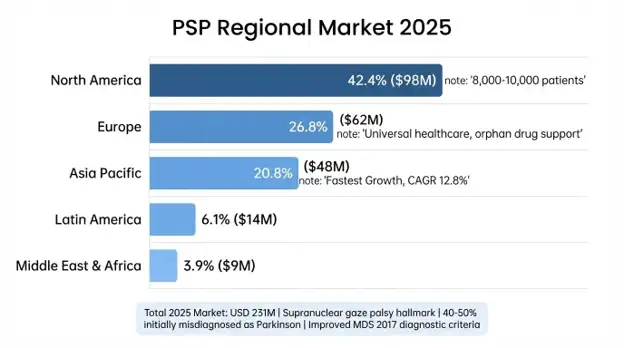
The Asia Pacific region is anticipated to be the fastest-growing market for progressive supranuclear palsy (PSP), which will experience growth at a CAGR of 12.8% till 2034 and reach a market size of USD 148 million. The factors driving growth in this region include healthcare infrastructure development, advancements in the diagnostics of neurological disorders, and an increase in awareness about PSP in China, Japan, South Korea, and India. China is the largest regional market owing to the aging population, reforms in the healthcare sector, and developments in the field of neurological treatment.
Symptomatic treatments have held their position as the largest treatment segment in the progressive supranuclear palsy (PSP) market, capturing 85% of market share and worth USD 196 million in 2025. This treatment segment includes drugs like levodopa, dopamine agonists, anticholinergics, amantadine, antidepressants, and support therapies that help alleviate symptoms. Disease-modifying therapies have the highest growth rate among other segments in the market and are expected to grow at a 24.6% CAGR till 2034. The disease modifying treatment segment is worth USD 35 million in 2025 and includes drugs that target tau protein, such as FNP-223, NIO752, ASN90, and AZP-2006.
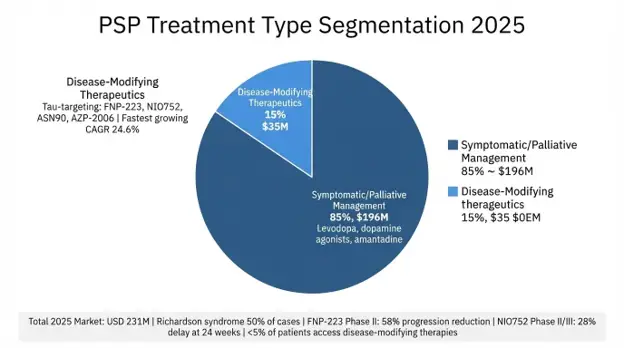
Tau-directed therapies constitute the most revolutionary group of therapeutic drugs in the PSP market, which will exhibit a CAGR of 28.4% until 2034. While constituting only 8% of the market in 2025, they will see rapid growth owing to the impending launches of FNP-223, NIO752, and ASN90. The former class of drugs acts on the removal of toxic tau protein whereas the latter works on the synthesis of tau protein. On the other hand, symptomatic treatments will continue to dominate the market at 62%. However, they will be losing their market share owing to the introduction of disease-modifying therapies.
The Richardson syndrome accounts for 50% market share and is valued at USD 115 million in the year 2025, becoming the major driver for the market in the PSP space. Being the most common form of PSP, it has rapid disease onset along with the highest unmet medical needs. The PSP-parkinsonism subtype accounts for 25% market share and PSP-progressive gait freezing and PSP-speech/language predominant subtype account for 12% and 8% market share respectively. Clinical development efforts have increasingly been centered around Richardson syndrome, with late-stage clinical studies such as NIO752 Phase III targeting the subtype for maximum efficacy.
The major market players in the progressive supranuclear palsy (PSP) sector include hospitals and specialized neurology clinics with a market share of 52% and a value of USD 120 million in 2025. The dominance of hospitals and neurology clinics is fueled by their ability to provide a pool of movement disorder specialists, excellent diagnostic services, interdisciplinary treatment approach, and participation in clinical studies. Research organizations and academic institutions possess 28% of the market due to active research and drug development activities. Home care and community neurology clinics occupy 20% of the market share and will witness steady growth because of the developments in biomarker diagnostics, telemedicine, and distributed patient monitoring systems.
The global progressive supranuclear palsy market shows some concentration, where the main companies involved include Eli Lilly (FNP-223 development), Ferrer (ASN90 and FNP-223 license), Ionis Pharmaceuticals (development of NIO752), Janssen Pharmaceuticals (co-development of NIO752), Biogen, Axsome Therapeutics, and medical universities that conduct PSP research. The competition is notably different compared to bigger neurological disease markets by the presence of research organizations and the CurePSP patient group organization that helps in coordinating therapeutic development and clinical trial recruitment. Differentiation in competition is based on the degree to which the progression of the disease slows down in clinical trials; safety and tolerability of oral drugs that facilitate patient adherence; biomarker engagement as the proof of MOA validation; and clinical trial support for patient recruitment and retention.
December 2025: Positive Phase II/III interim results for NIO752 were reported by Ionis Pharmaceuticals and Janssen in Richardson syndrome patients, which show 28% disease progression delay versus placebo at 24-week interim analysis with good safety profile, thus warranting its further progression to Phase III completion and regulatory filing by late 2026.
November 2025: Positive clinical trial results were announced by Ferrer for FNP-223 at the Tau Global 2025 conference, where it was found to achieve 58% disease progression reduction in the PROSPER Phase II trial after 52 weeks, paving the way for the commencement of Phase III trials in 2026, ending in 2027/202
October 2025: Blood-based phosphorylated tau biomarker validation results showing 94% sensitivity and specificity for PSP diagnosis compared to Parkinson’s disease and healthy controls have been shown, allowing for the implementation of non-invasive biomarkers in PSP diagnosis.
September 2025: Launch of international registry for PSP patients was announced by CurePSP with 85 sites in North America, Europe, and Asia Pacific regions, improving clinical trial recruitment infrastructure as well as disease progression data collection.
August 2025: Academic researchers provided results from tau-PET imaging showing correlation of tau burden with PSP rating scale progression rates, thus allowing use of the tau-PET biomarker in clinical trials as a surrogate endpoint of clinical disease progression.
You'll get the sample you asked for by email. Remember to check your spam folder as well. If you have any further questions or require additional assistance, feel free to let us know via-
+1 724 648 0810 +91 976 407 9503 sales@intellectualmarketinsights.com
24 Aug 2026
Intellectual Market Insights Research © 2026. All rights reserved.