Share this link via:

The global pyruvate kinase deficiency market size was valued at USD 0.85 billion in 2025 and is projected to reach USD 0.98 billion in 2026, expanding to USD 1.99 billion by 2035, growing at a CAGR of 7.32% during the forecast period (2026-2034).
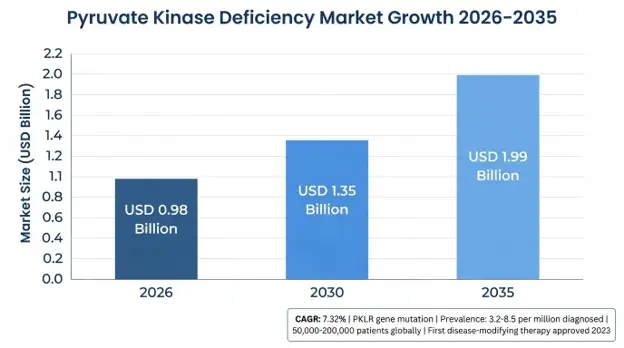
The seven major markets (United States; European Union countries including Germany, France, Italy, Spain, and the United Kingdom; and Japan) specifically reached USD 0.85 billion in 2025, with projections reaching USD 1.26 billion by 2036.
Pyruvate kinase deficiency is a rare genetic disorder that affects the energy metabolism of red blood cells through a compound heterozygous or homozygous mutation of the PKLR gene, which encodes the key enzyme of the glycolysis pathway called pyruvate kinase. Pyruvate kinase deficiency leads to chronic hereditary non-spherocytic hemolytic anemia with a wide range of signs and symptoms of variable severity, including asymptomatic compensated hemolysis up to severe anemia dependent on blood transfusions for lifelong periods. Disease pathology includes lack of pyruvate and adenosine triphosphate in red blood cells along with elevated levels of 2,3-diphosphoglycerate.
Red blood cell transfusions depending on symptom load rather than hemoglobin levels, iron chelation treatment for iron overload from chronic hemolysis irrespective of the patient's history of transfusions, and surgery for splenectomy leading to an increase in hemoglobin in approximately 90% of the cases and sustained postoperative reticulocytosis are all instances of supportive care techniques currently used in the management of this condition. As opposed to the constraints of supportive care in the past, the emergence of disease-modifying drugs in the treatment of the condition, such as allosteric pyruvate kinase activators and gene therapy, constitutes revolutionary treatment strategies.
| Report Coverage | Details |
|---|---|
| Base Year | 2025 |
| Base Year Value | USD 0.85 Billion |
| Forecast Value | USD 1.99 billion |
| CAGR | 7.32% |
| Forecast Period | 2025-2034 |
| Historical Data | 2022-2025 |
| Largest Market | North America |
| Fastest Growing Market | Asia Pacific |
| Segments Covered | By Diagnosis Type, Treatment Type, Disease Severity, Patient Population, End-User |
| Region Covered | North America, Europe, Asia-Pacific, Middle East & Africa, Latin America |
| Countries Covered | US, Canada, Germany, France, UK, Italy, Spain, Netherlands, Japan, China, India, Australia, Brazil, Mexico, UAE, South Africa |
| Key Market Playes | Agios Pharmaceuticals, Rocket Pharmaceuticals, Bristol-Myers Squibb, Pfizer, Novartis, Bayer, Amgen, Sanofi, Roche, Takeda Pharmaceutical, Vertex Pharmaceuticals |
Get more details on this report - Request Free Sample
The market for pyruvate kinase deficiency is expected to witness growth because of increased awareness, advanced diagnostics, and improved recognition of the condition. The condition was previously not well-diagnosed since it was often misdiagnosed as other hereditary types of hemolytic anemia. Availability of enzyme tests, next-generation sequencing, and PKLR genetic tests has helped improve the process of diagnosis. Implementation of newborn screenings and diagnostic criteria has improved diagnosis rates globally. Improved and earlier diagnosis leads to proper treatment and better patient stratification. Awareness of the condition will continue to increase in the future, and this will lead to the diagnosis of more people with pyruvate kinase deficiency, thus driving the growth of the market during the forecast period.
The global pyruvate kinase deficiency market is witnessing a complete revolution due to the emergence of disease-modifying drugs along with the development of gene therapies. Mitapivat (Pyrukynd), the first-ever drug approved as an allosteric pyruvate kinase activator, has exhibited major clinical advantages with the help of better hemoglobin levels, a decrease in hemolysis, and transfusion independence among transfusion-dependent and non-transfusion-dependent individuals. With the help of increasing the enzyme activity directly in the body, the drug helps overcome the metabolic issue and does not offer supportive treatment only. In addition, the gene therapy pipeline, which involves genetically altered autologous hematopoietic stem cells, is at the advanced stages of development and has the potential to offer a cure for the disease.
The most significant factor that will hinder the growth of the pyruvate kinase deficiency market is the extremely low number of global patients, which is estimated to range from 50,000 to 200,000 patients in the world at large regardless of their varying severity levels. This means that the market will be very small compared to other chronic diseases. This rarity affects the focus of pharmaceuticals on this condition since, despite having high prices, the total market size revenue for such rare diseases is way too small compared to that of other non-rare diseases. Around 8,000-12,000 people in the US have been estimated to be suffering from pyruvate kinase deficiency, which is the largest national market in the world. The European markets consist of 6,000-10,000 diagnosed patients, whereas the Asian markets have 3,000-6,000 diagnosed patients.
The extreme scarcity leads to orphan drug development processes that have longer timelines, uncertain regulations for trials suitable for small populations, and low financial returns due to the lack of incentives for developing multi-indication drugs. Moreover, the heterogeneous presentation of the disease in different forms (asymptomatic compensated disease, intermittently transfused disease, transfusion-dependent disease, and post-splenectomy disease with different reactions) subdivides the already scarce patient population into several dozen or even hundreds of people per group in one country.
Several business opportunities are present in the development of systematic recognition programs and the creation of molecular testing capabilities in the developing healthcare marketplaces where pyruvate kinase deficiency is not yet diagnosed properly. Diagnostic rates in developed countries are relatively low at the current time, with statistics indicating that only about 20-35% of patients are correctly diagnosed, thus leaving a great number of undiagnosed cases available for further identification. Developing Asian markets such as China, India, and Southeast Asian countries have no developed mechanisms for diagnosing the disease, genetic testing availability, and proper knowledge in hematologists and pediatricians regarding the condition. The development of cost-efficient molecular diagnostic tests, including enzyme activity tests, genetic tests, and other similar testing methods, represents business opportunities in the field for diagnostic and molecular testing laboratories. Partnership programs between the developed country clinics and the developing market healthcare institutions could be a way to establish diagnosis and begin treatment in patients from underdeveloped regions.
The pyruvate kinase deficiency market is witnessing a revolution in the form of the development of the oral allosteric pyruvate kinase activator, which is for the first time acting as a disease-modifying treatment modality. The approval of mitapivat has proved the efficacy of this therapeutic approach through its ability to increase the activity of pyruvate kinase enzymes, increase hemoglobin, and decrease hemolysis without fixing the genetic abnormality. Clinical trials have shown sustained efficacy in the form of low bilirubin levels, reduced reticulocyte count, and need for transfusions. Oral administration makes it much more convenient than other therapeutic methods like injections or cell therapy. There are some next-generation pyruvate kinase activators that have entered clinical trials and would soon change the dynamics of this market.
The diagnostic tests for the pyruvate kinase deficiency are dominated by genetic tests due to their reliability and the rising prevalence of PKLR mutation analysis for diagnosis confirmation. The testing of enzyme activity remains an important test when it comes to evaluation of the functioning of the enzyme and the detection of the disease. Regular blood tests, like hemolysis tests and reticulocyte counts, help confirm the first diagnosis and monitor the course of the condition, while bone marrow testing is used in complicated cases only.
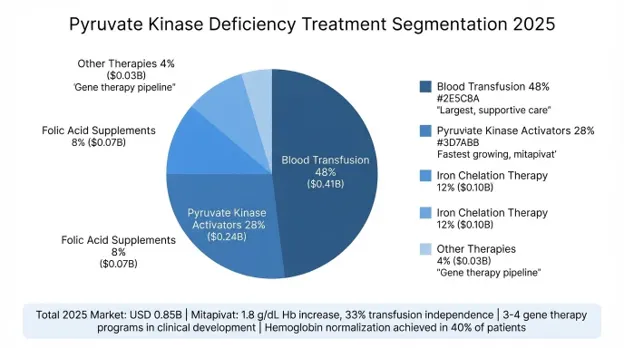
As the main supportive therapy in treating the disease among symptomatic anemia and transfusion-dependent cases, blood transfusions remain the biggest treatment segment within the pyruvate kinase deficiency market. The fastest growing segment in the market is pyruvate kinase activators, which include the drug mitapivat, owing to their growing utilization and ability to change the illness. Although bone marrow transplantations are applied in exceptional cases, folic acid remains a supportive treatment due to its prevention of folate deficiencies. With the growing development in the clinical phase towards commercialization, gene therapy has become a new market that holds great potential for growth.
Transfusion-dependent disease has a 48% market share worth USD 0.41 billion in 2025, which includes patients needing regular transfusions of blood (once every two weeks to one month) to keep their hemoglobin level over 9-10 g/dL to avoid symptoms of anemia complications. The Non-Transfusion-Dependent Disease has a 38% market share worth USD 0.32 billion in 2025 with a 7.8% CAGR till 2035, comprising patients compensated for hemolysis and a hemoglobin level of 8-10 g/dL but no requirement for transfusion but suffering from symptomatic fatigue. Asymptomatic compensated hemolysis has a market share of 14% worth USD 0.12 billion in 2025, which includes the mild disease phenotype having a hemoglobin level of 10-12 g/dL.
The pediatric population holds 38% of the market share, worth USD 0.32 billion by 2025, which consists of children with pyruvate kinase deficiency and requires testing of infants and subsequent diagnosis and treatment during the childhood period. The adult population holds 42% of the market share worth USD 0.36 billion in 2025, which consists of adults with long-term disease and involves issues regarding their career, fertility, and quality of life. The geriatric population is the fastest-growing market segment, holding 20% of the market share, worth USD 0.17 billion in 2025, with a 9.2% CAGR until 2035 due to the aging of the previously diagnosed patients who now suffer from comorbid conditions along with pyruvate kinase deficiency, such as heart, kidney, and endocrine disorders.
Hospitals & Specialty Clinics hold the leading position as the end-user segment with a 58% market share worth USD 0.49 billion in 2025 that includes tertiary care hematology centers, academic medical centers, and children's hospitals offering diagnosis, treatment, and disease surveillance. Hemophilia Treatment Centers and Rare Bleeding Disorders Centers have a 22% market share worth USD 0.19 billion in 2025 that includes specialty clinics specializing in hemolytic anemias caused by genetic factors and hematological conditions. Research institutes account for 12% market share, worth USD 0.10 billion, in 2025. Home healthcare services have an 8% market share worth USD 0.07 billion in 2025 that represents a growing end-user segment due to rising usage of oral pyruvate kinase activators and home iron chelation therapy.
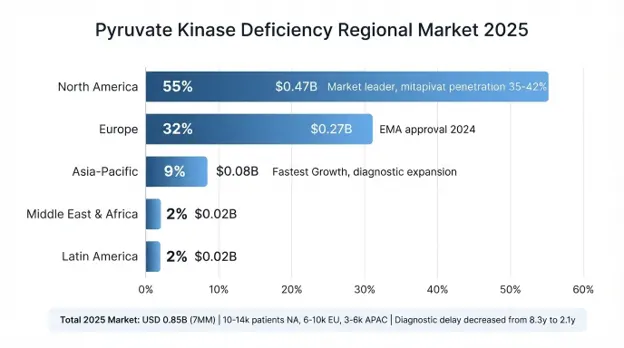
North America dominates the global market for pyruvate kinase deficiency owing to its expertise in rare diseases and effective hematology, along with reimbursement policies for orphan drugs. Considering patient registries, availability of genetic testing, and fast adoption of disease-modifying drugs such as mitapivat, the US holds the largest share in the region. The dominance of North America in the market will be accentuated throughout the forecast period due to FDA regulations, including orphan drug designation and breakthrough therapy designation.
Europe is a large share of the global market for pyruvate kinase deficiency because of the presence of great hematology centers in the region, rare disease legislation, and the increased availability of advanced therapies. With their diagnostic abilities, network of specialists, and extensive clinical trials, Germany, France, and the UK are leading countries in Europe. Regulatory support by the European Medicines Agency and patient support groups continue to increase awareness about the diseases and improve access to therapy. Increasing use of disease-modifying therapies is expected to drive steady growth of the market through the forecast period, despite the difference in the reimbursement process in different countries.
Asia Pacific holds the position of being the fastest-growing region in the world’s pyruvate kinase deficiency market due to increased development of healthcare facilities, growing utilization of genetic testing, and investments in rare disease management. The leading country in the region is Japan, which has high-quality capabilities for diagnosis and pharmaceutical innovations; other countries, such as China and India, provide considerable potential for growth through healthcare transformation and better access to molecular diagnosis. There are numerous patients who have not been diagnosed yet but whose diagnosis and treatment will be facilitated by increased physician awareness.
A market share of 4%, worth USD 0.03 billion, is held by the Middle East & Africa and Latin America in 2025 with a 6.2% CAGR. These regions have large numbers of undiagnosed pyruvate kinase deficiency patients owing to poor health care systems and lack of knowledge regarding rare diseases. The growth of the market in the future will rely upon improved availability of diagnostic tools, programs for rare diseases, and market entry by pharmaceutical companies into emerging health care systems.
The competitive intensity of the global market for pyruvate kinase deficiency is relatively low compared to larger treatment areas because Agios Pharmaceuticals has been able to establish market dominance through its early mover, Mitapivat, launch. The market has shown some features of emerging rare disease therapy markets characterized by dominance among those that have received regulatory approval and large market opportunities for those that are successful at becoming the follower in development. Competitive advantages are based on effectiveness advantages proven in clinical trials; innovative therapies such as allosteric activators rather than gene therapy methods; access programs overcoming reimbursement issues; and overall support services.
June 2024: The European Medicines Agency approved Mitapivat (Pyrukynd) for adult patients with pyruvate kinase deficiency who have hemolytic anemia, making the treatment commercially available in the member countries of the European Union in the coming years of 2024 to 2025.
March 2024: Agios Pharmaceuticals reported extended follow-up results of mitapivat Phase III clinical trials showing a hemoglobin response of up to 24-36 months along with reduced transfusion burden and a good safety profile in the long term.
December 2023: Mitapivat (Pyrukynd) gains FDA approval as a disease-modifying drug for pyruvate kinase deficiency in adults suffering from hemolytic anemia; this approval marks a major step forward in the treatment of a rare inherited condition that was previously addressed only with supportive care options.
September 2023: Positive interim results of Rocket Pharmaceuticals' Phase I trials in RP-L301 gene therapy program indicate exceptional effectiveness in treating patients with transfusion independence and normalization of hemoglobin levels.
May 2023: FDA awards Rocket Pharmaceuticals’ RP-L301 gene therapy with RMAT (Regenerative Medicine Advanced Therapy) designation for treating pyruvate kinase deficiency on account of high safety and efficacy outcomes of the current Phase I trial.
You'll get the sample you asked for by email. Remember to check your spam folder as well. If you have any further questions or require additional assistance, feel free to let us know via-
+1 724 648 0810 +91 976 407 9503 sales@intellectualmarketinsights.com
24 Aug 2026
Intellectual Market Insights Research © 2026. All rights reserved.