Share this link via:

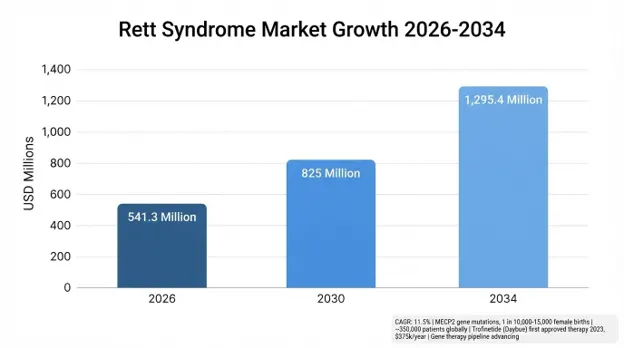
The global Rett syndrome market size was valued at USD 485.5 million in 2025 and is projected to reach USD 541.3 million in 2026, expanding to USD 1,295.4 million by 2034, growing at a CAGR of 11.5% during the forecast period (2026–2034).
In humans, Rett syndrome is a rare, severe, and progressive neurodevelopmental disorder caused primarily by de novo mutations in the X-linked gene encoding the methyl-CpG-binding protein 2 (MECP2) affecting one in 10,000 to 15,000 female live births and affecting about 350,000 people worldwide. It is almost exclusively found in females; in males, hemizygous mutations of MECP2 are usually more severe and can cause neonatal encephalopathy, a disorder that is often fatal, thus limiting the survival rate. After seemingly normal early development (between 6 and 18 months), affected children regress rapidly, losing purposeful hand use and spoken language and developing stereotypic hand gestures like wringing or clapping, altered gait, autonomic dysfunction and breathing irregularities, seizures, scoliosis, gastrointestinal dysfunction, and severe cognitive and motor impairment that requires lifelong, comprehensive care.
No disease-specific pharmaceutical intervention that could target the underlying molecular cause of Rett syndrome was available, and all treatment options were limited to symptomatic and supportive measures: antiepileptic drugs for controlling seizures, GI drugs for reflux and constipation, respiratory support for autonomic instability, and physical, occupational, and speech therapy for motor and communication preservation. This situation drastically altered in March 2023 when the first therapy specifically approved for patients with Rett syndrome, two years of age and older, was approved—trofinetide, known as Daybue. The synthetic analogue of the amino-terminal tripeptide of IGF1, trofinetide, targets neuroinflammation and promotes neuronal function and, at a commercial price of around USD 375,000 each year, sets the price and reimbursement floor for later disease-modifying drugs in this extremely rare disease.
The forecast period is forecast to see a shift from solely palliative and symptomatic management to a multi-layered therapy strategy involving gene replacement therapies, a growing pipeline of antisense oligonucleotide therapies, and small molecule modulators of MECP2-dependent pathways. Increased availability of next-generation sequencing and targeted MECP2 testing has continued to shorten diagnostic delays, and increased survival to adulthood through better seizure, respiratory, and nutritional management and continued biopharmaceutical investment spurred by growing availability of orphan drug incentives (including market exclusivity, tax credits, and priority pathways to regulatory approval across major regulatory jurisdictions) has continued to support growth.
The market for Rett syndrome is not just about sales of the individual drug but also a broader rare-disease ecosystem including genetic diagnostic services, specialized multidisciplinary Rett clinics, rare disease patient registries, and caregiver support programs, all contributing to improved clinical outcomes and to the enormous physical, emotional, and economic burden faced by families affected by the syndrome. With its scientific validation as a tractable therapeutic target, high unmet medical need, and robust patient advocacy infrastructure, it remains to be noted that despite its small patient population, it continues to attract high levels of investment from established biopharmaceutical companies, as well as specialized rare-disease developers.
| Report Coverage | Details |
|---|---|
| Base Year | 2025 |
| Base Year Value | USD 485.5 Million |
| Forecast Value | USD 1,295.4 million |
| CAGR | 11.5% |
| Forecast Period | 2025-2034 |
| Historical Data | 2022-2025 |
| Largest Market | North America |
| Fastest Growing Market | Asia Pacific |
| Segments Covered | By Treatment Type, Type, Route of Administration, Distribution Channel, End-User |
| Region Covered | North America, Europe, Asia Pacific, Middle East & Africa, Latin America |
| Countries Covered | US, Canada, Mexico, UK, Germany, France, Italy, Spain, Netherlands, China, Japan, India, Australia, South Korea, Brazil, Argentina, UAE, Saudi Arabia, South Africa |
| Key Market Playes | Acadia Pharmaceuticals Inc., Taysha Gene Therapies, Neurogene Inc., Anavex Life Sciences Corp., Ovid Therapeutics Inc., GW Research Ltd. (Jazz Pharmaceuticals) |
Get more details on this report - Request Free Sample
An important factor contributing to the structure of the Rett syndrome market is the increase in the diagnostic precision that has been attained due to the increased use of next-generation sequencing panels and MECP2 gene test kits for specific testing. On average, it took from two to five years to diagnose the syndrome after its onset, while affected patients were being treated in an inconsistent manner using various diagnoses like autism spectrum disorders, cerebral palsy, or simply developmental disorders without any specification. With time, genetic testing panel coverage has been increasing, and now, it takes only about one year to diagnose the disease after recognizing its symptoms.
International registries, such as those facilitated by the International Rett Syndrome Foundation as well as the US, UK, and Australian national registries, include information on thousands of patients with proven MECP2 mutations, providing important natural history data for clinical trials, regulatory filing, and reimbursement negotiations. At the same time, advances in treatment of seizures, respiratory complications, and nutritional problems have increased the life expectancy of patients into their adult years, resulting in a large, treated population of patients that require ongoing treatments.
Key Impact Metrics:
The regulatory approval of trofinetide marks a critical commercial breakthrough that has proved Rett syndrome as a legitimate target for biopharmaceutical investment with accepted clinical endpoints, trial design, and payer reimbursement mechanisms that minimize development risks for future development programs. The Phase III trial that was critical to the drug approval has shown a statistically significant difference in results in the Rett Syndrome Behavior Questionnaire and Clinical Global Impression of Improvement scales, thus offering regulators and payers the first validated measure of efficacy in this particular indication. Adoption of the trofinetide drug in leading commercial insurance companies and publicly funded organizations within a period of eighteen months since the launch proved the continuous demand from families and clinicians for an approved treatment of the disease, encouraging investors in other mechanisms that can complement or evolve trofinetide, such as gene replacement, antisense oligonucleotides, and small molecules acting in MECP2-dependent pathways.
Innovation Impact Indicators:
The key limitation facing the market for Rett syndrome treatment is that of a small and heterogeneous pool of patients, making clinical trials harder to conduct, limiting its commercial appeal, and affecting the ability to negotiate reimbursement even with orphan drug pricing. The relatively few numbers of patients diagnosed with Rett syndrome in the US and Europe usually have to participate in single-arm or externally controlled trials, which are under greater scrutiny from health technology assessment agencies and reimbursement bodies. Furthermore, the development of a gene therapy treatment faces challenges due to the limited therapeutic range for MECP2 expression. The low and high levels of MECP2 protein both lead to serious neurological conditions, necessitating strict regulation of the gene's activity.
Constraint Indicators:
Therapeutic approaches that aim to rectify the problem rather than treat the symptoms of MECP2 deficiency represent an extensive market opportunity. Gene replacement approaches based on delivery of the functioning MECP2 using adeno-associated virus vectors, which include the inclusion of microRNA-regulated sequences for safe maintenance of the physiological expression levels, represent the most innovative approaches in development. Such gene replacement approaches have already reached the phase of early clinical trials.
The antisense oligonucleotide and small-molecule approaches aimed at reactivation of the silenced wild-type allele represent an approach capable, should it prove to be effective, to restore the endogenous expression of MECP2 without the risks of overexpression associated with the gene addition approaches. This alternative, and biologically novel, approach exploits the fact that in the majority of the females suffering from the condition, one of their MECP2 alleles remains normal but is silenced by X-chromosome inactivation. Such approaches, representing a safer and mutation-independent treatment modality, can be applied to all patients with Rett syndrome as they leverage the existing infrastructure of oligonucleotide production and delivery platforms for other CNS indications.
Opportunity Metrics:
The Rett syndrome treatment arena is being transformed through the emergence of a more mature gene therapy pipeline utilizing novel dose regulation technologies for dealing with the tight therapeutic window of MECP2 expression. Examples include TSHA-102 from Taysha Gene Therapies, which is a self-complementary adeno-associated virus serotype 9 product, developed using an auto-regulatory element responsive to microRNAs, and NGN-401 from Neurogene, which is an adeno-associated virus serotype 9 product developed using a novel expression-regulating cassette that aims to prevent overexpression toxicity and ensure proper levels of MECP2 expression to yield better neurological outcomes, with early clinical data pointing to good safety profiles and functional gains in motor and communication function.
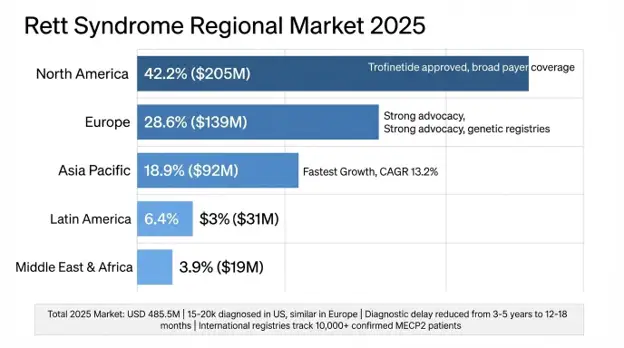
North America held the maximum share in the global Rett syndrome market, worth about USD 205 million in 2025, owing to a CAGR estimated to be about 11.4% till 2034. Market leadership is attributed to the availability of the sole approved disease-modifying treatment; comprehensive insurance coverage from both commercial and government payers; existence of dedicated pediatric neurology and genetics clinics; and existing advocacy infrastructure represented by groups such as the International Rett Syndrome Foundation and the Rett Syndrome Research Trust, which help diagnose and develop registries of patients for recruitment into clinical trials. The United States contributes significantly to regional revenues on account of fast post-approval adoption by payers and a high number of gene therapy companies developing pipeline products.
Key Performance Indicators:
The Asia Pacific region is likely to experience the highest rate of growth amongst all regional markets up to 2034 due to the presence of a strong population base and improving genetic diagnostics capabilities as well as reimbursement for rare diseases in countries such as Japan, China, South Korea, and Australia. Countries such as Japan and Australia that have a developed pathway for the approval and commercialization of orphan drugs are expected to experience faster uptake of approved and emerging disease-specific Rett therapies, while China, due to the increase in rare disease registries and genetic diagnostics capability, is expected to increase the diagnosed pool. Other emerging markets in Asia, such as India, are at an early stage of development, and the focus is currently on building up basic capabilities.
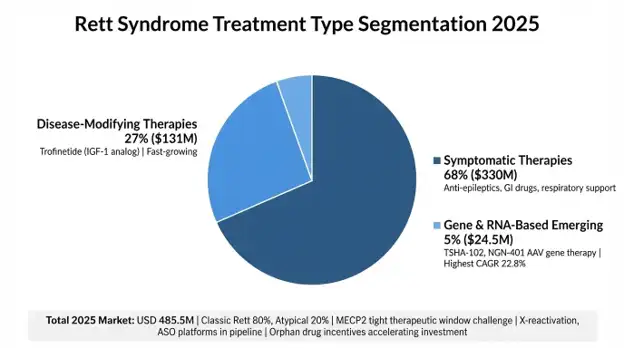
Treatment Type Insights: Symptomatic treatments such as anti-epileptic, gastrointestinal, and psychotropic drugs continue to be the base of Rett syndrome treatments. Trofinetide is leading to fast growth in the approvals of targeted treatments with increasing usage. Gene and RNA-based therapies are expected to grow at the highest rate in the future owing to their clinical pipelines and potential for premium treatment models.
Route of Administration & End-User Insights: The oral route of administration will continue to predominate the market for Rett syndrome due to the prevalence of approved drugs that treat the disorder. Increasing prominence of parenteral and intrathecal routes can be attributed to rising developments in gene and antisense therapies. Inpatient and outpatient facilities are expected to continue as the key end-users, followed by home care centers.
The market for Rett syndrome treatment on a global scale is currently characterized by significant concentration in the disease-modifying therapy space, wherein Acadia Pharmaceuticals holds a unique market presence owing to its drug trofinetide and existing commercial structure in the United States. The overall market scenario is much more fragmented owing to several firms at the clinical development stage focused on various approaches such as gene therapy, antisense oligonucleotides, and small molecules, some of which have Rett syndrome as their main or co-main pipeline indication. Competitive advantage is based on the mechanism of action; clinical efficacy and duration in terms of functional domains such as communication and hand function; safety and tolerability for long-term pediatric use; ease of administration; and supportive evidence.
January 2025: Research and development in the next generation of MECP2 gene therapies advanced with several biotech firms pursuing their preclinical and early-stage research to achieve long-lasting neurological benefits and disease modification.
March 2025: Research teams behind antisense oligonucleotide (ASO) therapies announced further advancements in dose optimization and safety tests that validated the RNA therapy approach for Rett syndrome.
May 2025: Efforts in expanding the availability of trofinetide through commercialization activities advanced in other international markets through regulatory filings, reimbursement conversations, and doctor awareness programs.
July 2025: Partnerships between biotech companies and rare disease research organizations have expedited efforts in biomarker discovery, natural history studies, and patient registries to help conduct clinical trials and regulatory filings in the future.
You'll get the sample you asked for by email. Remember to check your spam folder as well. If you have any further questions or require additional assistance, feel free to let us know via-
+1 724 648 0810 +91 976 407 9503 sales@intellectualmarketinsights.com
24 Aug 2026
Intellectual Market Insights Research © 2026. All rights reserved.