Share this link via:

The global Sandhoff disease market size was valued at USD 274.95 million in 2025 and is projected to reach USD 456.42 million by 2034, expanding at a CAGR of 5.75% during the forecast period (2026-2034).
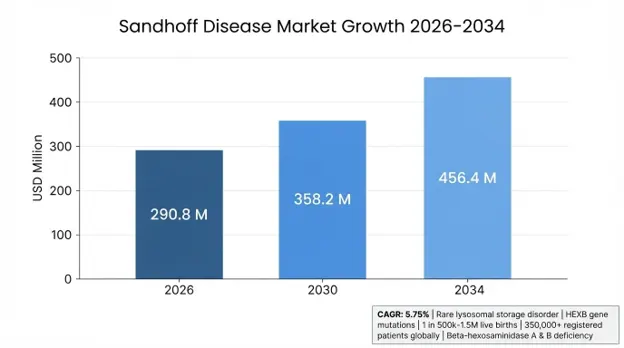
Sandhoff disease is a rare autosomal recessive LSD characterized by a lack of beta-hexosaminidase A and beta-hexosaminidase B enzymes that results in the progressive accumulation of GM2 gangliosides in neural tissues and causes devastating neurological degeneration in children and adults in different ethnic groups.
Sandhoff disease occurs on a clinical continuum ranging from acute-onset infantile disease (in the first six months of life) with rapid neurological progression and death by 3 years to late-onset disease (adolescent and adult) with slowly progressive motor neuronopathy and cerebellar dysfunction that may survive for decades. The disease involves a dysfunction of the lysosomes in multiple organ systems, necessitating a comprehensive multidisciplinary approach to management that includes treatment of seizures, respiratory support, optimization of nutrition, and new disease-modifying therapies with gene therapy, substrate reduction therapy, and enzyme replacement.
The pharmaceutical and therapeutic development environment has shifted dramatically from traditional supportive and symptomatic treatment to novel innovative disease-modifying drugs based on advances in the delivery platforms for gene therapy, viral vector optimization, and central nervous system penetration strategies that hold the promise of tackling the enzymatic deficiency at its core. There are still significant gaps in care and little therapeutic innovation with approved drugs available, and a great deal of research and development is underway at academic institutions and biotechnology firms, aiming to bring a successful long-term therapy to market for this devastating disease affecting families across the world.
| Report Coverage | Details |
|---|---|
| Base Year | 2025 |
| Base Year Value | USD 274.95 Million |
| Forecast Value | USD 456.42 Million |
| CAGR | 5.75% |
| Forecast Period | 2025-2034 |
| Historical Data | 2022-2025 |
| Largest Market | North America |
| Fastest Growing Market | Europe |
| Segments Covered | By Therapy Type, Disease Form, Drug Type, Route of Administration, End-User |
| Region Covered | North America, Europe, Asia Pacific, Middle East & Africa, Latin America |
| Countries Covered | US, Canada, Mexico, UK, Germany, France, Italy, Spain, China, Japan, India, Australia, South Korea, Brazil, Argentina, UAE, Saudi Arabia, South Africa |
| Key Market Playes | Denali Therapeutics, Taysha Gene Therapies, Passage Bio, Orchard Therapeutics, REGENXBIO Inc., Sanofi S.A., Takeda Pharmaceutical, Novartis AG, Amicus Therapeutics, Biomarin Pharmaceutical Inc. |
Get more details on this report - Request Free Sample
Increased awareness of rare lysosomal storage diseases and improved diagnostic capabilities across the globe form the major structural factors responsible for driving the market growth of Sandhoff disease. This trend is particularly evident with the increased number of newborn screening programs that diagnose affected children before the onset of clinical symptoms, as well as genetic screening becoming more accessible within developed and developing healthcare systems. The incidence rate of Sandhoff disease on a global scale is expected to be 1 in 500,000 to 1,500,000 live births. In some groups of people, like the Maronite population of Cyprus, Métis population of northern Saskatchewan, and Creole population of northern Argentina, higher carrier rates can lead to localized disease clusters where efforts to develop specific treatments will be prioritized.
Diagnosis has been accelerated not only for those with early symptoms but also for those who have late-onset symptoms that were previously misdiagnosed as amyotrophic lateral sclerosis and spinocerebellar ataxia and other degenerative disorders. There have been more accurate diagnostic procedures with tests for hexosaminidase A and B enzymes with genetic molecular analysis, which will allow for the diagnosis of people that need therapy when it is available.
Market growth through transformative innovation in the development of gene therapy in the treatment of Sandhoff disease is crucial, as there are a number of clinical programs undergoing Phase 1 and Phase 2 studies using adeno-associated viruses, lentiviral approaches, and new technologies that allow for crossing the blood-brain barrier to provide for therapeutic hexosaminidase B enzyme production in the central nervous system. Results of clinical testing in gene therapy for this disease indicate the capacity to stabilize the disease and even reverse its progression in animals and humans, thus creating a significant market opportunity for transformative or curative approaches to the disease.
Substrate reduction therapy through glucosylceramide synthase inhibitors and the development of enzyme replacement therapy are two paths of therapeutic innovation that run concurrently, with miglustat being considered for treatment of Sandhoff disease using its off-label application because of scientific evidence showing a reduction in the formation of toxic gangliosides. The combination of different forms of therapeutic interventions results in increased market opportunities, and gene therapy enjoys premium pricing due to the difficulty in developing and curing effects.
The most crucial factor that hinders the development of treatment for Sandhoff’s disease and its commercial success is the extremely low incidence rate of this disease, which causes immense difficulty in identifying enough patients for conducting successful clinical studies that prove the effectiveness of the drug. A low number of patients worldwide, belonging to various ethnicities and spread over different regions, makes clinical trials difficult, requires multinational collaboration across different centers specializing in treating neurological disorders, and increases the time required for clinical development of the drug.
Rarity adds complexity to the challenge posed by the need to develop clinical trials and drug candidates for different disease phenotypes characterized by widely varying disease progression rates and treatments needed to treat acute infantile diseases urgently within months after diagnosis compared to later-onset diseases that allow natural history studies for decades, developing their unique clinical development programs for phenotype-specific therapies.
Transformative market opportunities for the development of gene therapies that provide delivery of functional HEXB genes that allow for continuous expression of hexosaminidase B enzymes represent an attractive prospect for offering curative or disease-modifying therapies for the basic enzymatic dysfunction in Sandhoff disease. If successful, gene therapies will be able to offer premium-priced therapies for their curative and disease-stabilization value.
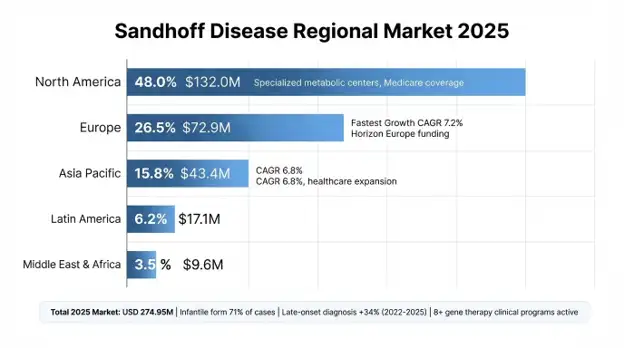
North America held the largest market share of 48% with revenue worth USD 132.0 million in 2025, indicating that the dominance is due to their specialized knowledge regarding rare lysosomal storage diseases, presence of specialist networks for retina and neurology specialties, insurance coverage for diagnostic tests and therapies, and higher concentration of clinical trial sites. The USA comprises 87% of the market value in the region owing to the existence of foundations like Medicare reimbursement, which offer economic incentive to hospitals and specialized centers to set up Sandhoff disease treatment programs.
Metabolic centers and university-affiliated hospitals possessing knowledge of geneticists, neurologists, and neuroradiologists in managing rare neurological disorders have the capability to manage and evaluate the patients for clinical trials and therapeutic procedures.
Europe is anticipated to be the fastest-growing region with a CAGR of 7.2%, attributed to investments in research and development activities, rare disease therapies funded under Horizon Europe, and existing EU rare disease registries, which help in identifying patients for conducting clinical trials. Germany and the United Kingdom spearhead regional growth owing to research activities conducted in universities in the field of gene and substrate reduction therapies.
The region of Asia Pacific showed fast adoption acceleration with a CAGR expected at 6.8% till 2034, owing to increased healthcare infrastructure, a middle-class population that increasingly uses advanced diagnostic services, and the creation of rare disease registries by the governments of China and India to identify patients. The country of India shows promise owing to its cost-effective model for providing care and health insurance scheme Ayushman Bharat.
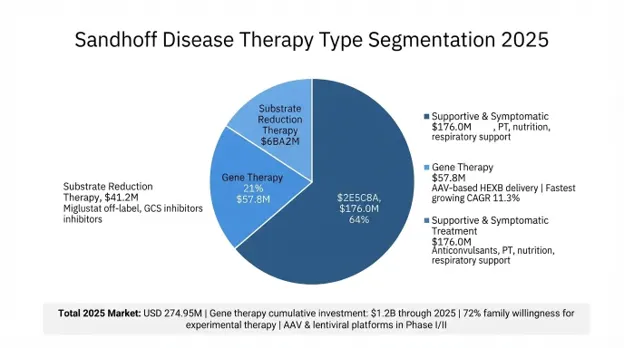
Supportive & symptomatic therapy is the leading therapy type, commanding 64% of the market with an estimated value of USD 176.0 million in 2025, which comprises anticonvulsants, physical therapy, nutrition, and respiratory treatments for the alleviation of disease symptoms without modifying the disease itself. The gene therapy market is expected to grow at the fastest rate, with an 11.3% CAGR from 2025 to 2034.
The infantile Sandhoff disease market shares 71% of the market due to higher detection rates and effective treatments, while the adult-onset disease segment is growing at a CAGR of 8.1% due to rising awareness amongst neurologists about this condition.
Oral is most dominant with a market share of 58% as a result of patient preference for non-invasive delivery of anticonvulsants and adjunctive treatment, whereas intrathecal/intravenous is fastest growing with a 12.4% CAGR due to advancements in gene therapy and enzyme replacement therapy.
Hospitals and specialty clinics have a market share of 58% as the primary location of care for complicated patients, whereas academic medical centers have shown the most rapid growth at a CAGR of 9.7%.
The Sandhoff disease drug development market in the world is moderately concentrated, with key firms such as Denali Therapeutics, Taysha Gene Therapies, Sanofi S.A., and REGENXBIO Inc. holding 52-58% shares in the development pipeline and research spending. The competitive differentiation in this market relies on the efficacy of the gene therapy platform used, production scalability due to rare diseases, regulatory expertise, and alliances with patient advocacy groups.
You'll get the sample you asked for by email. Remember to check your spam folder as well. If you have any further questions or require additional assistance, feel free to let us know via-
+1 724 648 0810 +91 976 407 9503 sales@intellectualmarketinsights.com
24 Aug 2026
Intellectual Market Insights Research © 2026. All rights reserved.