Share this link via:

The global Sanfilippo syndrome (MPS III) market size was valued at USD 218.6 million in 2025 and is projected to reach USD 248.3 million in 2026, expanding to USD 713.5 million by 2034, growing at a CAGR of 14.1% during the forecast period (2026-2034).
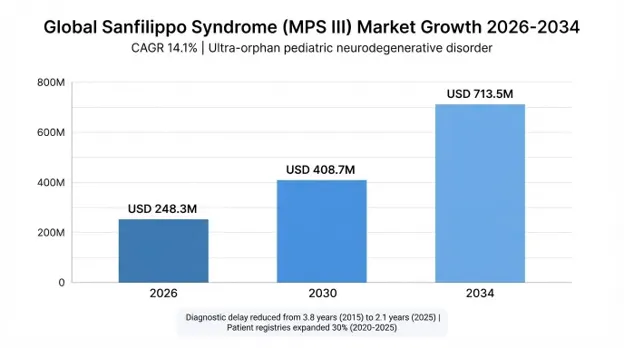
While relatively small in absolute terms to more common therapeutic areas, Sanfilippo syndrome is one of the most dynamic ultra-orphan therapeutic markets in the world, coming to the regulatory table for review as an unparalleled series of gene therapy, enzyme replacement, and substrate reduction programs.
Also known as mucopolysaccharidosis type III, Sanfilippo syndrome is a rare autosomal recessive lysosomal storage disorder. It is a result of the lack of any of four enzymes needed to break down heparan sulfate, a glycosaminoglycan that is found in connective tissue and, crucially, in the central nervous system. The four biochemically distinct subtypes MPS IIIA (heparan N-sulfatase deficiency, SGSH gene), MPS IIIB (alpha-N-acetylglucosaminidase deficiency, NAGLU gene), MPS IIIC (acetyl-CoA:alpha-glucosaminide N-acetyltransferase deficiency, HGSNAT gene), and MPS IIID (N-acetylglucosamine-6-sulfatase deficiency, GNS gene) share a common downstream pathology of progressive heparan sulfate accumulation within neuronal lysosomes, driving relentless neurodegeneration. In contrast to the other mucopolysaccharidoses, which are predominantly somatic and skeletal disorders, MPS III is a predominantly pediatric neurodegenerative disorder, with affected children becoming developmentally delayed early in childhood, losing speech and cognitive and mental abilities with increasing severity, significantly altered behavior, sleep disorders, seizures, and ultimately losing the ability to walk and dying in the second or third decade of life.
The treatments for Sanfilippo syndrome have historically been limited to symptomatic and palliative measures, including behavioral pharmacotherapy, sleep medications, anti-epileptic drugs, orthopedic support, and nutritional support; all are designed to address the symptoms of the disease with no universally accepted disease-modifying approach that could impact the underlying neurodegenerative process. The blood-brain barrier becomes the major therapeutic hurdle as systemically administered recombinant enzymes cannot be delivered to the brain at levels high enough to clear the stored heparan sulfate, making conventional intravenous enzyme replacement therapy, which is effective for other mucopolysaccharidoses, mostly ineffective for the neurological symptoms of MPS III. To bypass this hurdle, researchers are exploring intrathecal and intracerebroventricular enzyme delivery, direct intracerebral delivery, and adeno-associated virus vector-based enzyme replacement therapies designed to result in permanent, perhaps lifelong, enzyme replacement via a single injection.
The market for Sanfilippo syndrome is not just about the current revenue stream, and the relevance of the indication for other neuronopathic LSDs, leukodystrophies, and childhood neurodegenerative disorders is clear. The market is growing not because there are necessarily more patients, but because of the anticipated premium pricing of disease-modifying therapies, which will range from several hundred thousand to several million dollars per patient, like the approved gene therapy pricing of comparably rare neurological diseases. All of this gives the rare disease biopharmaceutical developer a strong rationale to continue investing in these therapies, which are developed for an undeniably small addressable population, in addition to regulatory programs that provide orphan designation, priority review vouchers, and accelerated pathway status.
| Report Coverage | Details |
|---|---|
| Base Year | 2025 |
| Base Year Value | USD 218.6 Million |
| Forecast Value | USD 713.5 Million |
| CAGR | 14.1% |
| Forecast Period | 2025-2034 |
| Historical Data | 2022-2025 |
| Largest Market | North America |
| Fastest Growing Market | Europe |
| Segments Covered | By Subtype, Treatment Modality, Route of Administration, Patient Age Group, End-User |
| Region Covered | North America, Europe, Asia Pacific, Middle East & Africa, Latin America |
| Countries Covered | US, Canada, UK, Germany, France, Italy, Spain, Netherlands, Japan, China, Australia, South Korea, Brazil, UAE, Saudi Arabia |
| Key Market Playes | Ultragenyx Pharmaceutical, JCR Pharmaceuticals, Esteve Pharmaceuticals, Lysogene, Denali Therapeutics, Abeona Therapeutics, Lacerta Therapeutics |
Get more details on this report - Request Free Sample
Market expansion is largely driven by the continuous improvements being made in the diagnostic process, one that has long been affected by the problem of a lag of about three to five years in which neurodegeneration takes place. The increasing reliance on next-generation sequencing panels for developmental delay and newborn screening trials that include heparan sulfate biomarkers, as well as greater awareness among physicians differentiating between MPS III and autism spectrum disorder, are together helping to reduce the time required for diagnosis. Earlier diagnosis leads to a larger patient base that is potentially eligible for investigational drugs when neurologic damage is minimal.
Key Performance Metrics:
The most revolutionary factor is the advancement of the AAV gene therapy program for MPS IIIA and MPS IIIB to the stage where it can be tested for pivotal purposes, providing a real chance for a sustained and disease-modifying treatment through a single administration. In addition to the development of enzyme replacement therapies tailored to have increased uptake into the central nervous system, this represents an alternate treatment approach for patients who cannot undergo gene therapy.
Innovation Impact Metrics:
Inability of systemically delivered large molecules to get access to lysosomal degradation due to the blood-brain barrier is one of the major hurdles impeding the progress of therapy. That hinders the availability of suitable treatment facilities since invasive procedures like intrathecal delivery, intracerebroventricular distribution through surgically placed reservoirs, or intracerebral administration of vectors must be used, and that brings about risks and requires special neurosurgical skills. Apart from complicating repeat dosing, invasiveness entails safety concerns, including neuroinflammation and the immune reaction to viral vectors.
Including Sanfilippo syndrome in newborn screening programs can be a game-changing move that could lead to changing the average time of diagnosis from two to five years to the post-natal stage. Early detection ensures greater efficacy of treatment through gene therapy or enzyme replacement therapy, because such therapies have been found to work most effectively when there is minimal neuronal damage. This will help companies working with diagnostic laboratories and public health institutions to promote MPS III as part of newborn screening programs to significantly increase their target population.
Convection-enhanced delivery techniques, which spread the vectors throughout the parenchyma of the brain by injecting at a few locations, and real-time MR-guided needle insertion, which enhances distribution precision and minimizes trauma associated with the procedure, are only two of the many advanced surgical and vector delivery approaches currently used to administer vectors intracranially or intrathecally. Serotypes with proven potential for efficient neuronal and glial transduction are AAV9 and AAVrh10. The use of second-generation constructs containing CNS-specific promoters and codon-optimized transgenes exhibits much greater enzyme expression compared to first-generation vectors.
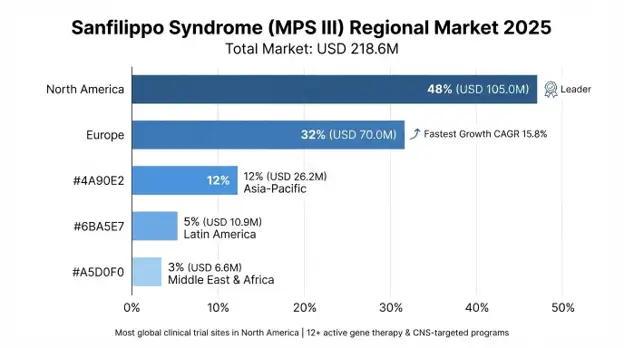
The North American region holds the biggest market share for Sanfilippo syndrome, driven by an extensive academic medical center ecosystem offering specialized care and research for lysosomal storage disorders, solid funding for rare pediatric neurodegeneration disease research, and active patient advocacy groups such as the National MPS Society and Cure Sanfilippo Foundation that fund early-stage research, conduct natural history studies, and recruit patients for trials. Most of the global clinical trial locations for MPS III are in the US, which benefits from a strong regulatory framework for rare diseases and a payer system that, although highly critical of ultra-expensive drugs, has demonstrated its willingness to pay for groundbreaking one-off treatments.
Europe: Fastest-Growing Region Through Collaborative Research Networks: Europe is the fastest-growing region for commercialization due to the presence of research consortia that link specialized centers in several countries for standardizing the collection of natural history data and outcomes. Germany, France, the UK, Spain, and the Netherlands have centers that provide care and conduct research on lysosomal storage disorders, including MPS III. The PRIME scheme of the European Medicines Agency provides scientific and regulatory support to the region, which is also developing capacity for commercialization of research through advanced therapy medicinal products.
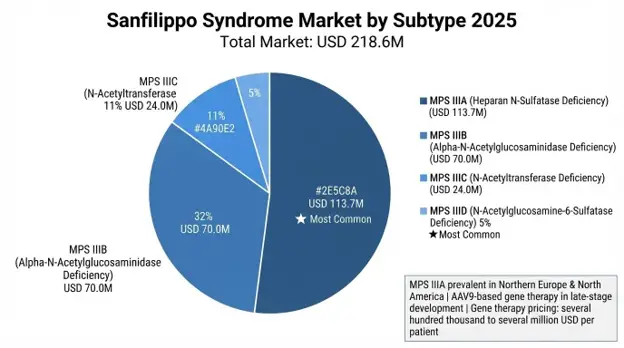
Subtype Insights: MPS IIIA is the most significant and serious subtype segment because of its high prevalence among Northern European and North American populations, along with the rapid neurodegeneration process associated with it, which has made most of the clinical research investment focus on this subtype. On the other hand, MPS IIIB is the second-largest subtype segment because of the presence of various active gene therapies for this subtype along with the varied clinical profile of the subtype. The combined MPS IIIC and MPS IIID segments have less market value because of the relatively rare occurrence of these subtypes.
Treatment Modality Insights: Symptomatic & Supportive Treatment is likely to continue to occupy a major part of the total market value due to the lack of any globally approved disease-modifying treatment and includes the use of antiepileptic drugs, sleep and behavior pharmacology treatments, and palliative treatment, which nearly all diagnosed patients need. Gene therapy is likely to be the fastest-growing segment due to the cost incurred in conducting clinical trials and the income generation after approval for sale during the latter years of the forecast period due to the high premium per dose charge.
End-User Insights: Academic and research centers form the leading segment of end-users due to the predominance of diagnoses, clinical trials, and specialized treatment in the limited set of rare disease reference centers. Hospitals & specialty clinics make up an important secondary segment by virtue of their continuous symptomatic treatment and monitoring of patients after the treatment. Home healthcare is a growing end-user segment, mainly on account of palliative treatment requirements of the disease progression.
The global Sanfilippo syndrome marketplace continues to be highly fragmented at the clinical stage and is led by specialized biotech companies, university startups, and gene therapy platform developers as opposed to diversified big pharma companies; the pipeline is still at an early stage, and the marketplace is niche in size. The factors that distinguish competition in the marketplace include vector delivery technology, clinical efficacy data maturity, number of regulatory designations, and manufacturing capability for advanced biologics and gene therapies.
March 2026: Ultragenyx Pharmaceuticals provided updated long-term follow-up results from its AAV9-based gene therapy program for MPS IIIA, showing a sustained decrease in biomarkers and stabilization of adaptive behavior scores among patients receiving treatment. The company is continuing its regulatory interactions with the FDA and the EMA.
January 2026: JCR Pharmaceuticals progressed its BBB-crossing enzyme replacement drug candidate, using its proprietary transport vehicle system, to further clinical testing for MPS IIIA due to promising CSF biomarker results.
November 2025: Esteve Pharmaceuticals and collaborators published positive safety and biodistribution results from their intracerebral AAV9 gene therapy program for MPS IIIA, reaffirming the use of convection-enhanced delivery strategies.
September 2025: National MPS Society and Cure Sanfilippo Foundation issued a joint statement about increased grant funding towards natural history study, biomarker standardization, and substrate reduction therapy development.
You'll get the sample you asked for by email. Remember to check your spam folder as well. If you have any further questions or require additional assistance, feel free to let us know via-
+1 724 648 0810 +91 976 407 9503 sales@intellectualmarketinsights.com
24 Aug 2026
Intellectual Market Insights Research © 2026. All rights reserved.