Share this link via:

The global stiff person syndrome market was valued at USD 127.5 million across major markets (US, EU4, UK, and Japan) in 2025 and is projected to reach USD 254.9 million by 2034, growing at a CAGR of 6.31% during the forecast period (2026-2034).
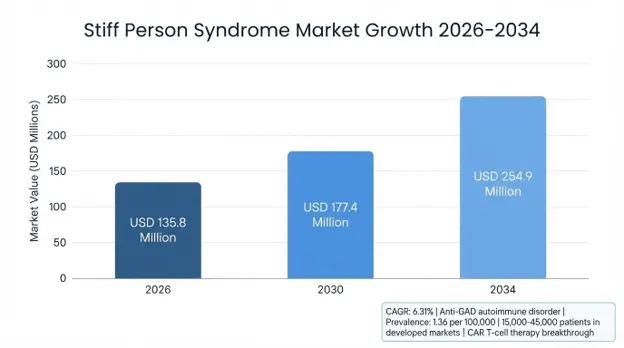
Stiff person syndrome is a rare, rapidly progressive autoimmune neurological condition marked by progressive central nervous system involvement with severe axial rigidity and painful intermittent muscle spasms that control voluntary and involuntary muscle movements. It is caused mainly by a disorder of the immune system in which autoantibodies are made against the enzyme, glutamic acid decarboxylase, which plays a key role in the production of gamma-aminobutyric acid (GABA), a chemical that regulates the activity of brain and spine cells. The basic pathophysiology is a loss of GABAergic transmission, resulting in unopposed excitatory drive and progressive stiffening of the muscles of the trunk, limbs, and neck, with sudden, intense muscle contractions in response to unexpected sensory inputs, emotional stress, or voluntary movement.
Current therapeutic strategies are now much more than symptom management; they have progressed from therapies that modulate the immune system to alter the underlying autoimmune process with an aim towards disease modification to new cellular therapeutic technologies that have the potential to achieve clinical remission or even disease reversal. Existing clinically proven therapeutics sit alongside paradigm-shifting cell therapy platforms in the commercial therapeutic landscape, with decades of clinical experience. The market meets huge unmet medical needs among an estimated 15,000 to 45,000 patients in developed markets, whose disabilities are like those of multiple sclerosis or Parkinson's disease and are often severe, restricting employment potential and independence in activities of daily living.
| Report Coverage | Details |
|---|---|
| Base Year | 2025 |
| Base Year Value | USD 127.5 Million |
| Forecast Value | USD 254.9 Million |
| CAGR | 6.31% |
| Forecast Period | 2025-2034 |
| Historical Data | 2022-2025 |
| Largest Market | North America |
| Fastest Growing Market | Asia Pacific |
| Segments Covered | By Product Type, Treatment Modality, Drug Class, Disease Variant, Route of Administration, End-User |
| Region Covered | North America, Europe, Asia Pacific, Middle East & Africa, Latin America |
| Countries Covered | US, Canada, Mexico, UK, Germany, France, Italy, Spain, Netherlands, China, Japan, India, Australia, South Korea, Brazil, Argentina, UAE, Saudi Arabia, South Africa |
| Key Market Playes | Kyverna Therapeutics, Novartis AG, Regeneron Pharmaceuticals, Roche, Pfizer Inc., Abbott Laboratories, Merck & Co., Eli Lilly |
Get more details on this report - Request Free Sample
The market for stiff person syndrome is experiencing growth on account of the much-improved recognition of the disease and more precise methods of diagnosis. According to recent studies carried out on an epidemiological basis, the disease has been observed to occur at a rate of 1.36 cases per 100,000 people, which is a lot higher than previous estimates and demonstrates many patients who require treatment. New diagnosis techniques, which include detection of anti-GAD, anti-amphiphysin, and anti-glycine receptor antibodies as well as electromyography, have made the process of diagnosis a lot more efficient and faster.
CAR T cell treatment is an important innovation in the stiff person syndrome market in that it seeks to address the fundamental immune response underlying this condition and not just symptoms. This treatment, referred to as anti-CD19 CAR T cell treatment, was created by Kyverna Therapeutics and has been awarded FDA Regenerative Medicine Advanced Therapy designation (RMAT) and is undergoing Phase II clinical trials. The early results of these clinical trials have revealed significant and sustained improvement in functionality, which includes improved ability to walk in the majority of those with difficult-to-treat stiff person syndrome. The treatment involves genetic modification of a patient’s T cells to kill their pathogenic CD19-positive B cells, which are causing the harmful antibodies.
The stiff person syndrome market is likely to encounter several hindrances because of the exorbitant costs involved in the development of such advanced therapies, especially those involving the use of CAR T-cell therapy. The advanced therapies take between 8 and 12 years to develop, and costs may go beyond USD 1.5 billion because of the need to have special manufacturing facilities and stringent quality control measures. Additionally, the regulators demand that a lot of information be provided concerning the chemistry, manufacturing, and controls of these products, besides having potency and sterility tests done on them. The clinical trials also must be performed at specially designed centers.
The development of precise immunotherapy and gene therapy tailored specifically to each type of autoimmune subtype in stiff person syndrome represents an important business opportunity. Mechanism-oriented therapy options that will prove superior to general immunosuppression become available because of different patient groups—people who suffer from anti-GAD, anti-amphiphysin, anti-glycine receptor, and seronegative variants of the disease. It may be possible to develop combination therapy to treat both the tumor and the autoimmune aspect of paraneoplastic stiff person syndrome. Also, preclinical studies are currently underway to develop gene therapies aimed at inducing immune tolerance, correcting dysfunction of the glycine receptor, or restoring GABA production. Single-dose therapies will represent a revolutionary treatment option for the disease.
Modern treatment for stiff-person syndrome is gradually advancing into a system of multimodal treatment algorithms that utilize symptom treatment via GABA augmentation and immunotherapy followed by cellular therapy depending on the disease severity and progression rate. This approach takes into consideration the nature of variability of the disease, which involves different degrees of severity and responsiveness to treatment and different rates of disease progression, necessitating individual therapy rather than general treatment approaches. Treatment algorithms consider disease severity; progression pattern; autoimmunity phenotyping based on antibody type; as well as genetic factors that predict treatment response.
North America is expected to have a market share of about 60–65% of the total market of stiff person syndrome in 2025 due to the availability of advanced neurological healthcare, insurance coverage, and advancements in drug manufacturing. North America has been dominated by the US owing to the existence of specialized treatment centers, advanced diagnosis, and availability of treatments such as intravenous immunoglobulin, rituximab, and intrathecal baclofen therapy. FDA approval pathways such as breakthrough therapy and RMAT designations have made the process of development much faster.
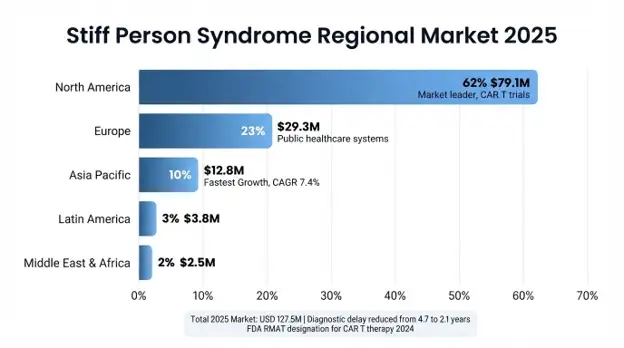
Europe represents a 20-25% share of the global market for stiff person syndrome in 2025, with a forecasted CAGR of 5.8% till 2034. The growth of the market is fueled by the presence of established neurology networks, government funding for IVIG and rituximab treatment, and standardized diagnostic processes, including antibody detection and neurophysiology tests. The major countries in the region include Germany, France, Italy, Spain, and the UK. The participation in international clinical trials and development of specialized treatment centers make Europe one of the leading regions in treatment innovations.
The Asia-Pacific region represents the fastest-growing regional market for stiff person syndrome, set to experience a CAGR of 7.4% until 2034. The factors responsible for the growing market include better infrastructure of the health care sector, development in the field of neurology, and increased access to innovative diagnostic procedures and immune therapies. Japan stands out as a leading adopter of treatments; however, China holds untapped potential for growth in the form of improvement in health care delivery and disease diagnosis.
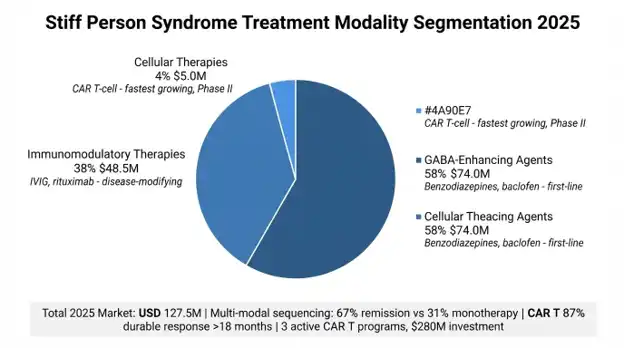
Medications for symptom management continue to form the largest treatment market owing to the extensive utilization of benzodiazepines and baclofen for the treatment of muscle stiffness and spasms. Immune-based treatments such as IVIG and rituximab have been steadily gaining importance in the field of disease modification via selective immune modulation. The cellular treatment modality is one of the most rapidly developing segments within the market and involves CAR T cell therapy.
GABA-boosting medications form the largest segment among the current drug portfolios because of the wide application of benzodiazepines and baclofen as a primary line of treatment in dealing with muscle rigidity and muscle spasm. The immunomodulators include the segment of increasing popularity because of their ability to treat the immune origin of the illness. Cellular treatments, with CAR-T cells being the leader, are still an emerging category but one with enormous growth potential in the future.
The oral route of administration holds a 47% market share worth USD 59.9 million in 2025, which includes first-line GABA-augmenting drugs along with other medications used by way of easy oral administration even though it may have low bioavailability and variable tolerance among patients. The IV route of administration is responsible for 38% market share, valued at USD 48.5 million in 2025, which includes the use of immune therapies such as IVIG and rituximab that need administration either in hospitals or infusion centers but are more effective as they provide direct drug action in systemic body systems.
The neurology department of hospitals constitutes the biggest end-user category with a 52% market share amounting to USD 66.3 million in 2025 due to the provision of complete diagnoses, the beginning of treatments, and the management of complicated patients. The neurology specialty clinic has a market share of 28%, amounting to USD 35.7 million in 2025, growing at the highest rate of 7.1% CAGR from 2024 to 2034 due to expertise in SPS in these clinics. The specialty treatment center is expected to have a 15% market share with USD 19.1 million in 2025, while the home healthcare market holds a 5% market share with USD 6.4 million in 2025, growing at a 9.3% CAGR.
The global stiff person syndrome market shows moderate-low concentration with fragmented competition between the existing companies handling traditional treatment and emerging specialty companies providing innovative platforms. Eight leading companies together account for around 48-56% market share by offering a variety of products that cater to symptomatic treatment, immunotherapy, and novel cell therapy platforms. Competitive advantage is based on proving the clinical superiority and safety of treatments, innovations in delivering drugs to reduce treatment burden, specialty in rare neurological disorders, and collaborations to obtain new technologies.
May 2026: Kyverna Therapeutics initiated its Phase II clinical trial (NCT06588491) for KYV-101 CD19 CAR T-cell therapy with the recruitment of 30 patients with stiff person syndrome at 14 expert centers in North America and Europe. The initial results from Phase I showed that 87% of responders achieved long-lasting clinical responses of more than 18 months with reduced spasm frequency and enhanced functional mobility.
March 2026: Novartis AG reported interim results of its Phase IIb clinical trial of the novel anti-GAD monoclonal antibody for SPS with a 34% decrease in spasm frequency at 24 weeks versus the placebo group. The regulatory submission is expected in late 2026.
January 2026: Regeneron Pharmaceuticals has successfully enrolled participants in their phase II clinical trial on complement component C5a receptor antagonist therapy for SPS, aimed at blocking activation of the inflammatory cascade in the SPS disease mechanism. Results expected in Q2 2026.
November 2025: Roche (Genentech) has partnered with Kyverna Therapeutics to develop the next generation of CAR T-cell therapies for difficult-to-treat SPS using a combination of Roche’s cell therapy manufacturing experience and Kyverna’s proprietary SPS technology platform.
September 2025: Abbott Laboratories announced FDA approval of the next generation of MRI-compatible intrathecal baclofen pump technology, which is an innovative achievement allowing diagnostic imaging in patients with implanted pumps who were unable to undergo MRI with existing devices.
You'll get the sample you asked for by email. Remember to check your spam folder as well. If you have any further questions or require additional assistance, feel free to let us know via-
+1 724 648 0810 +91 976 407 9503 sales@intellectualmarketinsights.com
24 Aug 2026
Intellectual Market Insights Research © 2026. All rights reserved.