Share this link via:

The global Tay-Sachs disease market was valued at USD 2.81 billion in 2026 and is projected to reach USD 4.40 billion by 2033, expanding at a compound annual growth rate of 6.6% during the forecast period (2026-2033).
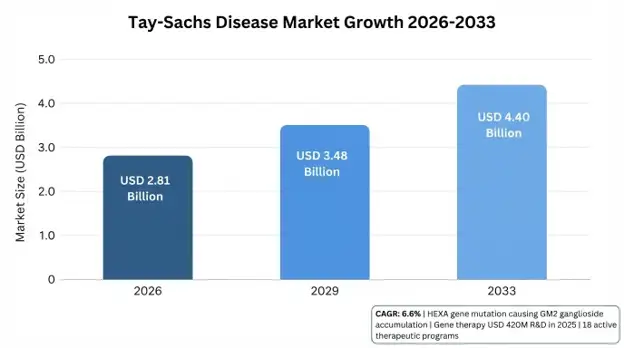
Tay-Sachs disease is a devastating inherited form of a neurodegenerative disorder with a genetic defect in the enzyme hexosaminidase-A, leading to progressive accumulation of GM2 gangliosides in the CNS and catastrophic neurological disease. This very rare disease has three clinical presentations depending on the age of onset: infantile, juvenile, and adult onset and has a very different clinical course in each, ranging from death in early childhood with the infantile presentation through to progressive psychiatric and neurological complications that continue for decades in the adult-onset forms.
Both the therapeutic options for managing the disease and the availability of approved disease-modifying therapies are still relatively poor, and the clinical management is focused largely on symptomatic treatments, such as seizure control, nutrition, and palliative care. An alternative pathway for transformation, though, is in the development pipeline with emerging therapeutic modalities such as gene therapy with adeno-associated viral vectors for delivery of functional HEXA, enzyme replacement therapy with novel technologies that bypass the blood's BBB, and substrate reduction therapy, which targets ganglioside synthesis. The market is expanding owing to the increasing awareness of disease burden by healthcare systems across the globe; the increasing speed of the diagnostics, with next-generation sequencing technologies; increasing newborn screening programs, especially in developed countries and emerging markets; and significant investments from the pharmaceutical industry in genetic disease therapeutic drugs, due to the regulatory support and reimbursement framework for orphan drug development for ultra-rare genetic diseases.
| Report Coverage | Details |
|---|---|
| Base Year | 2025 |
| Base Year Value | USD 2.81 billion |
| Forecast Value | USD 4.40 billion |
| CAGR | 6.6% |
| Forecast Period | 2025-2034 |
| Historical Data | 2022-2025 |
| Largest Market | North America |
| Fastest Growing Market | Asia Pacific |
| Segments Covered | By Disease Type, Treatment Type, Route of Administration, End-User, Distribution Channel |
| Region Covered | North America, Europe, Asia Pacific, Middle East & Africa, Latin America |
| Countries Covered | U.S., Canada, U.K., Germany, France, Italy, Spain, China, Japan, India, Australia, South Korea, Brazil, Argentina, UAE, Saudi Arabia, South Africa |
| Key Market Playes | IntraBio Inc., Recursion Pharmaceuticals, Forge Biologics, Taysha Gene Therapies, JCR Pharmaceuticals, Sanofi, Sio Gene Therapies |
Get more details on this report - Request Free Sample
The global market for Tay-Sachs disease is largely influenced by fast-moving developments in the field of gene therapy with the goal of rectifying the HEXA gene mutations. The dual adeno-associated virus vectors have provided an efficient means for the delivery of genetic material needed for the synthesis of the hexosaminidase-A enzyme. This constitutes an important milestone in the development of disease-modifying therapies. Moreover, substrate reduction drugs such as nizubaglustat have been developed through clinical trials and provide new options in the reduction of gangliosides. Enzyme replacement therapies using blood-brain barrier penetrative technologies are also being developed to ensure that enzymes get to the brain.
The global market for Tay-Sachs disease is set to gain from breakthroughs in newborn screening and genetic tests, which facilitate disease identification at an earlier stage. With the introduction of next-generation sequencing, tandem mass spectrometry, and enzyme testing, the diagnosis of Tay-Sachs disease has become much easier and more accurate. There has been an increase in the number of cases of infants detected with Tay-Sachs disease and carriers in regions like the US and Asia Pacific. Increased campaigns and availability of genetic counseling have also contributed to early identification and family planning. Early detection will improve the chances of successful use of gene and enzyme therapies on patients.
Tay-Sachs disease presents an extremely limited market due to its small patient base and thus limits the potential to commercialize any new treatment, even with incentive programs such as orphan drugs. This disease affects only a select few populations, and hence there is a small addressable market as well as little demand for treatments. Its geographical limitations also make recruiting patients for clinical trials difficult and may need the participation of multiple countries in order to achieve success.
The advancement of gene therapy that would either be a one-off treatment or an extended treatment would be the greatest opportunity in the market for Tay-Sachs disease. Even though the patient pool would be small, the commercial success of highly valued gene therapies in rare diseases has resulted in a premium pricing model that generates significant revenues. To make the process of delivering the product more effective and safer along with restoring the functioning of the HEXA gene, companies have been coming up with new gene replacement therapies using AAV vectors. There would be greater momentum in therapeutic research due to increasing orphan drug designation, strategic licensing partnerships, and clinical advances. The future looks bright for gene therapy, as it is expected to revolutionize medicine and bring in economic opportunities in the rare diseases market.
Approaches to presymptomatic and prenatal therapies, which aim to prevent any neurological damage before the manifestation of any symptoms, represent a great prospect in the Tay-Sachs disease industry. It is possible due to the development in genetic tests and neonatal screenings that make early detection and treatment possible during the critical period of brain development. One of the prenatal gene therapies under research includes the in-utero delivery of the HEXA gene, which shows promising neuroprotective results during the preclinical trials. These therapies that have the potential to cure the disease instead of treating its symptoms and are still in the experimental phase have the potential to revolutionize disease management.
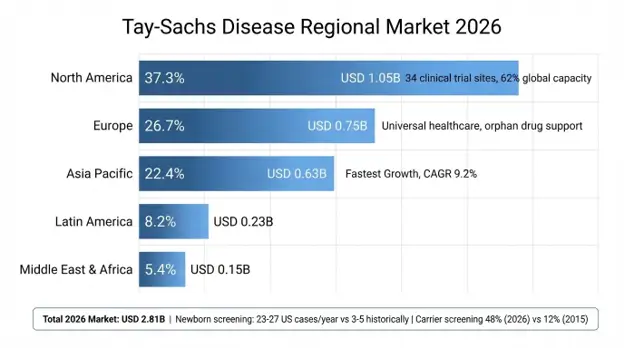
North America is the most dominant market for Tay-Sachs disease, which holds 37.3% of total revenue by 2026 due to high-quality healthcare infrastructure, extensive rare disease research, and supportive government regulations. The United States is the biggest market in the region owing to the presence of various developments in gene therapy and genetic disease centers and widespread newborn screening facilities. Strong support from the NIH, availability of genetic counseling, and the FDA orphan drug policy are also contributing to making North America the most dominant market for Tay-Sachs disease.
The European Tay-Sachs Disease Market is expected to hold 26.7% of the global market share in 2026 and is forecasted to register a growth rate of 6.4% CAGR during the forecast period from 2021 to 2033. Factors driving the growth include a universal health care system, a rare diseases research network, and strict orphan drug regulation. Germany holds the top position in the regional market owing to its state-of-the-art gene therapy expertise and research programs. Other contributing factors include EU-funded rare disease programs, increased newborn screening programs, genetic counseling services, etc.
The Asia Pacific is anticipated to be the fastest-growing market of Tay-Sachs disease due to an expected expansion at a 9.2% CAGR from 2019 to 2033. The factors responsible for the growth of the market include improvement in healthcare infrastructure, the growing number of newborn screenings, adoption of next-generation sequencing technologies, and promotion of precision medicine by governments. China will take the lead in the region owing to its genomic mapping projects, while India will increase its genetic diagnosis capacity through its public healthcare programs.
Infantile Tay-Sachs disease forms the biggest segment due to the extremely early onset of the condition, rapid neurodegeneration, and need for immediate treatment. Juvenile Tay-Sachs disease forms a considerable portion of the market owing to increasing neurodegeneration and high demand for disease-modifying treatments. Later-onset Tay-Sachs disease forms a smaller portion of the market because of the delays in diagnosis, slower progression of the disease, and misdiagnosis. However, more awareness and genetic testing are expected to drive growth of the segment.
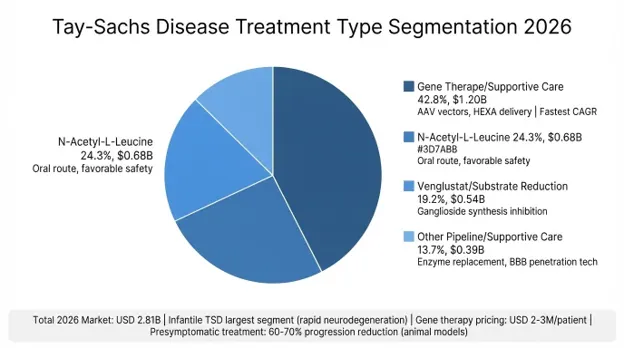
Gene therapy is the major player in the Tay-Sachs disease market owing to the possibility of disease modification on a permanent basis by treating the root cause of disease. N-Acetyl-L-Leucine is emerging as an upcoming therapeutic option backed up with favorable clinical results and an easy oral route of administration. Substrate reduction therapies, such as venglustat, have been gaining prominence as emerging options by inhibiting gangliosides.
The oral administration route will have a 51.5% share in 2026 owing to increased treatment convenience that promotes patient compliance, especially among pediatric patients and maintenance therapy. The parenteral administration route that includes intrathecal, intravenous, and intramuscular administrations is the second largest with a market share of 36.8%. Other routes, including the intracerebral and in utero administration routes, have 11.7% market share. Such routes are not commonly used at present but could prove to be more viable with the advancement of presymptomatic intervention techniques.
Hospitals & Specialty Neurology Clinics form the largest end-user segment, accounting for 39.2% market share, and include pediatric neurology centers, metabolic disease clinics, and rare disease centers that perform complete disease management, which includes diagnosing, treatment monitoring, and patient support services. Diagnostic Laboratories & Genetic Centers form the 27.4% market share, which have vital roles in diagnostics and counseling, which include enzyme activity analysis, genetic sequencing, and carrier screening services. The research & academic institutes form the 18.6% market share through conducting investigation programs and clinical trials, whereas homecare settings and patient support organizations form the remaining 14.8% market share.
The global Tay-Sachs disease market is moderately fragmented and competitive due to competition between rare disease biotech companies and selected pharmaceutical players. The dominant players are developing novel technologies such as gene therapy, substrate reduction therapy, etc., which help to target the root cause of the disorder. Competitive advantages lie in viral vector technologies, gene delivery, scalability of manufacturing, clinical development experience, and effective patient engagement programs. Collaboration between biotech companies, pharmaceutical companies, and some of the leading academic organizations is boosting development and clinical trials. Investment in orphan drugs and precision medicine is likely to enhance competitiveness in the coming years.
September 2025: MEDIPAL HOLDINGS and JCR Pharmaceuticals have entered into an agreement involving global licensing as well as Japan co-development for JR-479, which is an investigational drug meant to treat GM2 gangliosidosis, which includes Tay-Sachs disease, and has granted MEDIPAL global commercialization rights for all territories except Japan, where there will be joint development and commercialization.
August 2025: According to the National Institutes of Health, scientists have been able to reduce the severity of the late-onset Tay-Sachs disease in human cells as well as mice through a new approach to gene editing that rectified HEXA gene mutations and increased the activity of the enzyme.
August 2025: Cambridge University emphasized groundbreaking studies on autophagy aimed at exploring cellular clearing methods as therapeutic approaches for the treatment of Tay-Sachs disease and similar neurodegenerative disorders to show the trend of academic research driving the development of treatment approaches.
February 2025: MedGenome initiated the 'CarefortheRare' initiative with the documentary to stress the role of genomic testing at an earlier stage in the diagnosis of rare diseases and to tell stories of the families facing hardships due to rare genetic diseases like GM2 gangliosidosis.
March 2024: Azafaros reported successful completion of Phase 2 RAINBOW clinical trial conducted for 12 weeks on 13 individuals suffering from Tay-Sachs disease and related diseases using nizubaglustat.
You'll get the sample you asked for by email. Remember to check your spam folder as well. If you have any further questions or require additional assistance, feel free to let us know via-
+1 724 648 0810 +91 976 407 9503 sales@intellectualmarketinsights.com
24 Aug 2026
Intellectual Market Insights Research © 2026. All rights reserved.