Share this link via:

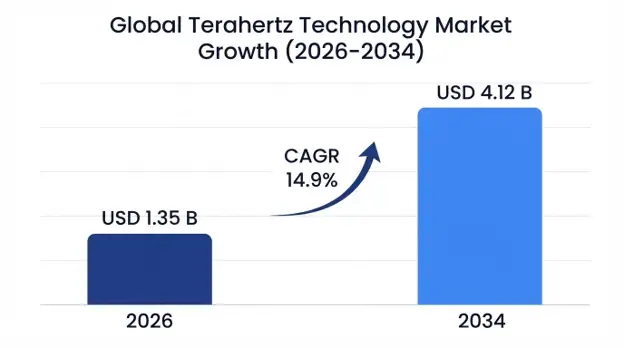
The global terahertz technology market was valued at USD 1.18 billion in 2025 and is projected to reach USD 1.35 billion in 2026, before expanding to USD 4.12 billion by 2034, growing at a CAGR of 14.9% during the forecast period (2026–2034).
Terahertz technology operates in the frequency range of the electromagnetic spectrum between the microwave and infrared ranges, usually from 0.1 THz to 10 THz, or from 3 mm to 30 μm wavelengths. The “terahertz gap” as it was historically called, has been revolutionized with recent breakthroughs in semiconductor physics, ultrafast laser science and quantum engineering. Terahertz radiation has unique properties that allow it to easily pass through non-conducting materials such as plastics, textiles, paper, ceramics, and biological tissues, yet it is non-ionizing and significantly less hazardous than X-ray radiation under typical operating conditions.
The key advantage of terahertz systems is its remarkable combination of penetration and spectroscopic selectivity. Terahertz waves can penetrate internal structures, detect hidden objects and identify chemical compositions using signature absorption lines of molecules, unlike other imaging techniques, without causing radiation damage. The dual capability allows systems for security screening to be used for applications such as detection of concealed weapons and explosives under clothing, pharmaceutical quality control systems to measure tablet coating thickness and identify polymorphic forms that are vital to the bioavailability of pharmaceuticals, and semiconductor metrology systems to characterize carrier dynamics and material uniformity, essential measurements in advanced electronic devices.
There are two basic strategies for modern THz systems. Time-domain terahertz spectroscopy systems rely on the use of femtosecond laser pulses to create broad-band transient terahertz radiation by using a photoconductive antenna or a nonlinear optical crystal, which allows the simultaneous measurement of both the terahertz spectral and temporal properties over a large frequency range with extreme sensitivity to material properties. Continuous-wave terahertz systems use quantum cascade lasers, photomixing or electronic frequency multiplication to produce narrowband radiation for high-resolution spectroscopy and for new communication applications. These generation technologies combined with more refined detection schemes such as electro-optic sampling, bolometric detector arrays and heterodyne receivers, have led to practical instruments for both laboratory and field-deployable configurations.
The impact of this technology is not limited to scientific instrumentation. but is also applicable in industrial and defense applications aimed at vital needs in various fields. Terahertz non-destructive testing (NDT) systems for aerospace manufacturing applications can inspect composite aircraft structures without the need for surface contact as with ultrasound systems or the potential for ionizing radiation as in X-ray systems and are increasingly being used because of the increased use of carbon fibre reinforced polymer in modern commercial aircraft applications. In the pharmaceutical industry, Terahertz quality control (QC) systems offer real-time Process Analytical Technology (PAT) capabilities. that allow for monitoring of critical quality parameters on a continuous basis, such as coating uniformity, active pharmaceutical ingredient content and characterization of the solid-state form, which are essential for regulatory QbD initiatives.
The emergence of terahertz technology for 6G wireless communication represents a paradigm-shifting opportunity. because terahertz frequency bands can deliver more than 100 GHz per channel, which means data rates of 100 gigabits per second to 1 terabit per second of data over short-range distances. This capability will help address the vast amount of data required and the bandwidth of existing 5G networks and play a key role in future applications such as holographic communication, ultra-high-definition immersive media, and large-scale machine-type communications systems needed for smart city infrastructure and in the autonomous vehicle ecosystem.
| Report Coverage | Details |
|---|---|
| Base Year | 2025 |
| Base Year Value | USD 1.18 Billion |
| Forecast Value | USD 4.12 Billion |
| CAGR | 14.9% |
| Forecast Period | 2025-2034 |
| Historical Data | 2022-2025 |
| Largest Market | North America |
| Fastest Growing Market | Asia Pacific |
| Segments Covered | By Component, Technology, Application, End-User, Region |
| Region Covered | North America, Europe, Asia Pacific, Middle East & Africa, Latin America |
| Countries Covered | US, Canada, Mexico, UK, Germany, France, Italy, Spain, Netherlands, China, Japan, South Korea, India, Australia, Brazil, Argentina, UAE, Saudi Arabia, South Africa |
| Key Market Playes | Advantest Corporation, TeraView Ltd., Menlo Systems GmbH, Luna Innovations, Toptica Photonics AG, TeraSense Group Inc. |
Get more details on this report - Request Free Sample
The main growth catalyst of the Terahertz technology market is the rising demand for innovative non-destructive testing solutions in various industries, including aerospace, automotive, semiconductor, and pharmaceutical. Terahertz technology provides the possibility to perform inspections of the inner structure, multilayer materials, and defects without any impact on the inspected part, which is a clear advantage over the existing inspection methods. With respect to the aerospace industry, the rising popularity of carbon fiber composites as material for modern aircraft has created the necessity of using innovative inspection tools for delamination, voids, moisture, and coating detection.
The pharmaceutical industry is also witnessing the rising use of terahertz technology for quality control and process analytical technology purposes, as it allows measuring the thickness of coating on a tablet, ingredients identification, and polymorph analysis of the substance without destroying a sample. The rising demand from manufacturers for product quality and process automation makes Terahertz technology very important for industrial inspections.
The telecommunications sector is increasingly adopting terahertz frequency bands as the backbone for 6G wireless networks expected to be commercially introduced in the 2028-2032 timeframe, thus introducing a game-changing demand for terahertz component suppliers and integrators. The fifth-generation networks in the millimeter-wave frequency bands below 100 GHz have speeds of up to 20 Gbps, which are insufficient for emerging applications of holographic telepresence (1-10 Tbps per user), real-time processing of daily streams of data from sensors of autonomous vehicles (up to petabytes per day), and the ultra-dense machine-type communication that can be used in smart city environments, supporting millions of machine types per square kilometer.
The terahertz communication channels between 0.1–1 THz provide bandwidths of tens to hundreds of GHz per channel. with aggregate data rates greater than 100 Gbps for distances up to 10-100 meters for wireless backhaul, device-to-device communication and high-density deployments in indoor environments. Advanced modulation methods have been used to demonstrate 206 Gbps single channel transmission at 300 GHz, and multi-channel implementations have reached aggregate speeds of more than 1 Tbps in a controlled lab environment. The International Telecommunication Union (ITU) has started some spectrum allocation studies for terahertz (THz) communication bands, and preliminary studies are being considered for standardization in 2027 for 275-450 GHz frequency bands.
Research and development of terahertz integrated circuits have come a long way in the semiconductor industry, and Intel, Samsung Electronics, and TSMC have all announced research programs for complementary metal-oxide-semiconductor and III-V compound semiconductor-based circuits that can operate at terahertz frequencies. Cost-effective silicon-based terahertz transceivers are another key enabling technology for robust 6G device integration, with research showing silicon-germanium transistors can oscillate at over 700 GHz and terahertz front-end components can be integrated with digital baseband processing circuits on a single chip.
One of the most critical barriers limiting wider adoption of terahertz technologies lies in high system cost and complicated production of high-performing devices such as quantum cascade lasers, photoconductive antennas and sensitive detectors, which are expensive capital items that cannot be afforded by most potential users of terahertz systems. Terahertz time-domain spectroscopy systems that are suitable for applications in pharmaceutical industry or material testing sell at the cost of USD 150,000-450,000, while terahertz imaging systems that employ two-dimensional detector arrays cost around USD 300,000-800,000, which restricts adoption of Terahertz systems only to those companies with sufficient capital expenditure budget and potential return on investments.
Quantum cascade lasers, one of the most powerful terahertz radiation sources, of terahertz radiation above 1THz – currently require cryogenic cooling to temperature lower than 200 Kelvin in order to produce continuous terahertz wave. Although recent innovations in active regions engineering resulted in gradual increase of the highest possible operating temperature up to 261 Kelvin, the problem of room-temperature continuous wave generation is yet to be solved, which would have radically changed terahertz system accessibility.
Terahertz systems provide significant prospects in medical diagnosis, such as margin identification during oncologic surgeries and skin cancer diagnosis due to specific tissue contrast provided by Terahertz radiation. The radiation can penetrate biological tissues up to 0.5-2 mm depth, which is enough to examine epithelial layers and surface tissues, with contrast provided due to the differences in water content, tissue structure, and molecules that create terahertz optical contrast. Clinical trials showed terahertz imaging sensitivity of 89% and specificity of 85% for margin detection of basal cell carcinoma, comparable to the results of frozen sections histopathology, but terahertz technique allows obtaining results in real-time mode.
Breast cancer surgery is an especially valuable application of terahertz imaging, since current intraoperative margin detection methods, including frozen sections analysis, show positive margins in 20-40% cases, thus requiring additional surgeries, increasing morbidity of patients, expenses of healthcare facilities (USD 8,500-14,000 for each procedure), and psychological stress. Imaging probes capable of examining excised tissue samples within 2-5 minutes, when patient is still anesthetized, will allow performing the additional surgery immediately after detecting positive margins.
The combination of machine learning algorithms with terahertz spectroscopy and imaging techniques represents an unprecedented shift in analytical capacity and usability in terms of automating challenging tasks of spectral interpretation that previously needed experienced spectroscopists, conducting real-time decisions within industrial quality control applications, and identifying hidden material signatures in terahertz data exceeding the capabilities of human analysis. The convolutional neural networks trained on databases of terahertz spectra comprising thousands of reference spectra exhibit the identification rate above 97% in respect of pharmaceuticals, explosives, and controlled substances, significantly surpassing library matching algorithms especially for mixtures and partially hidden materials.
Deep learning methods applied to terahertz imaging data allow for the automatic detection and classification of subsurface defects in composite materials, wherein the trained model reaches the same level of sensitivity as humans in defect detection but processes entire datasets in several seconds instead of hours for manual evaluation. This feature is especially important for aerospace maintenance purposes wherein large composite structure inspection creates gigabytes of terahertz data that takes hours for an analyst to process manually.
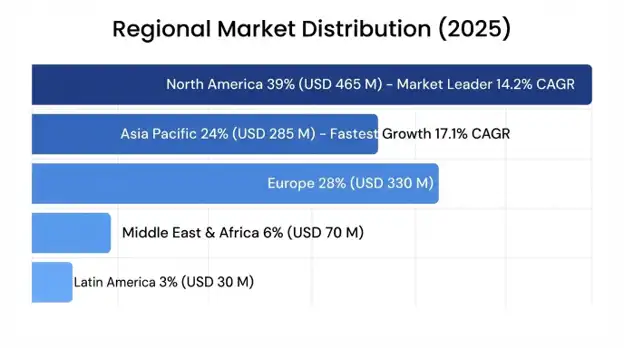
The North American region accounted for the highest regional market share at around USD 465 million in 2025 and maintained a projected CAGR of 14.2% through 2034. Regional dominance is attributed to consistent investment by the federal government in terahertz research through defense and intelligence initiatives, presence of the leading technology firms and research universities working on fundamental and applied science in terahertz, established pharmaceutical and aerospace manufacturing sectors that drive industrialization, and advanced venture capital networks that finance terahertz commercialization.
The United States Department of Defense through DARPA, Air Force Research Laboratory, and Army Research Laboratory remains the largest single funder of terahertz technology development in the world with annual investments of around USD 180-240 million in 2025 for communication, sensing, imaging, and electronic warfare applications. These initiatives have created intellectual property portfolio and trained terahertz engineers who then formed their companies or joined technology companies to create an innovation cluster. The National Science Foundation and the Department of Energy also fund fundamental research in terahertz technologies through university grants with over 85 terahertz research groups in US universities in 2025.
Asia Pacific was the fastest-growing regional market, with its CAGR reaching 17.1% and estimated value of USD 285 million in 2025. The drive for regional expansion is fueled by massive government investments in the development of 6G wireless technology in China, Japan and South Korea, the convergence of global semiconductor and electronics fabrication and the need for enhanced metrology solutions, and the rapid growth of pharmaceutical manufacturing industries demanding quality control solutions, alongside the increasing defense modernization programs adopting terahertz sensing technologies.
China has included terahertz technology in its national science and technology development plans, with both the Ministry of Science and Technology setting up special research centers at top universities and the National Development and Reform Commission providing preferential financing to develop the application of terahertz technology in industries. In 2025, the total amount of Chinese funding in terahertz research was estimated to be USD 320 million, ranking second among the world's national investments, with a particular focus on industrial quality control instruments, security screening systems and communication components for the domestic manufacturing.
Japan has outstanding capabilities in manufacturing precision photonics, and Japan's companies such as Hamamatsu Photonics are leading the world in terahertz detector technology and photoconductive antenna fabrication. These are among the key features of the Beyond 5G promotion strategy of the Japanese government, which also explicitly introduces terahertz communication as a key enabling technology, and coordinates industry-academic-government cooperation on standardization and system development efforts, managed by the National Institute of Information and Communications Technology (NICT).
Sources have been estimated to be the largest segment in the terahertz market with an estimated market share of 42% and a value of USD 496 million in 2025. Sources include quantum cascade lasers, photoconductive antennas, photomixers, electronic multiplier chains, and nonlinear optical crystals which are used to produce terahertz radiation of different frequencies and powers. The segment commands high prices because of the difficulty involved in producing efficient sources of broadband or narrowband terahertz and the low number of companies which can manufacture such high-performance terahertz sources. The segment is expected to record rapid growth due to the increasing use of terahertz in spectroscopy, communication, and imaging industries creating multiple streams of demand with different specifications.
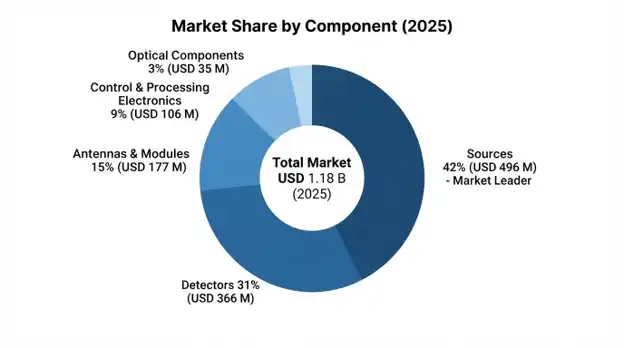
Detectors have a market share of 31% worth USD 366 million in 2025. Detectors include bolometric detector arrays, electro-optic crystals, photoconductive receivers, and heterodyne mixers used in different detection purposes depending on the sensitivity, speed, and operating temperatures. Technology development in detectors, especially those that enable room-temperature sensitive arrays thus real-time terahertz imaging without cryogenic cooling, has been important to expand terahertz uses in industry and security.
Time-domain terahertz spectroscopy is currently the dominant technology within the technology segment, comprising 45% of market share valued at USD 531 million by 2025, with a CAGR of 14.1% through 2034. The reasons behind the dominance of the technology include its extensive spectral range that allows performing material characterization of various types, commercial ecosystem of instruments featuring robust software and applications, and proven efficiency in pharmaceuticals, materials research, and security screening applications. Improvement in performance of femtosecond laser sources, photoconductive antennas, and algorithmic processing of signals allows gradually increasing spectral resolution, shortening measurement times, and expanding frequency ranges.
The terahertz imaging systems comprise 35% market share worth USD 413 million by 2025, with CAGR of 16.2% through 2034, becoming the fastest-growing technology sector due to implementation of security screening, industrial inspection and new medical imaging technologies. Innovation within the focal plane array detectors allowing real-time two-dimensional imaging at video frame rates allows transforming laboratory raster-scanning techniques into industrially relevant technology.
The nondestructive testing & evaluation market is the biggest at USD 354 million in 2025 and expected to see 15.8% CAGR up to 2034 owing to applications in aerospace composite inspection, pharmaceutical quality control and electronics manufacturing metrology. Clear ROI calculations show cost reductions for defect detection prior to assembly or product release regulatory requirements drive non-discretionary applications in pharmaceutical and aerospace and increasing ROI in application scope as terahertz solution characteristics are better established in a wide range of industrial materials.
Security and surveillance represent one of the largest and fastest-growing application segments., valued at USD 295 million in 2025 at a CAGR of 16.9%, representing the fastest growth as the government security agencies are actively procuring security equipment and the private sector is increasingly using security equipment for critical infrastructure protection. The segment is supported by government procurement funding, which is relatively less sensitive to economic cycles, performance benefits over the existing screening technologies for specific threat categories and growing threat landscape, which is encouraging security investment across the globe.
The communication systems segment is estimated at USD 189 million in 2025 and is projected to grow at a CAGR of 18.2%. and is in the early stages of development for 6G communication applications. Although the current share is the least of all the major applications, communication systems have the highest growth potential due to investments of the telecom industry in development of beyond 5G technology, and the special characteristics of the terahertz frequencies bandwidth for ultra-high-capacity wireless links.
Global terahertz technology market is moderately fragmented with no leading firms having significant share in the market, indicating low maturity of this technology coupled with diverse range of application sectors attracting different kinds of specialized firms. The top ten companies collectively account for approximately 45–52% of the market., while the rest of the market is held by numerous specialized firms, spin-offs from universities, as well as vertically integrated system integrators that operate in some specific niches of applications. The differentiation strategy is based on the performance specifications of source and detector, ability to integrate systems into turnkey application-ready tools, proprietary software for spectrum analysis and database of materials, and expertise in specific applications to provide reliable customer support.
Competitive advantages of market leaders include intellectual property portfolio covering core technologies for generating and detecting terahertz waves, established connections with key end-user sectors such as defense institutions and pharmaceutical industry, and continuous investment in R&D.
April 2026: Advantest Corporation launched its next-generation Terahertz Time-Domain Spectroscopy System. which is characterized by compact fiber-coupled design that reduces the size of the equipment by 60%, maintaining the same spectral bandwidth of 6 THz, and aims at pharmaceutical process analytical technology market and semiconductor characterization market with USD 185,000 price tag on the system.
March 2026: The European Commission granted EUR 28 million Horizon Europe consortium funding to a research project involving 14 partners that aims to develop integrated Terahertz transceiver chipsets for 6G wireless backhaul applications with capacity of transmitting data rates of 100 Gbps at 300 GHz within 200-meter link distances.
February 2026: TeraView Ltd. achieved CE approval for their Terahertz intraoperative imaging probe system used in breast cancer margin evaluation, facilitating commercial release of the technology in EU operating theaters and constituting first CE approval of a medical device utilizing Terahertz imaging technology.
January 2026: Luna Innovations completed the acquisition of a dedicated terahertz NDT company with purchase consideration of USD 47 million, allowing the addition of terahertz composite analysis capabilities to the company’s existing aerospace inspection portfolio while benefiting from connections with aircraft maintenance operators.
November 2025: Menlo Systems GmbH announced a strategic partnership with a major pharmaceutical instrumentation distributor that operates across 34 countries, substantially enhancing commercial opportunities for the terahertz quality control systems in oral solid dose manufacturing in emerging pharmaceutical markets.
You'll get the sample you asked for by email. Remember to check your spam folder as well. If you have any further questions or require additional assistance, feel free to let us know via-
+1 724 648 0810 +91 976 407 9503 sales@intellectualmarketinsights.com
Intellectual Market Insights Research © 2026. All rights reserved.