Share this link via:

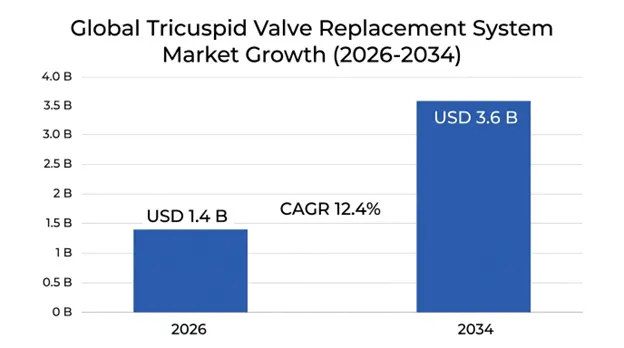
The global tricuspid valve replacement system market size was valued at USD 1.2 billion in 2025 and is projected to reach USD 1.4 billion in 2026, expanding to USD 3.6 billion by 2034, growing at a CAGR of 12.4% during the forecast period (2026-2034).
Tricuspid valve replacement systems consist of advanced cardiovascular prosthetic valves and associated delivery systems designed to restore normal cardiac hemodynamics by replacing structurally or functionally compromised tricuspid valves. The tricuspid valve was historically referred to as the ‘forgotten valve’, but in recent times due to its high morbidity and mortality, it became a focus area of cardiology after epidemiological evidence proved that patients suffering from severe tricuspid regurgitation without treatment face a mortality rate above 50% within five years, equivalent to many cancers.
The complicated structure of the tricuspid valve complex sets it apart completely from procedures on the aortic and mitral valves. It should be noted that the tricuspid valve annulus is a nonplanar, saddle-shaped fibromuscular structure that lacks the fibrous support present in left-sided valves that would be present in the case of left-sided valves. As a result, it is particularly susceptible to enlargement and deformation during right ventricular overload. The tricuspid valve typically consists of three leaflets connected by chordae tendineae and papillary muscles, whose geometries differ greatly among individual patients, thereby making transcatheter treatment difficult. These and other factors unique to right-sided circulation, such as its low-pressure, high-compliance physiology, lead to unique problems with regard to prosthesis design, including large and frequently irregularly shaped annulus size, lack of calcification to secure the device, proximity to conduction system and right coronary artery, and potential interference with right ventricular leads in implanted pacemakers or ICDs.
The concept of modern tricuspid valve replacement includes not only traditional surgical approaches based on replacement with mechanical or bioprosthetic valves through an open-heart operation but also in newly developing transcatheter techniques which deliver tricuspid valve replacement through catheter-based percutaneous transjugular, transfemoral, or combined access routes. Transcatheter platforms are specifically designed to provide treatment for a highly complex and elderly patient cohort. characterized by the presence of tricuspid insufficiency associated with right heart dilation, pulmonary hypertension, atrial fibrillation, or chronic left-sided valve pathology when surgery is contraindicated and referral rate is below 1%.
The value proposition extends beyond product sales to include the provision of end-to-end solutions by utilizing state-of-the-art imaging before performing procedures, hybrid ORs set up for structural heart diseases intervention, delivery systems, as well as follow-up procedures post procedure. There is a significant unmet clinical need, with an estimated 65 million people globally affected by moderate-to-severe tricuspid regurgitation of whom less than 8,000 cases per year go under surgery / transcatheter valve replacement.
| Report Coverage | Details |
|---|---|
| Base Year | 2025 |
| Base Year Value | USD 1.2 Billion |
| Forecast Value | USD 3.6 Billion |
| CAGR | 12.4% |
| Forecast Period | 2025-2034 |
| Historical Data | 2022-2025 |
| Largest Market | North America |
| Fastest Growing Market | Asia Pacific |
| Segments Covered | By Product Type, Valve Type, Access Route, Indication, End-User |
| Region Covered | North America, Europe, Asia Pacific, Middle East & Africa, Latin America |
| Countries Covered | US, Canada, Mexico, UK, Germany, France, Italy, Spain, Netherlands, China, Japan, India, Australia, South Korea, Brazil, Argentina, UAE, Saudi Arabia, South Africa |
| Key Market Playes | Edwards Lifesciences, Abbott Laboratories, Medtronic, Boston Scientific, NaviGate Cardiac Structures |
Get more details on this report - Request Free Sample
The primary driver of the tricuspid valve replacement system market is the large and increasing incidence of tricuspid regurgitation among an estimated global population of 65 million individuals with moderate-to-severe disease. This disease shows high correlation with aging population statistics, with the prevalence increasing from 0.55% among the general adult population to 4-5% among individuals older than 75 years and up to 15-20% among those with atrial fibrillation. The biological mechanism for connecting atrial fibrillation and tricuspid regurgitation is the progressive annular dilatation secondary to right atrial enlargement causing functional leaflet malcoaptation.
Screening echocardiographic studies estimate that approximately 1.6 million Americans have severe tricuspid regurgitation, while only 12,000 surgical repair/replacement procedures are done annually, indicating a treatment rate of less than 1% among potentially treatable patients. Individuals with severe untreated tricuspid regurgitation have five-year survival rates of 48-55%, markedly inferior compared with those of comparable aged individuals without valvular disease, hence creating the immediate clinical need for therapy.
Another rapidly emerging contributor is the increasing use of cardiac implantable electronic devices, in which transvalvular lead-induced tricuspid regurgitation is reported to occur in 7-38% of the patients. Considering that there are more than 1.5 million device implantations being done worldwide each year, the aggregate number of people suffering from tricuspid regurgitation because of the implantation is also a sizable indication for valve replacement.
The technological maturation of transcatheter tricuspid valve replacement platforms represents the most significant catalyst for market growth since they allow for treating patients considered impossible to operate on by providing treatment options which had not been available previously. In early transcatheter systems like the EVOQUE system made by Edwards Lifesciences, technical feasibility and clinically meaningful results were achieved in clinical trials involving populations with a mean surgical risk of 8-12%. Procedure success rate was above 85%.
Volumes of transcatheter tricuspid valve replacements increased from about 200 procedures worldwide in 2020 to more than 3,400 in 2025, representing a seventeen-fold increase. Success rates of the procedure ranged between 92-96% among well-experienced centers, with notable advances in technical success due to learning curve effects as the operators gained more experience. Trace or zero tricuspid regurgitation occurred in 85-91% patients undergoing transcatheter valve replacement compared to 34-48% patients undergoing valve repair procedures.
The primary clinical challenge limiting broader adoption remains the significant anatomical variability of the tricuspid valve complex. The tricuspid annulus is a dynamic, non-calcified structure with diameter variations throughout the cardiac cycle with severe tricuspid regurgitation having annular diameters often >45-55 mm much larger than those of left-sided transcatheter valve replacement applications.
Adequate anchoring force without annular calcification can be achieved only using active fixations or sub annular anchoring devices, thereby posing risks such as injury to conduction system due to its proximity to the AV node, right ventricular outflow tract obstruction, and obstruction of already placed transvalvular pacing leads. Annular size mismatches and need for repositioning were seen in 4-8% cases, constituting the most common reason for procedural failure, whereas conduction abnormalities requiring pacemaker placements were observed in 18-28% patients.
The emerging reimbursement environment constitutes an important market constraint, especially in the short to medium term, as payers in countries other than the US have not developed specific coverage policies for transcatheter tricuspid valve replacement procedures yet. The Centers for Medicare & Medicaid Services developed a national coverage determination after approval by the Food & Drug Administration; however, similar coverage determinations in Europe and other key countries are still at development stage through 2027-2029.
An opportunity for a sizable market is created by engineering of valve replacement systems to account for the presence of pacing and defibrillation leads that go through the tricuspid valve. This is since the currently available alternatives are limited to either lead extraction before implanting the new valve or having a substandard valve installed, both options being unsatisfactory to the patients that need to have both functions.
The target market consists of those patients that need valve replacement and have transvalvular leads, thus comprising approximately 400,000-600,000 individuals on a worldwide basis.
The ever-increasing evidence favoring tricuspid interventions while undergoing a planned procedure on the left side of the heart opens doors for surgical valve replacement technology that caters to concomitant surgery. The new guidelines released by the American Heart Association and the European Society of Cardiology have set the bar lower for concomitant tricuspid intervention, advocating repair or replacement of valves suffering from moderate tricuspid regurgitation with annular dilatation.
The transfemoral transvenous method for transcatheter tricuspid valve replacement has moved beyond an experimental method to a more standardized procedure. Transfemoral transvenous valve delivery involves crossing the interatrial septum through transseptal puncture and placement of the device within the tricuspid annulus, all done under fluoroscopy and echocardiography guidance, without the need for access through the thorax. This procedure can be performed under conscious sedation, with same-day discharge after surgery.
AI-based technologies are currently being adopted for use in tricuspid valve replacement to tackle the issue of anatomical variability. Using automated analysis algorithms on echocardiographic or CT images allows obtaining accurate measures of annular dimensions and leaflet morphology and predicting device sizing in a way comparable to that of an expert structural heart disease imager.
North America: Market Leadership Through Regulatory Approval and Infrastructure
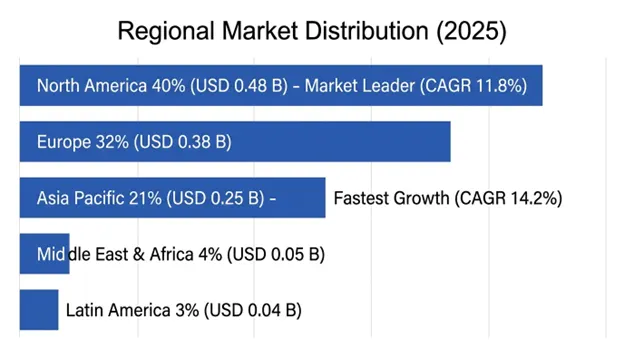
North America dominated the global market with a market size of USD 480 million in 2025 at a CAGR of 11.8%. Such dominance is driven by the FDA's approval of the EVOQUE transcatheter tricuspid valve replacement system in 2024, making it the first developed country with commercially available transcatheter devices to treat tricuspid disease. In addition, the infrastructure built in the structural heart disease program in more than 650 transcatheter aortic valve replacement sites serve as the basis for tricuspid replacement program.
Coverage under Medicare by the national coverage determination framework ensures reimbursement security with procedure reimbursement costs at USD 35,000-52,000 per case making institutional investments in program development easier. There are an estimated 2,100 transcatheter tricuspid valve replacement procedures performed in the US in 2025, with expected numbers of 12,000-18,000 annual procedures by 2030.
The Asia Pacific region is expected to exhibit the highest CAGR of 14.2% by 2034, achieving USD 310 million in 2025. Japan remains at the forefront of adopting transcatheter heart valves due to its highly aging population with one of the highest incidences of tricuspid regurgitation globally, mature cardiac surgery market, and regulation that usually approves major transcatheter heart valves from the USA in 12-18 months.
China emerges as the largest growth prospect in the coming years due to its 18 million or more cases of moderate or greater tricuspid regurgitation coupled with rapidly growing interventional cardiology market and healthcare reforms favoring structural heart diseases treatment capabilities.
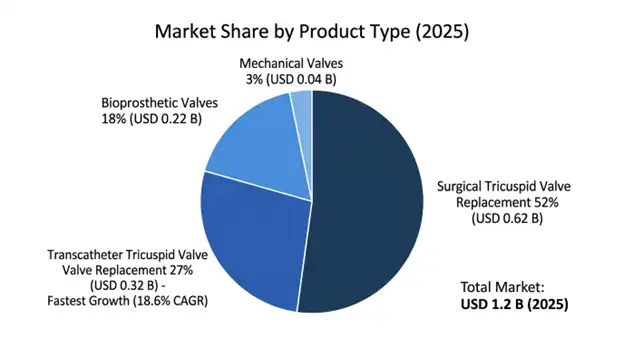
Transcatheter Tricuspid Valve Replacement Devices are considered as the fastest-growing category, which will have a CAGR of 18.6% from a base value of USD 320 million in 2025 until 2034. Such growth will be attributed to commercialization after approval, operator experience in performing complex procedures, and preference as a treatment mode among the high-surgical-risk patient population accounting for most severe cases of tricuspid regurgitation.
Surgical Tricuspid Bioprostheses have the largest market share at USD 620 million in 2025, growing at a CAGR of 7.8% until 2034, catering to the category of surgical valves for the treatment of concomitant surgeries and isolated replacements in low-risk patients.
Transfemoral access is the most common transcatheter technique, used in almost 68% of transcatheter interventions in 2025, because it provides such benefits as familiarity of access through veins, procedure experience, and ability to perform conscious sedation techniques that require less recovery time than thoracic surgery access.
Functional Tricuspid Regurgitation includes ventricular functional cause due to right ventricle dilatation, and atrial functional cause due to annulus dilatation secondary to atrial fibrillation, which constitutes about 68% of the tricuspid valve replacement cases. This form of functional tricuspid regurgitation has significant implications for transcatheter tricuspid replacement due to normal right ventricular function.
The market of global tricuspid valve replacement systems is moderately concentrated about companies specializing in the production of transcatheter heart valves. The market share held by the top five firms constitutes roughly 71%, with competitive advantage based on such factors as clinical results of pivotal studies, ease of use of the delivery system, anatomical flexibility across the tricuspid annulus sizes, etc.
March 2026: Enrollment was completed in the TRISCEND III trial for Edwards Lifesciences' next generation EVOQUE system which includes a new anchoring technology as well as an improved delivery profile, aimed at broadened anatomical inclusion criteria to include patients with an annulus size up to 60 mm.
February 2026: The CE Mark approval has been secured by Abbott Laboratories for its Tendyne transcatheter tricuspid valve replacement device for Europe to facilitate its commercialization in Germany, France, and the Netherlands.
January 2026: Positive one year results from Medtronic's INTREPID TMVR tricuspid adaptation trial showed a 76% decrease in tricuspid regurgitation grade with functional capacity improvement as well.
You'll get the sample you asked for by email. Remember to check your spam folder as well. If you have any further questions or require additional assistance, feel free to let us know via-
+1 724 648 0810 +91 976 407 9503 sales@intellectualmarketinsights.com
23 May 2026
Intellectual Market Insights Research © 2026. All rights reserved.