Share this link via:

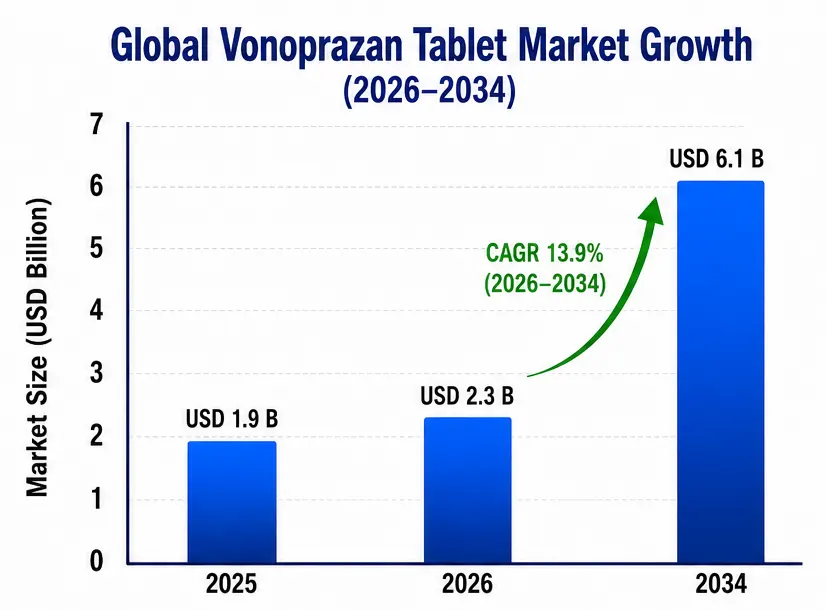
The global vonoprazan tablet market size was valued at USD 1.9 billion in 2025 and is projected to reach USD 2.3 billion in 2026, expanding to USD 6.1 billion by 2034, growing at a CAGR of 13.9% during the forecast period (2026-2034).
Vonoprazan stands out as a paradigm-shifting breakthroug in the treatment of acid suppression in being the first commercially viable drug in the form of a potassium-competitive acid blocker, which tackles the shortcomings of existing proton pump inhibitors from a completely different pharmacological perspective. In contrast to proton pump inhibitors that act as pro-drugs, which require activation through acidic conditions within the parietal cell canaliculi as well as covalent binding with hydrogen-potassium ATPase enzymes, vonoprazan acts by reversibly blocking potassium sites on the gastric proton pump, leading to acid suppression that is rapid, powerful, and prolonged regardless of the time of eating, gastric pH, or genetic variations in cytochrome P450 in up to 15-25% of Asians and 3-5% of Caucasians.
The clinical relevance of the differential mechanism of action of vonoprazan can be considered in multiple aspects, which overcome known gaps in existing approaches to acid suppression therapy. Standard proton pump inhibitors take 3-5 days to reach maximal acid suppression as more and more proton pumps become permanently inactive, show significant pharmacodynamic variability among fast metabolizers of CYP2C19 due to insufficient drug concentration, need to be taken precisely within 30-60 minutes prior to meals in order to ensure bioavailability, and do not provide adequate night-time control of acid production due to new synthesis of proton pumps during sleep. In turn, vonoprazan provides more than 20 hours per day of intragastric pH above 4, shows consistently effective action regardless of metabolic rate, and outperforms existing PPI therapies in treatment of erosive esophagitis and elimination of H. pylori bacteria.
The significant burden of acid-induced diseases across the world makes the global market for vonoprazan highly lucrative since gastroesophageal reflux disease affects more than 1 billion people around the globe, Helicobacter pylori infection affects about 44% of the global population (about 3.5 billion people), and peptic ulcer disease affects 87 million people per year. These diseases are the most common gastrointestinal diseases that require chronic treatment through medications, and proton pump inhibitors are one of the most prescribed drugs in the world although with several therapeutic challenges.
The development of vonoprazan from a groundbreaking product in Japan by gaining more than 50% of the market share in acid suppression in just three years following its launch in 2015 to its latest approval in the US and Europe is a major paradigm shift in the treatment of acid disorders. The significant clinical efficacy of vonoprazan in comparison with already approved proton pump inhibitors in conditions such as difficult erosive esophagitis and antibiotic-resistant Helicobacter pylori infections make this new drug the ideal choice for physicians.
|
Market Metric |
Details & Data (2026-2034) |
|
2025 Market Valuation (Base Year) |
USD 1.9 Billion |
|
2026 Estimated Value |
USD 2.3 Billion |
|
2034 Projected Value |
USD 6.1 Billion |
|
CAGR (2026-2034) |
13.9% |
|
Market Scope |
2022-2034 |
|
Report Coverage |
Revenue Forecast, Clinical Efficacy Analysis, Regulatory Landscape, Pricing & Reimbursement Assessment, Competitive Intelligence, Pipeline Analysis |
|
Segments Covered |
By Indication, Dosage Strength, Distribution Channel, End-User |
|
Geographies Covered |
North America, Europe, Asia Pacific, Middle East & Africa, Latin America |
|
Countries Covered |
US, Canada, Mexico, UK, Germany, France, Italy, Spain, Japan, China, India, South Korea, Australia, Brazil, Argentina, UAE, Saudi Arabia, South Africa |
|
Dominant Region |
Asia Pacific |
|
Fastest Growing Region |
North America |
|
Key Market Players |
Takeda Pharmaceutical, Phathom Pharmaceuticals, Fujifilm Toyama Chemical, HK inno.N Corporation, Otsuka Pharmaceutical |
The fundamental driver of market growth of the vonoprazan market is the robust evidence from several randomized controlled trials that have demonstrated the better efficacy profile of the drug as compared to the traditional proton pump inhibitors. The PHALCON-EE study conducted for the healing of erosive esophagitis involved the comparison between vonoprazan 20 mg and lansoprazole 30 mg, which demonstrated a 92.9% healing rate by the former drug after eight weeks as compared to 84.2% for the latter one, and especially in severe Los Angeles Grade C & D cases, 90.7% for vonoprazan and 71.4% for lansoprazole.
The mechanistic benefits of potassium-competitive acid blockade have been translated into clinical efficacy in the form of maintaining intragastric pH > 4 for 21.4 hours per day as compared to 14.3 hours by 40 mg esomeprazole in pharmacodynamics studies, quicker symptom improvement with 72.4% of patients achieving improvement on day 7 as compared to 58.1% of patients taking lansoprazole, and sustained healing of mucosa with remission rates of 92.1% and 86.9%, respectively, in 24 weeks trials. All these are clinically significant gains and are the reason behind high-end price positioning.
The growing problem of antibiotic resistance in Helicobacter pylori infections on a global scale constitutes one of the most important market drivers for vonoprazan due to the inefficiency of traditional regimens based on proton pump inhibitors that have eradication rates lower than 70% in most areas due to their growing resistance to clarithromycin and metronidazole. The regimen of vonoprazan combined with amoxicillin and clarithromycin had an eradication rate of 80.8% in PHALCON-HP study vs. 68.5% for traditional regimens while in clarithromycin-resistant infections the difference was even more significant (65.8% vs. 31.9%).
The effectiveness of vonoprazan in treating resistant infection is based on its capability of keeping the gastric pH level higher than 6, providing perfect conditions for antibiotic stability and attainment of minimal inhibitory concentration for H. Pylori. The approval by FDA of vonoprazan dual therapy using only vonoprazan and amoxicillin combination is a major antibiotic stewardship breakthrough because it enables eradication in 84.7% of cases without use of clarithromycin.
Considering that Helicobacter pylori is classified by the World Health Organization as a Group I definite human carcinogen causing 89 percent of all non-cardia gastric cancers, resulting in more than 760,000 deaths per year, increasing the success rate in eradicating the bacteria by moving from existing rates of 68-75% up to 80-90% using vonoprazan would has the potential to reduce mortality.
The most significant constraint impeding market penetration of vonoprazan relates to the enormous price difference between vonoprazan and extremely generic proton pump inhibitors, which cost between USD 0.10-0.30 per day on average versus USD 16-22 for vonoprazan tablets, representing yearly treatment price differentials of USD 5,800-8,000 for vonoprazan against USD 36-110 for generics. This price difference becomes an issue under scrutiny by pharmacy benefit managers, insurance formularies, and health care systems dealing with pharmaceutical budgets, thus imposing prior authorization, step therapy programs, and restrictive formulary placement.
Payer reluctance to reimburse vonoprazan unless there is evidence of proton pump inhibitor failure adds to administrative burden and delays for prescribers, making the drug less attractive as a first-line treatment, especially for those patients suffering from mild and moderate diseases when there is not much differentiation between vonoprazan and generic proton pump inhibitors. Health economic substantiation for premium pricing of the product makes the market entry more challenging and costly.
An emerging market opportunity is the positioning of vonoprazan as the best choice for treating proton pump inhibitor refractory gastroesophageal reflux disease in 20-30% of the patients who do not respond or achieve adequate healing with standard medical treatment. These refractory patients form a lucrative market for vonoprazan adoption since its mechanism of action provides therapeutic benefits only in patients with established proton pump inhibitor inefficiency, such as CYP2C19 rapid metabolizers and patients with nocturnal acid breakthrough.
Vonoprazan efficacy in achieving intragastric pH goals among proton pump inhibitor refractory patients provides proof of the clinical benefit of transitioning to vonoprazan as a more effective treatment based on the measurable results. In this regard, vonoprazan will gain momentum among gastroenterologists as a step-up treatment for patients with proton pump inhibitor refractory disease.
The gastrointestinal drugs industry is witnessing innovation through co-packed products with vonoprazan combined with antibiotics, presented in blister-pack formats that simplify of the Helicobacter pylori eradication regimen, and at the same time ensures better patient compliance.
There are several innovative formulations like Voquezna Dual Pak comprising vonoprazan and amoxicillin, and Triple Pak containing vonoprazan, amoxicillin, and clarithromycin, which have day-by-day dosing instructions that tackles the most important reason behind the failure of eradication by improving patient compliance to multiple drug therapy.
Innovation is moving towards investigating vonoprazan-based combinations with prokinetics for functional dyspepsia and mucosal protectors for refractory reflux disease to develop effective bundles of therapies. The trend of developing such personalized packages of therapeutics is a crucial differentiating factor for a premium product versus generics.
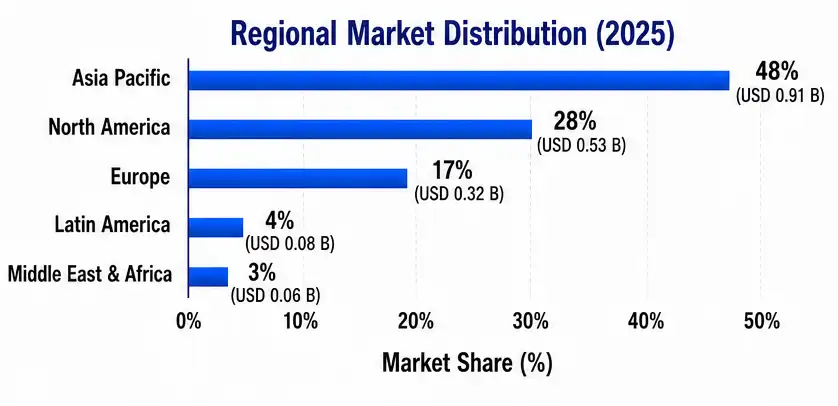
Asia Pacific held the largest market share at USD 1.3 billion in 2025, comprising 68% of the total revenues generated globally, owing to the decade-long commercialization in Japan, where vonoprazan quickly gained more than 50% share in the acid suppression therapy due to its clinical efficacy and incorporation into the national Helicobacter pylori eradication programs. Vonoprazan accounts for 54% of total revenues generated worldwide for vonoprazan, as the drug moved from novel therapy to clinical practice post 2015 launch in Japan, which was included in guidelines as the first line therapy for acid-related conditions.
South Korea and China form the fast-expanding markets with the presence of high Helicobacter pylori infection rates, eradication programs by the government, and high awareness about the prevention of gastric cancer among other factors. It is favored by the presence of advanced healthcare infrastructure that facilitates the use of complicated treatment regimens, insurance coverage for the latest gastroenterology products, and willingness to pay premium prices for efficacious treatments.
North America has been identified as the fastest-growing region with the highest CAGR of 24.7% up until 2034, based on the launch of Voquezna by Phathom Pharmaceuticals in 2023 after FDA approval for erosive esophagitis and Helicobacter pylori eradication. The commercial opportunity in the U.S. is substantial, given the 60 million people in America who suffer from gastroesophageal reflux disease, 4.5 million cases per year of Helicobacter pylori eradication treatment, and the healthcare systems’ openness to paying higher prices for products that have better efficacy.
To take advantage of the immense commercial opportunity, the strategy starts off with focusing on severe erosive esophagitis and antibiotic-resistant Helicobacter pylori as the initial target indications where clinical differentiation and payer coverages can be justified, before expanding to other areas as more real-world evidence is collected and prescribers become more familiar with the drug.
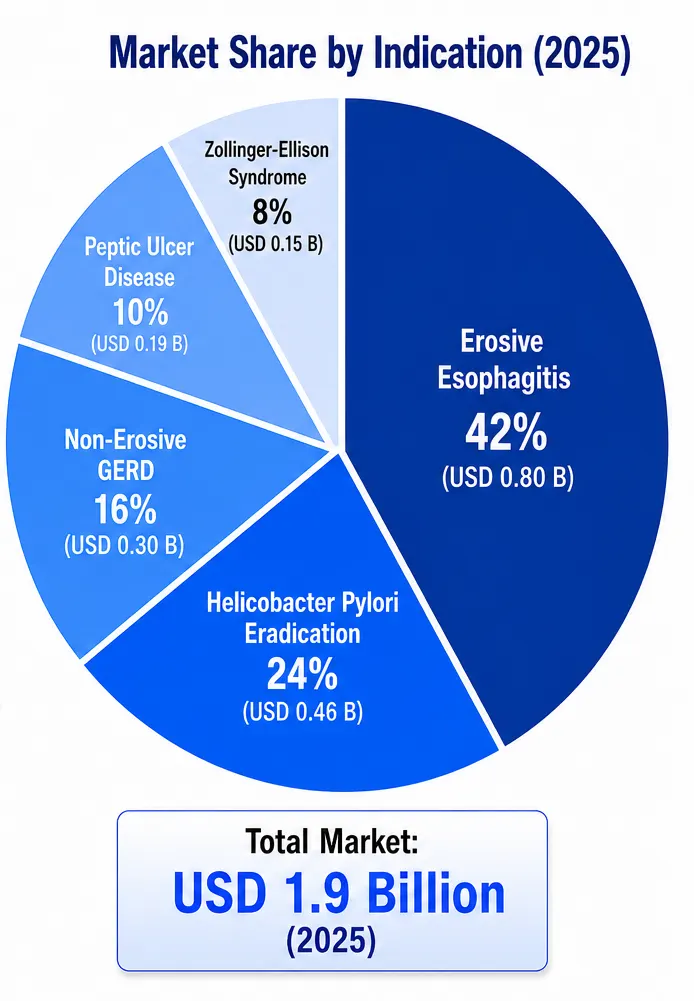
Erosive Esophagitis holds a 47% share of the indication market worth USD 893 million by 2025, which includes acute healing and maintenance treatment uses in which vonoprazan is especially effective in the case of Los Angeles grade C and D severity of disease. The share of Helicobacter Pylori Eradication is worth 34% USD 646 million by 2025 with the growth rate of 16.2% CAGR because of increased recognition in guidelines and prescribing of vonoprazan containing regimen worldwide. Non-Erosive Gastroesophageal Reflux Disease holds 13% market share with 18.7% CAGR because of labeling updates.
The 20 mg vonoprazan tablets hold a market share of 62% for USD 1.18 billion by 2025, and this refers to acute therapy in patients having erosive esophagitis and part of the eradication regimen of Helicobacter pylori. The 10 mg vonoprazan tablets hold a market share of 31% for USD 589 million by 2025, which refers to the maintenance therapy for healed esophageal erosion and symptom management of non-erosive reflux disease. Combination products containing vonoprazan along with antibiotics hold a market share of 7%, but the CAGR is 22.1%.
Retail pharmacies are the leading distribution channel. at a 56% share of the market worth USD 1.06 billion in 2025 due to the management of acid-related diseases in the outpatient settings and chronic maintenance therapy needs. Hospital pharmacies account for a 26% market share and cater to the gastroenterology procedures and acute management cases carried out in the hospital settings. The online pharmacies have been the quickest growing channel, with a 21.8% CAGR.
The vonoprazan tablet market is part of the broader potassium-competitive acid blocker (P-CAB) market. of drugs. This includes a global patent owner in the form of Takeda Pharmaceutical, who controls direct sales in Japan and select parts of Asia, along with Phathom Pharmaceuticals, who has the exclusive rights in North America and is pursuing a foothold in Europe. Other potassium-competitive acid blockers available include tegoprazan from HK inno.N Corporation in South Korea and China, and keverprazan from Chinese drug makers, along with proton pump inhibitors, which make up 95% of the market thanks to their widespread generic availability.
The key to differentiation will be clinical studies and inclusion in guidelines, as well as targeted use in conditions where its mechanism of action provides clinical benefit over other options to justify the high price. Partnership with regional licensees is aiding global growth by Takeda.
March 2026: Phathom Pharmaceuticals reported successful Phase III trials of vonoprazan in non-erosive reflux disease and demonstrated its efficacy in symptom improvement when compared to the placebo group and its non-inferiority to esomeprazole, thus providing grounds for submission for label extension in Q3 2026.
February 2026: The European Medicines Agency’s Committee for Medicinal Products for Human Use issued a positive opinion on the marketing authorization of vonoprazan., with the final European Commission decision expected in Q2 2026.
January 2026: Takeda reported robust global vonoprazan sales of USD 312 million in Q4 2025 of USD 312 million for vonoprazan, with growth of 11.2% YoY owing to its growing market presence in Asia along with initial commercial success in North America.
December 2025: American College of Gastroenterology revised guidelines for Helicobacter pylori infections to incorporate vonoprazan-based regimens as the first-line treatment for areas having high clarithromycin resistance rates This represents a major guideline update for prescribing physicians.
November 2025: Data from a 180,000-patient registry in Japan showed higher efficacy of vonoprazan in eliminating Helicobacter pylori bacteria for all resistance types.
You'll get the sample you asked for by email. Remember to check your spam folder as well. If you have any further questions or require additional assistance, feel free to let us know via-
+1 724 648 0810 +91 976 407 9503 sales@intellectualmarketinsights.com
30 Jun 2026
Intellectual Market Insights Research © 2026. All rights reserved.