
Top Aircraft Engine Companies 2026 Fuel-Efficient Propulsion
Author:
Intellectual Market Insights Research
Published Date:
09 Jul 2026
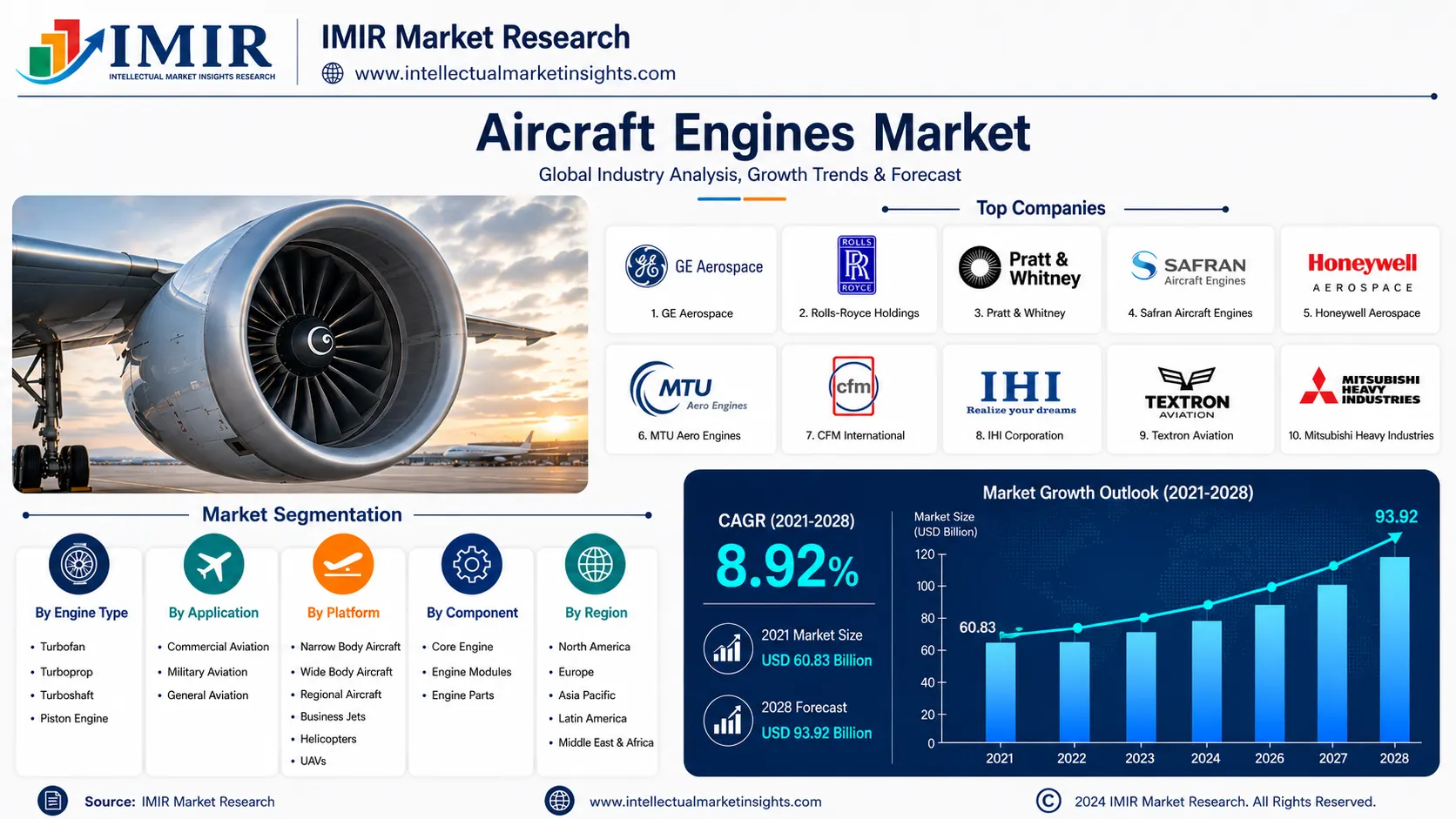
Top Leading Companies Transforming the Global Aircraft Engine Market in 2026: Fuel Efficiency, Sustainable Propulsion, and the Future of Flight
Five years ago, the aircraft engine business was a story about backlogs and delivery schedules. That story has been rewritten by supply shocks the industry did not fully see coming. A production ramp-up interrupted by the pandemic, a persistent shortage of forgings and castings, a geared-turbofan durability issue that grounded hundreds of narrow-body jets worldwide, and record aircraft order books at Boeing and Airbus have combined to make one fact unavoidable to airline executives and defense procurement officers alike: the manufacturers that can build, certify, and sustain engines fastest now set the pace for the entire aviation industry, and the ones that cannot are costing their airline customers billions in grounded capacity.
At the same time, climate commitments from governments and airlines are permanently rewiring how new engines get designed, while a generation of digital-twin and predictive-maintenance tooling has made it possible to monitor engine health at a level of granularity that was simply unaffordable a decade ago. The result is a market in the middle of a structural re-rating. Independent estimates of the global Aircraft Engine Market now cluster around the $100 billion mark for 2024, with most analyst houses projecting a climb toward $170–185 billion by the early-to-mid 2030s, at compound annual growth rates between roughly 5.8% and 9%, depending on scope and methodology. Several forecasts now explicitly cite open-fan architecture, hybrid-electric propulsion, and sustainable aviation fuel compatibility not simply higher bypass ratios as the primary growth drivers for the remainder of the decade.
What is happening underneath those numbers is more interesting than the numbers themselves. The aircraft engine is no longer just a mechanical powerplant. It is becoming a connected, data-generating asset and, increasingly, a platform for entirely new propulsion architectures hardware that does not just burn fuel more efficiently, but reports its own wear patterns, schedules its own maintenance visit, and is being redesigned from the turbine disc outward to run on a fundamentally different balance of fuel, electricity, and airflow. This article tells that story: how Aircraft Engine Market leaders are racing from single-shaft turbofan architecture toward geared, open-fan, and hybrid-electric propulsion systems and who is best positioned to own that future.
Market Snapshot
|
Category |
Details |
|---|---|
|
Market Size (2024) |
~USD 100 billion |
|
Projected Market Size (Early-to-Mid 2030s) |
USD 170–185 billion |
|
CAGR (Forecast Period) |
~5.8% to 9% |
|
Base Year |
2024 |
|
Forecast Period |
2025 – Early/Mid 2030s |
|
Largest Regional Market |
North America |
|
Fastest-Growing Region |
Asia-Pacific |
|
Leading Companies |
GE Aerospace, Rolls-Royce Holdings, Pratt & Whitney, Safran Aircraft Engines, Honeywell Aerospace, MTU Aero Engines, CFM International, IHI Corporation, Textron Aviation, Mitsubishi Heavy Industries |
|
Key Growth Drivers |
Fuel efficiency & emissions regulation, sustainable aviation fuel adoption, defense modernization, aftermarket/MRO expansion, AI-powered predictive maintenance, supply chain resilience, urban/regional air mobility |
|
Key Technology Trends |
Open-fan architecture, hybrid-electric propulsion, digital twin technology, ceramic matrix composites, additive manufacturing, hydrogen-compatible propulsion, FADEC advancements |
|
Dominant Engine Architecture |
High-bypass turbofan (transitioning toward geared turbofan & open-fan designs) |
|
Major Industry Challenge |
Persistent shortages of forgings, castings, and specialty materials constraining production since 2023 |
|
Emerging Disruptors |
ZeroAvia, magniX, hydrogen-fuel-cell aviation specialists, independent MRO providers, urban air mobility developers |
The Evolution of Aircraft Engine Technology
The Turbojet Era: Raw Thrust Over Efficiency
For the first decades of the jet age, engine design was a story about raw thrust. Early turbojets from Rolls-Royce, Pratt & Whitney, and General Electric prioritized speed and altitude performance, with fuel burn and noise treated as secondary concerns. These engines were transformational for their era, compressing intercontinental travel from days to hours, but they were mechanically simple and thermodynamically inefficient by modern standards, burning through fuel at a rate that would be commercially unviable today.
The Turbofan Revolution and the Widebody Age
The 1960s and 1970s brought the high-bypass turbofan, and with it, three structural shifts: dramatically lower fuel burn per passenger mile, quieter operation that unlocked airport growth near population centers, and engines powerful enough to make wide-body jets like the Boeing 747 commercially viable. Rolls-Royce's Trent family and GE's CF6 and GE90 lineages turned engine selection into one of the most consequential decisions an airframe manufacturer could make, often locking airlines into a single engine supplier for the operational life of a fleet.
Geared Turbofan and the Efficiency Breakthrough
The next inflection point arrived when Pratt & Whitney commercialized the geared turbofan, decoupling the fan and low-pressure turbine so each could spin at its own optimal speed through a planetary gearbox. The PW1000G family, which now powers the Airbus A320neo and A220 families, delivers roughly 16% lower fuel burn, a 75% reduction in noise footprint, and 50% lower regulated emissions versus the previous generation but the technology's early durability issues, particularly powder-metal contamination that forced widespread fleet inspections, also became a cautionary tale about the operational risk of architectural leaps.
Digital Engine Health and Predictive Maintenance
Full Authority Digital Engine Control systems and onboard sensor networks have matured from basic monitoring into real-time diagnostic platforms. Engine manufacturers now run continuous telemetry against a living model of each individual engine's wear pattern, allowing airlines to schedule a shop visit before a fault occurs rather than reacting to an in-flight event compressing maintenance planning that once relied on fixed inspection intervals into condition-based, engine-specific schedules.
Open-Fan and Hybrid-Electric: The Current Frontier
The defining shift of 2025–2026 is the move beyond the conventional ducted turbofan altogether. GE Aerospace and Safran are jointly developing the RISE open-fan demonstrator, targeting a further 20% fuel-burn reduction through an unducted architecture, while Rolls-Royce's UltraFan program has already logged a 25% efficiency improvement over first-generation Trent engines in ground testing. Pratt & Whitney and Collins Aerospace are simultaneously developing hybrid-electric systems for 30–50 seat regional aircraft, targeting entry into service around 2030 a genuinely new propulsion category rather than an incremental refinement of the turbofan.
Market Forces Reshaping the Industry
Fuel Efficiency and Emissions Regulation. Rising jet fuel costs and tightening carbon regulation have made fuel burn the single largest lifetime cost variable in an airline's fleet decision, pushing every major OEM to compete primarily on efficiency rather than raw thrust or price.
Sustainable Aviation Fuel and Alternative Propulsion. Airlines and regulators are accelerating adoption of sustainable aviation fuel blends, while hydrogen and hybrid-electric propulsion programs are moving from concept demonstrators toward funded development programs aimed at regional and short-haul routes.
Defense Modernization. Governments worldwide are increasing military aviation budgets, driving demand for next-generation fighter and transport aircraft engines and giving manufacturers with strong defense portfolios, such as GE Aerospace, Rolls-Royce, and Pratt & Whitney, a second durable revenue base beyond commercial aviation.
Aftermarket and MRO Expansion. With record order backlogs colliding against a persistent shortage of forgings, castings, and skilled labor, engine maintenance, repair, and overhaul has become as strategically important as new engine production a dynamic reflected in the expansion of aftermarket programs like the Engine Assurance Program across Rolls-Royce, GE Aerospace, and Pratt & Whitney Canada platforms.
Digital Twin and AI-Powered Diagnostics. The fusion of sensor telemetry with AI inference is allowing manufacturers to predict component fatigue before it becomes a safety event, shifting the commercial relationship between OEM and airline from a parts-and-labor transaction toward long-term, outcome-based service contracts.
Supply Chain Resilience. Persistent shortages of specialty forgings, castings, and rare-earth-dependent components have made supplier diversification and vertical integration a board-level priority, with manufacturers increasingly bringing critical machining and additive-manufacturing capacity in-house rather than relying solely on multi-tier suppliers.
Urban and Regional Air Mobility. Emerging electric and hybrid-electric aircraft programs targeting regional and urban routes are creating an entirely new addressable market for lightweight propulsion systems, distinct from the large commercial turbofan segment that has defined the industry for decades.
Top Leading Companies Shaping the Aircraft Engine Market
- GE Aerospace
- Rolls-Royce Holdings
- Pratt & Whitney
- Safran Aircraft Engines
- Honeywell Aerospace
- MTU Aero Engines
- CFM International
- IHI Corporation
- Textron Aviation
- Mitsubishi Heavy Industries
1. GE Aerospace
|
Category |
Details |
|---|---|
|
Company Name |
GE Aerospace |
|
Headquarters |
Evendale, Ohio, USA |
|
Founded |
1917 |
|
Industry Focus |
Commercial & Military Aircraft Engines, Aviation Technology, Propulsion Systems |
|
Global Presence |
Operations across North America, Europe, Asia-Pacific, and the Middle East, serving airlines, defense agencies, and OEMs worldwide |
|
Company Overview |
GE Aerospace is one of the world's largest aircraft engine manufacturers, supplying propulsion systems for commercial, military, and cargo aviation. Spun off as an independent company in 2024, it holds sole-source or shared engine positions on major Boeing wide-body platforms and, through its CFM International joint venture with Safran, powers the majority of the world's narrow-body fleet. |
|
Key Products & Services |
GE9X, GEnx, GE90-115B, CF6, CFM56 & LEAP (via CFM International), Military Jet Engines, RISE Open-Fan Program |
|
Market Position |
Global leader in wide-body commercial and military aircraft propulsion, with an installed base of approximately 45,000 engines including CFM figures |
|
Recent Developments |
Advancing the RISE open-fan demonstrator with Safran targeting ~20% fuel-burn reduction; scaling production to address industry-wide forging and casting shortages |
|
Strategic Advantages |
Sole-source positions on flagship wide-body programs, unmatched installed base, strong defense portfolio, and joint-venture scale through CFM International |
2. Rolls-Royce Holdings
|
Category |
Details |
|---|---|
|
Company Name |
Rolls-Royce Holdings plc |
|
Headquarters |
London, United Kingdom |
|
Founded |
1904 |
|
Industry Focus |
Wide-Body Commercial Aircraft Engines, Defense Propulsion, Power Systems |
|
Global Presence |
Operations across Europe, North America, and Asia, with major facilities in the UK, Germany, and Singapore |
|
Company Overview |
Rolls-Royce is a leading manufacturer of wide-body aircraft engines and the European counterpart to GE and Pratt & Whitney in long-haul propulsion. Its Trent engine family powers a significant share of the global wide-body fleet, and the company is exclusive powerplant supplier for the Airbus A350. |
|
Key Products & Services |
Trent XWB, Trent 1000, Trent 7000, UltraFan Demonstrator, Military & Defense Engines, Power Systems |
|
Market Position |
Leading player in the wide-body long-haul engine segment, with strong incumbency on Airbus platforms |
|
Recent Developments |
Committed roughly £1 billion to a Trent 1000 durability upgrade program, including a new "XE" retrofit offering up to 30% improved time-on-wing; UltraFan demonstrator has shown 25% efficiency gains over first-generation Trent engines |
|
Strategic Advantages |
Deep wide-body incumbency, strong defense and power systems diversification, and continued heavy investment in next-generation efficient architecture |
3. Pratt & Whitney
|
Category |
Details |
|---|---|
|
Company Name |
Pratt & Whitney (a subsidiary of RTX Corporation) |
|
Headquarters |
East Hartford, Connecticut, USA |
|
Founded |
1925 |
|
Industry Focus |
Commercial & Military Aircraft Engines, Geared Turbofan Technology, Hybrid-Electric Propulsion |
|
Global Presence |
Operations across North America, Europe, and Asia, with global MRO and joint-venture partnerships (e.g., International Aero Engines) |
|
Company Overview |
Pratt & Whitney is a century-old aerospace engine manufacturer known for pioneering the geared turbofan, a major architectural departure from traditional single-shaft turbofan design. Its PW1000G family powers the Airbus A320neo and A220 families and represents the largest commercial engine program in company history. |
|
Key Products & Services |
PW1100G, PW1500G, PW4000, F135 Military Engine, Hybrid-Electric Regional Propulsion (with Collins Aerospace) |
|
Market Position |
Second-largest engine manufacturer by sales volume, with over $28 billion in 2024 revenue and roughly 43,000 employees |
|
Recent Developments |
Secured over 1,100 engine orders in H1 2025 despite prior geared-turbofan durability issues; advancing hybrid-electric propulsion for 30–50 seat regional aircraft targeting service entry around 2030 |
|
Strategic Advantages |
Proven geared-turbofan fuel-efficiency advantage, strong narrow-body order book, and early leadership in hybrid-electric regional propulsion development |
4. Safran Aircraft Engines
|
Category |
Details |
|---|---|
|
Company Name |
Safran Aircraft Engines (Safran SA) |
|
Headquarters |
Paris, France |
|
Founded |
1945 |
|
Industry Focus |
Commercial & Military Aircraft Engines, Aerospace Equipment, Propulsion Systems |
|
Global Presence |
Operations across Europe, North America, and Asia, with a global aftermarket support network through its CFM joint venture |
|
Company Overview |
Safran is a major French aerospace manufacturer best known for its 50/50 CFM International joint venture with GE Aerospace, which dominates the narrow-body commercial engine segment. Beyond propulsion, Safran maintains a broad aerospace equipment portfolio spanning adjacent aircraft systems. |
|
Key Products & Services |
CFM56, LEAP Engines (via CFM International), RISE Open-Fan Program, Aerospace Equipment & Systems |
|
Market Position |
Co-leader of the world's highest-volume narrow-body engine platform through CFM International |
|
Recent Developments |
Jointly advancing the RISE open-fan demonstrator with GE Aerospace, targeting a 20% fuel-burn reduction through unducted fan architecture |
|
Strategic Advantages |
Insulated exposure through CFM's dominant narrow-body position, broad aerospace systems engineering depth, and shared R&D funding for next-generation propulsion |
5. Honeywell Aerospace
|
Category |
Details |
|---|---|
|
Company Name |
Honeywell Aerospace (Honeywell International Inc.) |
|
Headquarters |
Phoenix, Arizona, USA |
|
Founded |
1906 |
|
Industry Focus |
Business & Regional Aircraft Engines, Helicopter Propulsion, Avionics, Connected Aviation Technology |
|
Global Presence |
Operations across North America, Europe, and Asia-Pacific, serving business aviation, helicopter, and defense customers globally |
|
Company Overview |
Honeywell Aerospace focuses on business jet, helicopter, and defense propulsion rather than large commercial narrow-body or wide-body engines, pairing its engines with a broad avionics and connected-aircraft technology portfolio for an integrated systems offering. |
|
Key Products & Services |
Business Jet Turbofan Engines, Helicopter Turboshaft Engines, Avionics Systems, Connected Aircraft Health Monitoring |
|
Market Position |
Leading propulsion and systems provider in business aviation, helicopter, and defense aircraft segments |
|
Recent Developments |
Continued integration of real-time aircraft health monitoring and predictive diagnostics across its avionics and propulsion product lines |
|
Strategic Advantages |
Differentiated propulsion-plus-avionics bundle, strong business/general aviation specialization, and deep connected-aircraft technology capability |
Competitive Landscape
The global Aircraft Engine Market is highly consolidated at the top, with a small group of established aerospace propulsion giants competing alongside specialized component manufacturers and program partners. Companies are investing heavily in open-fan architecture, hybrid-electric propulsion, digital twin technology, predictive maintenance analytics, and additive manufacturing to strengthen their market positions.
Strategic joint ventures, long-term aftermarket service contracts, capacity expansion initiatives, and continuous propulsion innovation remain key competitive strategies. Vendors are increasingly focusing on platform-specific solutions that address the unique operational requirements of commercial narrow-body, wide-body, business aviation, military, and regional aircraft segments.
Long-term maintenance, repair, and overhaul (MRO) service agreements continue to gain traction, allowing airlines to reduce unscheduled downtime while manufacturers secure decades of predictable aftermarket revenue.
Regional Market Analysis
North America
North America remains the largest market for aircraft engines due to the presence of major manufacturers such as GE Aerospace and Pratt & Whitney, extensive domestic and international airline fleets, and significant investments in next-generation propulsion R&D.
Europe
Europe is experiencing steady growth driven by Rolls-Royce's and Safran's continued leadership in wide-body and narrow-body propulsion, aviation sustainability regulations, and increasing adoption of digital engine health monitoring platforms.
Asia-Pacific
Asia-Pacific is projected to witness the fastest growth during the forecast period. Rapid fleet expansion, growing domestic air travel demand, expanding manufacturing capabilities, and government-led aerospace industrialization programs are driving demand across China, India, Japan, South Korea, and Southeast Asia.
Latin America
Growing investments in airline fleet modernization and regional air connectivity are encouraging carriers to adopt newer, fuel-efficient engine technologies across the region.
Middle East & Africa
The Middle East & Africa is gradually emerging as a promising market due to expanding long-haul hub airlines, growing wide-body fleet orders, and increasing investments in aviation infrastructure and MRO capacity.
Emerging Technology Trends
The future of the aircraft engine industry will be shaped by several transformative technologies:
- Open-Fan Architecture for next-generation fuel efficiency
- Hybrid-Electric Propulsion for regional aircraft
- Artificial Intelligence for predictive maintenance and diagnostics
- Digital Twin technology for engine health simulation
- Sustainable Aviation Fuel (SAF) compatible combustion systems
- Ceramic Matrix Composites for higher thermal efficiency
- Additive Manufacturing for lighter, more durable components
- Full Authority Digital Engine Control (FADEC) advancements
- Hydrogen-compatible propulsion research
- Autonomous inspection and robotics in MRO operations
Emerging Challengers and Disruptors
A second tier of specialists is reshaping the edges of the market faster than the legacy majors can fully absorb. Electric and hydrogen-electric propulsion developers such as ZeroAvia and magniX are targeting regional and short-haul aircraft with zero- or low-emission powertrains, aiming to certify propulsion systems for routes the large commercial OEMs have largely left uncontested. Hydrogen-fuel-cell aviation specialists are pushing parallel programs aimed at proving out cryogenic hydrogen storage and fuel-cell propulsion for smaller aircraft, a technology path distinct from the combustion-based sustainable aviation fuel strategy pursued by the major OEMs. Independent MRO providers are also expanding aggressively into engine aftermarket services, competing for the maintenance and overhaul revenue that has become increasingly central to OEM profitability as new-engine production remains constrained by supply-chain bottlenecks.
Beyond these propulsion-focused challengers, a wave of urban and regional air mobility developers is targeting lightweight electric and hybrid-electric propulsion as a standalone discipline, distinct from the large commercial turbofan segment, while digital-twin and predictive-maintenance software specialists are increasingly focused on engine health analytics categories that traditional engine OEMs built internal capability for a generation ago but now face genuine outside competition in.
Future Outlook: The Road to Next-Generation Propulsion
The next five years will be defined by five converging capabilities. Open-fan architecture will move from ground-test demonstrator toward certified commercial product, as GE, Safran, and Rolls-Royce race to prove their respective efficiency claims translate into a reliable, in-service engine. Hybrid-electric regional propulsion will extend Pratt & Whitney and Collins Aerospace's early development work toward a genuinely new category of 30–50 seat aircraft entering service around 2030. Sustainable aviation fuel compatibility will move from a blended, incremental measure toward a design requirement built into every next-generation engine from the outset. Predictive maintenance will fuse sensor telemetry with AI-driven diagnostics to anticipate component fatigue days, not flight hours, before it becomes a safety event, further shifting OEM revenue toward long-term service contracts. And supply chain resilience will increasingly define competitive position, as manufacturers that can secure forgings, castings, and specialty materials capacity outpace rivals still constrained by the shortages that have defined the industry since 2023.
Expert Analysis
Three categories of manufacturer are best positioned for durable leadership a decade out, and the dividing line is installed-base economics as much as engineering talent.
The first category is the wide-body and defense incumbents GE Aerospace and Rolls-Royce chief among them whose advantage compounds over time because sole-source or near-sole-source positions on flagship long-haul and military platforms generate decades of predictable aftermarket revenue that funds the next architectural leap. Their risk is execution, not demand: the same forging and casting shortages constraining the entire industry can turn a strong order book into a customer-relations liability, as Pratt & Whitney's geared-turbofan durability issue demonstrated.
The second category is the architecture-native bet-makers Pratt & Whitney with the geared turbofan, and the GE-Safran RISE partnership with open-fan design who have committed capital to a genuine mechanical departure from the conventional turbofan rather than incremental refinement. This is a higher-risk, higher-reward path: it can deliver a durable efficiency advantage, as the PW1000G family has largely proven despite its reliability setbacks, but it also carries meaningfully higher technical and reputational risk than sustaining a proven architecture.
The third category is the partnership and aftermarket specialists MTU Aero Engines, IHI Corporation, and Mitsubishi Heavy Industries chief among them whose moat is deep participation in major programs and strong regional MRO and component-manufacturing positions rather than ownership of a flagship engine brand. These companies become structurally more valuable as new-engine production remains supply-constrained, because aftermarket and component revenue grows even when new engine deliveries do not.
By the mid-2030s, the most probable outcome is not a single dominant architecture but a stratified market: wide-body and defense incumbents owning the highest-value long-haul and military segments, architecture-native bet-makers owning whichever next-generation platform proves most reliable in service, and partnership specialists owning the component and aftermarket layer that connects them all. Manufacturers that fail to commit decisively to one of these positions remaining a generalist, mid-tier supplier without a defensible platform or aftermarket advantage face the greatest consolidation risk in a market where engine development costs continue to rise.
Frequently Asked Questions (FAQs)
1. What is an aircraft engine?
An aircraft engine, or aero engine, is the propulsion system that generates the thrust or power required for an aircraft to take off, fly, and land, spanning turbofan, turboprop, turboshaft, and piston engine types.
2. Which industries use aircraft engines?
Commercial aviation, military and defense, business and general aviation, cargo and logistics, and helicopter operators are among the primary users.
3. Why is fuel efficiency becoming a bigger priority in engine design?
Rising fuel costs, tightening carbon emissions regulations, and airline profitability pressures have made fuel burn the single largest lifetime cost variable in engine selection, driving demand for geared turbofan, open-fan, and hybrid-electric architectures.
4. How does AI improve aircraft engine performance and maintenance?
Artificial intelligence enhances predictive maintenance, component fatigue forecasting, real-time engine health monitoring, and maintenance scheduling, improving both operational reliability and cost efficiency.
5. Who are the leading companies in the Aircraft Engine Market?
Leading companies include GE Aerospace, Rolls-Royce Holdings, Pratt & Whitney, Safran Aircraft Engines, Honeywell Aerospace, MTU Aero Engines, CFM International, IHI Corporation, Textron Aviation, and Mitsubishi Heavy Industries.
Conclusion
The Aircraft Engine Market of 2026 rewards a different evaluation framework than the one airlines and defense buyers used a decade ago. Three recommendations follow directly from the evidence above.
First, evaluate manufacturers on architecture risk and aftermarket depth together, not engine specifications alone. A platform with genuinely differentiated efficiency, like the geared turbofan, can deliver real fuel-burn advantages, but buyers must weigh that against demonstrated in-service reliability, not just certification-stage performance claims.
Second, weight supply chain resilience as seriously as technology roadmap. The forging, casting, and specialty-materials shortages that have constrained deliveries since 2023 are not resolving quickly, and a manufacturer's ability to secure capacity matters as much as its next-generation engine's projected efficiency gain.
Third, match manufacturer specialization to mission profile rather than brand prestige. A regional or business aviation operator is often better served by Honeywell's or Textron's segment-specific depth than by a wide-body-focused major built for a different scale of operation entirely, while a long-haul or defense-focused buyer should weight GE Aerospace's and Rolls-Royce's flagship-platform incumbency and aftermarket support network as heavily as any single efficiency figure.