
Top 20 Companies in the Global Gypsum Board Market Driving Industry Growth in 2026
Author:
Intellectual Market Insights Research
Published Date:
06 Jul 2026
Introduction
The global construction industry is undergoing a profound transformation, and at the heart of this evolution sits one of the most versatile and widely adopted building materials of the modern era gypsum board. From the sleek office towers of Dubai to the suburban homes of the American Midwest, gypsum board also commonly known as drywall, plasterboard, or wallboard has become the backbone of interior construction worldwide.
The global gypsum board market was valued at approximately USD 55.91 billion in 2023 and is on a remarkable growth trajectory, expected to reach USD 137.89 billion by 2031, expanding at a robust compound annual growth rate (CAGR) of 12.7% over the forecast period from 2024 to 2031. These numbers tell a compelling story: gypsum board is not merely a construction commodity it is a high-growth industry sector driven by urbanization, sustainability mandates, and rapid infrastructure development across emerging economies.
So what exactly is gypsum board? At its core, gypsum board is a panel made of calcium sulfate dihydrate (gypsum) sandwiched between two sheets of facer and backer paper. It is used as an interior wall and ceiling lining, prized for its fire resistance, acoustic insulation, ease of installation, and cost-effectiveness. Compared to traditional lath-and-plaster construction, gypsum board dramatically reduces labor time and cost, making it the preferred choice for both residential and commercial builders globally.
Several powerful forces are propelling this market forward in 2026 and beyond. First, rapid urbanization in developing economies particularly China, India, Indonesia, and Brazil is creating a construction supercycle that demands lightweight, affordable, and sustainable interior building solutions. Emerging-economy governments are investing heavily in affordable housing programs, smart cities, and commercial infrastructure, all of which rely heavily on gypsum board products.
Second, the global shift toward energy-efficient buildings is creating strong demand for gypsum board products with enhanced thermal and acoustic performance. Green building certifications such as LEED, BREEAM, and EDGE explicitly reward buildings that incorporate sustainable interior materials, pushing developers to adopt gypsum board over alternatives.
Third, North America and Western Europe already mature markets are experiencing a powerful renovation and remodeling wave, further supported by post-pandemic housing booms and a surge in home improvement spending. The U.S. residential housing market continues to benefit from sustained employment growth and mortgage accessibility, driving consistent wallboard demand.
Finally, the frequency of natural disasters in the United States including hurricanes, wildfires, and floods is paradoxically driving reconstruction activity, creating additional demand spikes for gypsum board in affected regions.
Understanding which companies lead this dynamic, rapidly expanding market is critical for investors, construction professionals, procurement specialists, and industry analysts. This article provides an authoritative, research-based analysis of the top companies in the global gypsum board market, covering their strategies, market positions, key products, and recent developments, alongside a comprehensive regional and competitive landscape review.
Market Overview
|
Parameter |
Details |
|---|---|
|
Market Size (2023) |
USD 55.91 Billion |
|
Projected Market Size (2031) |
USD 137.89 Billion |
|
CAGR (2024–2031) |
12.7% |
|
Base Year |
2023 |
|
Forecast Period |
2024–2031 |
|
Leading Product Segment |
Wallboard (50.3% market share, 2023) |
|
Leading Application Segment |
Residential |
|
Fastest-Growing Application |
Pre-Engineered Metal Buildings (CAGR 12.9%) |
|
Dominant Region (Volume) |
Asia-Pacific |
|
Key Growth Drivers |
Urbanization, sustainable construction, energy efficiency regulations |
|
Key Challenges |
Environmental concerns, landfill restrictions, rising raw material costs |
|
Key Opportunities |
Recycling innovations, green building mandates, emerging market infrastructure spending |
Why the Gypsum Board Market is Growing
1. Urbanization and Emerging Economy Construction Boom
Asia-Pacific represents the single most powerful growth engine for the gypsum board industry. Countries like China, India, Indonesia, and Vietnam are witnessing unprecedented urban migration, with millions of people relocating from rural to urban areas each year. This drives massive demand for affordable residential construction, in which gypsum board is the preferred interior finishing solution. India's PEB (Pre-Engineered Building) sector alone is growing at over 25%, with gypsum board playing a central role in these structures.
2. Sustainability and Green Building Regulations
Environmental regulations are becoming increasingly stringent worldwide. Building codes in North America, the European Union, and increasingly in Asia now require or incentivize the use of low-carbon, recyclable building materials. Gypsum board particularly recycled-content gypsum board is well-positioned to benefit from these trends. The recycling of gypsum board is gaining traction, especially in Europe, where manufacturers like Saint-Gobain and Knauf have established dedicated recycling facilities.
3. Fire Safety and Building Code Compliance
Gypsum board's inherent fire resistance makes it a non-negotiable material in modern commercial and institutional construction. Building codes globally require specific fire ratings for walls and ceilings in commercial buildings, hospitals, schools, and high-rise residential developments. This regulatory demand creates a stable, inelastic base of demand that persists regardless of economic cycles.
4. Technological Advancements in Product Innovation
The market is witnessing a wave of product innovation. Advanced gypsum board formulations now offer enhanced moisture resistance, mold prevention, acoustic performance, and even air-purifying properties. Saint-Gobain India's '4PRO Active Air' laminated gypsum wallboard, launched in January 2021, actively absorbs indoor air pollutants a breakthrough product for health-conscious commercial and residential builders. Similarly, Chiyoda-Ute's 2023 announcement of a carbon-neutral gypsum board made from 100% recycled construction-site gypsum signals the industry's technological direction.
5. Post-Disaster Reconstruction Demand
Natural disasters hurricanes, wildfires, earthquakes, and floods cause significant structural damage requiring full interior reconstruction. In the United States, regions affected by seasonal hurricanes and California wildfires regularly generate spikes in wallboard demand as communities rebuild. This reconstruction demand provides a cyclical boost to market volumes, particularly in North America.
6. Digital Tools Enhancing Customer Experience
Leading players like Saint-Gobain Gyproc now offer online visualization tools that allow customers to preview interior design outcomes before purchase, reducing decision friction and accelerating sales cycles. This digital transformation of the gypsum board customer journey is helping established brands capture a larger share of the DIY and renovation market.
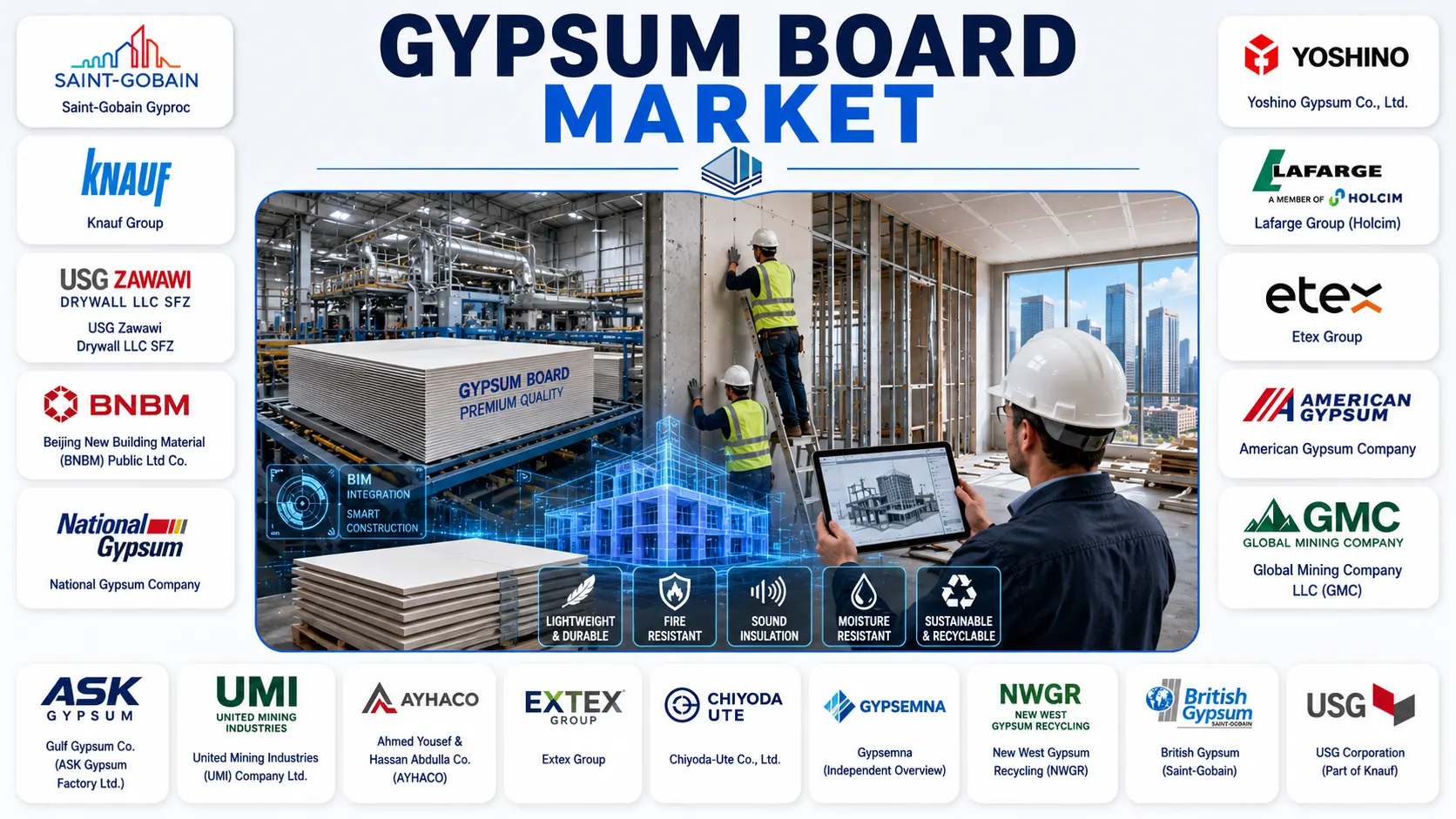
Top 20 Companies in the Global Gypsum Board Market
- Saint-Gobain Gyproc
- Knauf Group
- USG Zawawi Drywall LLC SFZ
- Beijing New Building Material (BNBM) Public Ltd Co.
- National Gypsum Company
- Knauf (Gypsemna)
- Yoshino Gypsum Co., Ltd.
- Lafarge Group (Holcim)
- Etex Group
- American Gypsum Company
- Global Mining Company LLC (GMC)
- Gulf Gypsum Co. (ASK Gypsum Factory Ltd.)
- United Mining Industries (UMI) Company Ltd.
- Ahmed Yousef & Hassan Abdulla Co. (AYHACO)
- Extex Group
- Chiyoda-Ute Co., Ltd.
- Gypsemna (Independent Overview)
- New West Gypsum Recycling (NWGR)
- British Gypsum (Saint-Gobain)
- USG Corporation (Part of Knauf)
1. Saint-Gobain Gyproc
| Category | Details |
|---|---|
| Company Name | Saint-Gobain (Gyproc) |
| Headquarters | Courbevoie, France |
| Founded | 1665 (Gyproc brand: 1917) |
| Industry Focus | Building Materials, Interior Systems |
| Global Presence | Operations in 70+ countries |
| Company Overview | Saint-Gobain is one of the world's oldest and largest building materials companies and a leading manufacturer in the global gypsum board market. Through its Gyproc brand, the company supplies high-quality plasterboard and interior systems for residential, commercial, institutional, and industrial construction projects worldwide. |
| Key Products & Services | Gyproc gypsum plasterboards, Gypframe metal components, Gyproc accessories, GypFine plaster, interior wall and ceiling systems. Products have been used in projects including Dubai Metro, Palm Jumeirah, Capital Gate, Ferrari Experience, and Masdar Institute. |
| Market Position | Recognized as a global leader in the gypsum board industry with strong brand recognition. The company emphasizes sustainability, including a 120 MW wind power agreement with Blooming Grove Wind Farm in the U.S., expected to reduce its U.S. carbon footprint by approximately 21%. |
| Recent Developments | 2021: Saint-Gobain India introduced 4PRO Active Air, a laminated gypsum wallboard designed to absorb indoor pollutants and improve air quality. 2016: Gyproc partnered with New West Gypsum Recycling (NWGR) in Norway to establish gypsum recycling facilities, supporting sustainable manufacturing. |
| Strategic Advantages | Extensive global manufacturing network, premium Gyproc brand, significant R&D capabilities, sustainability leadership, advanced recycling initiatives, and strong relationships with leading developers and contractors worldwide. |
2. Knauf Group
| Category | Details |
|---|---|
| Company Name | Knauf Group |
| Headquarters | Iphofen, Germany |
| Founded | 1932 |
| Industry Focus | Building Materials, Drywall Systems, Insulation Solutions |
| Global Presence | Operations in 90+ countries |
| Company Overview | Knauf Group is one of the world's leading manufacturers of gypsum-based building materials and construction systems. The company produces gypsum boards, plasters, ceiling systems, insulation materials, and flooring solutions for residential, commercial, industrial, and infrastructure projects worldwide. |
| Key Products & Services | Gypsum plasterboards, AQUAPANEL® cement boards, drywall systems, ceiling systems, insulation products, plasters, flooring systems, and metal framing solutions. |
| Market Position | Knauf is among the global leaders in the gypsum board industry, recognized for innovation, product quality, and sustainable construction solutions. |
| Recent Developments | Continued expansion of gypsum board manufacturing facilities in Asia and the Middle East, investments in low-carbon production technologies, and increased focus on recycled gypsum and energy-efficient building materials. |
| Strategic Advantages | Extensive global manufacturing footprint, vertically integrated operations, strong R&D capabilities, sustainable product portfolio, and diversified construction material offerings. |
3. USG Zawawi Drywall LLC SFZ
| Category | Details |
|---|---|
| Company Name | USG Zawawi Drywall LLC SFZ |
| Headquarters | Salalah, Oman |
| Founded | 2013 |
| Industry Focus | Gypsum Boards, Drywall Systems, Building Materials |
| Global Presence | Middle East, GCC, Africa, and South Asia |
| Company Overview | USG Zawawi Drywall LLC SFZ is a joint venture between USG Corporation and Zawawi Minerals. The company manufactures premium gypsum boards and drywall systems from one of the largest integrated gypsum production facilities in the Middle East. |
| Key Products & Services | Gypsum wallboards, ceiling boards, moisture-resistant boards, fire-resistant boards, drywall systems, finishing compounds, and accessories. |
| Market Position | A leading supplier of premium gypsum board products across the GCC region, known for high-quality manufacturing and international standards. |
| Recent Developments | Expanded export markets across the Middle East and Africa while enhancing production efficiency and sustainable manufacturing processes. |
| Strategic Advantages | Strategic location near high-quality gypsum reserves, advanced manufacturing technology, strong partnership with USG Corporation, and efficient regional distribution network. |
4. Beijing New Building Material (BNBM) Public Ltd Co.
| Category | Details |
|---|---|
| Company Name | Beijing New Building Material (BNBM) Public Ltd Co. |
| Headquarters | Beijing, China |
| Founded | 1979 |
| Industry Focus | Building Materials, Gypsum Boards, Interior Construction Systems |
| Global Presence | Operations across China with exports to 80+ countries |
| Company Overview | BNBM is China's largest manufacturer of gypsum boards and one of the world's leading producers of new building materials. The company supplies gypsum boards, mineral wool products, ceiling systems, and insulation materials for residential, commercial, and industrial construction. |
| Key Products & Services | Gypsum plasterboards, acoustic ceiling systems, mineral wool insulation, metal framing systems, decorative building materials, and prefabricated construction products. |
| Market Position | One of the world's largest gypsum board manufacturers with dominant market share in China and a rapidly expanding international presence. |
| Recent Developments | Continued expansion of overseas manufacturing capacity, investment in smart manufacturing technologies, and development of environmentally friendly building materials. |
| Strategic Advantages | Large-scale manufacturing capacity, advanced production technology, strong domestic market leadership, cost-efficient operations, and expanding international distribution. |
5. National Gypsum Company
| Category | Details |
|---|---|
| Company Name | National Gypsum Company |
| Headquarters | Charlotte, North Carolina, USA |
| Founded | 1925 |
| Industry Focus | Gypsum Boards, Building Products, Construction Materials |
| Global Presence | Primarily North America with international exports |
| Company Overview | National Gypsum Company is one of the largest privately held manufacturers of gypsum board and building products in North America. The company serves residential, commercial, and industrial construction markets with a broad portfolio of drywall and finishing solutions. |
| Key Products & Services | Gold Bond® gypsum boards, PermaBASE® cement boards, drywall finishing products, joint compounds, interior finishing systems, and construction accessories. |
| Market Position | A leading North American gypsum board manufacturer recognized for premium drywall products, strong distribution channels, and long-standing industry reputation. |
| Recent Developments | Ongoing investments in manufacturing modernization, energy-efficient production technologies, and product innovations focused on fire resistance, moisture resistance, and sustainability. |
| Strategic Advantages | Nearly a century of industry experience, strong North American manufacturing network, trusted Gold Bond® brand, continuous product innovation, and comprehensive construction product portfolio. |
Competitive Landscape
The global gypsum board market exhibits a moderately concentrated competitive structure, with a handful of multinational players Saint-Gobain, Knauf (including USG), and BNBM collectively commanding significant global market share, while a large number of regional and local manufacturers serve specific geographic niches.
The competitive landscape is shaped by several key dynamics:
Market Consolidation through M&A: The past decade has witnessed significant consolidation activity. Knauf's acquisition of USG Corporation's international operations created a mega-player with global reach. Etex's acquisition of Australian plasterboard businesses and Holcim's acquisition of Cantillana are representative of the ongoing M&A activity reshaping the industry's competitive hierarchy.
Vertical Integration: Leading players like Saint-Gobain, Knauf, and BNBM are deeply vertically integrated, controlling gypsum mining, board manufacturing, and in some cases distribution. This integration provides cost advantages and supply chain resilience that smaller players cannot easily replicate.
Innovation as Differentiation: With commodity board products subject to intense price competition, leading manufacturers are investing heavily in product innovation. High-performance boards moisture-resistant, mold-resistant, fire-rated, acoustic, and air-purifying command premium pricing and higher margins.
Sustainability as Competitive Advantage: As environmental regulations tighten globally, companies with established recycling capabilities and low-carbon manufacturing credentials will be better positioned to win business from sustainability-focused developers and government procurement programs.
Regional Champions: Beyond the global majors, regional champions like Yoshino Gypsum in Japan, National Gypsum in the U.S., and Gulf Gypsum in Saudi Arabia maintain strong positions in their home markets through local brand trust, regulatory expertise, and distribution efficiency.
Regional Analysis
North America
North America's gypsum board market stood at USD 16.21 billion as of 2018, with the United States accounting for over two-thirds of regional demand. The market is relatively mature but continues to grow steadily, driven by residential remodeling, commercial renovation, post-disaster reconstruction, and new homebuilding activity.
Key trends include tightening environmental regulations pushing manufacturers toward sustainable sourcing and recycling, sustained demand from the Sun Belt housing boom, and growing adoption of high-performance board products in energy-efficient building programs. The U.S. residential housing market benefits from continued employment growth, accessible mortgage financing, and a chronic undersupply of housing inventory.
Europe
Europe leads the world in gypsum board recycling practices, driven by high environmental consciousness among consumers and some of the world's most stringent waste management regulations. Western European markets Germany, France, the UK, Italy, and Spain are the largest and most mature, while Eastern Europe represents a growing opportunity as housing renovation programs gain momentum.
The EU's Green Deal and Energy Performance of Buildings Directive are powerful tailwinds for gypsum board demand in renovation applications. Recycling rates in Western European countries are significantly higher than in emerging markets, positioning the region as a global innovator in circular economy gypsum practices.
Asia-Pacific
Asia-Pacific dominates the global gypsum board market by volume and represents the highest growth opportunity globally. China alone accounts for a dominant share of regional demand through BNBM and other domestic manufacturers. India's rapidly growing PEB sector, expanding at over 25% annually, is a significant incremental demand driver, as are infrastructure programs in Indonesia, Vietnam, Thailand, and the Philippines.
Commercial real estate investment is surging across the region, creating substantial demand for partition systems, ceiling boards, and fire-rated assemblies in office towers, shopping malls, and industrial facilities.
Latin America
Latin America is a smaller but growing market, driven primarily by Brazil, Mexico, and Colombia. Brazil's massive social housing programs and urban renewal initiatives create structural demand for affordable interior construction materials. However, political instability and economic volatility periodically disrupt growth trajectories.
Middle East & Africa
The Middle East is a high-value growth market, driven by Saudi Arabia's Vision 2030 mega-projects, UAE's continued commercial and hospitality construction, and Qatar's post-World Cup infrastructure legacy. Africa is an early-stage market with significant long-term potential, underpinned by rapid urbanization and growing foreign direct investment in infrastructure.
Emerging Trends in the Gypsum Board Market
1. Carbon-Neutral and Recycled-Content Boards: Chiyoda-Ute's 100% recycled gypsum board and European manufacturers' investments in gypsum recycling infrastructure are pioneering a new era of circular gypsum economy.
2. Smart and Functional Boards: Products like Saint-Gobain's air-purifying gypsum board represent the leading edge of functional building materials that actively contribute to occupant health and wellbeing.
3. Digital Sales and Visualization Tools: Online configuration and visualization platforms are transforming how architects, contractors, and homeowners specify and purchase gypsum board products, enabling manufacturers to capture direct consumer relationships.
4. Prefabrication and Modular Construction: The global shift toward prefabricated and modular building methods is reshaping gypsum board demand patterns. Factory-installed gypsum board panels assembled offsite are gaining traction, reducing on-site labor costs.
5. Post-Pandemic Residential Investment: The sustained work-from-home trend has accelerated home renovation spending globally, creating incremental demand for wallboard products as homeowners create dedicated home office spaces.
6. AI and Automation in Manufacturing: Leading gypsum board manufacturers are investing in AI-driven production monitoring and automation to improve product consistency, reduce waste, and lower unit production costs.
Future Outlook (2026–2031)
The global gypsum board market's trajectory toward USD 137.89 billion by 2031 is supported by a convergence of powerful, durable macro trends. The 12.7% CAGR forecast through 2031 reflects the sustained strength of urbanization-driven construction demand in Asia-Pacific, the renovation wave in North America and Europe, and the growing adoption of sustainable building materials worldwide.
Key investment themes include the scaling of gypsum board recycling infrastructure (particularly in Europe and Japan), the commercialization of functional and smart gypsum boards, expansion of manufacturing capacity in South and Southeast Asia, and the digitalization of the gypsum board specification and distribution process.
For investors, the gypsum board market offers exposure to the secular growth of global construction activity with added upside from sustainability premiums on innovative product lines. Leading companies Saint-Gobain, Knauf, and BNBM will continue to dominate, but differentiated innovators and regional champions in high-growth markets will also generate compelling returns.
Frequently Asked Questions (FAQ)
1. What is the current size of the global gypsum board market?
The global gypsum board market was valued at approximately USD 55.91 billion in 2023. It is projected to grow at a CAGR of 12.7%, reaching USD 137.89 billion by 2031.
2. Who are the top companies in the global gypsum board market?
The leading companies include Saint-Gobain Gyproc, Knauf Group, USG Corporation (now part of Knauf), Beijing New Building Material (BNBM), National Gypsum Company, Yoshino Gypsum, Lafarge (Holcim), Etex Group, American Gypsum, Gypsemna, and USG Zawawi Drywall, among others.
3. Which region dominates the gypsum board market?
Asia-Pacific dominates the global gypsum board market in terms of volume, driven primarily by China, India, and other rapidly urbanizing emerging economies. North America leads in market value maturity, while Europe leads in recycling innovation.
4. What is the forecast CAGR for the gypsum board market?
The global gypsum board market is forecast to grow at a CAGR of 12.7% from 2024 to 2031.
5. What are the primary applications of gypsum board?
Gypsum board is used across residential (largest segment), commercial, industrial, institutional, and pre-engineered metal building (PEB) applications. The most common use is as interior wall and ceiling lining.
6. What is the leading product segment in the gypsum board market?
Wallboard is the leading product segment, accounting for 50.3% of the market in 2023. It is used for interior walls, partitions, non-load-bearing walls, and suspended ceilings.
7. Which application segment is growing the fastest?
Pre-engineered metal buildings (PEBs) represent the fastest-growing application segment, forecast to grow at a CAGR of 12.9% through 2031, driven particularly by India's rapidly expanding PEB sector.
8. What are the main growth drivers for the gypsum board market?
Key drivers include urbanization in emerging economies, global sustainable construction trends, energy-efficient building regulations, increasing residential construction spending, and post-disaster reconstruction demand in North America.
9. What challenges does the gypsum board market face?
Key challenges include environmental concerns related to gypsum waste in landfills (which can generate toxic hydrogen sulfide gas), rising raw material costs, stringent environmental regulations, and the carbon footprint of gypsum board manufacturing.
10. How does gypsum board recycling work?
Gypsum board waste is collected from construction and demolition sites, then processed to separate the gypsum core from the paper facer. The recovered gypsum is ground into powder and used as a raw material for new board production. Companies like New West Gypsum Recycling (NWGR) in Norway supply recycled gypsum to manufacturers including Saint-Gobain and Knauf.
Conclusion
The global gypsum board market stands at an inflection point, transitioning from a volume-driven commodity business to a sophisticated, innovation-led industry shaped by sustainability imperatives, emerging economy urbanization, and digital transformation. With a projected market size of USD 137.89 billion by 2031 at a CAGR of 12.7%, the sector offers compelling growth opportunities for manufacturers, investors, and construction industry participants.
The top companies in the gypsum board market led by Saint-Gobain Gyproc, Knauf Group, BNBM, National Gypsum, and Yoshino Gypsum are not merely competing on price and volume. They are competing on innovation, sustainability, system integration, and brand trust. The companies that successfully navigate the transition to circular, low-carbon manufacturing while capturing urbanization-driven demand in Asia-Pacific and renovation-driven demand in North America and Europe will define the industry's leadership landscape through 2031 and beyond.


