Share this link via:

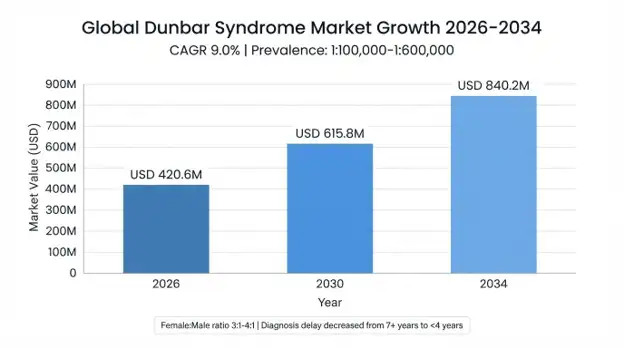
The global Dunbar syndrome market size was valued at USD 385.4 million in 2025 and is projected to reach USD 420.6 million in 2026, expanding to approximately USD 840.2 million by 2034, growing at a CAGR of 9.0% during the forecast period (2026-2034).
The median arcuate ligament syndrome, otherwise referred to as celiac axis compression syndrome or median arcuate ligament syndrome (MALS) is a rare vascular compression syndrome caused by the arcuate ligament that lies abnormally low, or the origin of the celiac axis is unusually high resulting in a compression of the celiac artery and celiac ganglia and plexus. This is a structural abnormality that causes poor blood supply to the foregut organs (stomach, liver, spleen, and proximal small bowel), and it also irritates the dense nerve network of the celiac plexus. Two mechanisms are used to explain pathophysiology: the ischemic theory states that pain occurs after a meal when there is a decrease in celiac blood flow during periods of increased metabolic demand, and the neurogenic theory suggests that pain occurs from direct compression and traction on the celiac ganglia, which occurs through neuropathic pathways unrelated to blood flow. It is now generally recognized that both mechanisms do often occur together, and both are common when the complete symptomatic triad is present, especially in modern-day vascular specialists.
The clinical features of Dunbar syndrome are usually: chronic postprandial pain, unintentional weight loss due to food avoidance and, in some patients, an audible epigastric bruit on auscultation. Given the significant overlap with much more common gastrointestinal problems like functional dyspepsia, gastroparesis, irritable bowel syndrome, and chronic cholecystitis, the diagnosis has historically been challenged clinically and has been seen as a controversial or exclusionary diagnosis. Misdirected gastrointestinal workup, endoscopies and empirical therapy have been reported to be performed for several years before a proper diagnosis of celiac axis compression is made, resulting in an important nutritional deterioration and quality of life during the diagnostic delay.
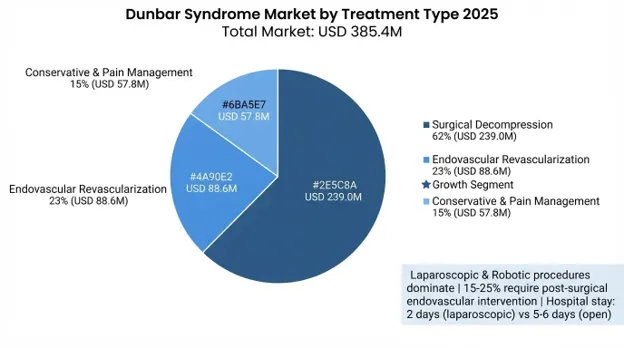
Precision diagnosis and minimally invasive intervention now dominate the modern landscape of Dunbar syndrome management. Multi-detector computed tomography (MDCT) angiography with dedicated inspiratory and expiratory phase acquisition is now the first line diagnostic tool and is used to assess the characteristic hooked or J-shaped deformity of the celiac artery, along with duplex ultrasonography measurement of respiratory phase-dependent peak systolic velocity changes, and in selected cases, magnetic resonance angiography (MRA) or catheter angiography (CA) when there is diagnostic ambiguity. Laparoscopic and now more often, robotic-assisted decompression of the median arcuate ligament with concomitant co-administration of celiac ganglion neurolysis has superseded open surgical division as the recommended first-line therapy in experienced centers, due to less postoperative pain, less hospitalization and quicker functional recovery. At most vascular tissue-specialized programs, a sequential surgical (then endovascular) approach is the current standard of care, with the combination of decompression and adjunctive endovascular balloon angioplasty or stenting to restore adequate mesenteric perfusion in the estimated 15-25% of patients in whom residual or fixed arterial stenosis persists after decompression is due to chronic intimal changes.
Commercially, the Dunbar syndrome market is best described as a low volume, but high revenue-intensity market, focused on tertiary academic medical centers and specialty vascular compression programs, rather than as a traditional pharmaceutical market. The most significant revenue sources are not chronic drug therapy, but rather advanced diagnostic imaging workups, surgical and robotic procedure fees, endovascular consumables and long-term follow-up care. Symptomatic Dunbar syndrome occurs from 1:100,000 to 1:600,000, and asymptomatic anatomic celiac compression is estimated to occur in up to 10-24% of the general population who have an unrelated abdominal imaging study, stressing the need for correlation of anatomic findings with hemodynamic and clinical significance. It is reported to have a definite predilection for females between 20 and 50 years of age and a female-to-male ratio of 3:1 to 4:1, often occurring in persons with a lean body habitus, which makes retroperitoneal fat less cushioning around the celiac axis. As doctors become more educated and get more specialized multidisciplinary MALS clinics, as well as more patient-driven awareness through advocacy groups, the diagnosed and treatable patient population is growing, creating structural support for continued market growth throughout the forecast period.
| Report Coverage | Details |
|---|---|
| Base Year | 2025 |
| Base Year Value | USD 385.4 Million |
| Forecast Value | USD 840.2 Million |
| CAGR | 9.0% |
| Forecast Period | 2025-2034 |
| Historical Data | 2022-2025 |
| Segments Covered | By Diagnosis, Treatment, Approach, End-User, Region |
| Region Covered | North America, Europe, Asia Pacific, Middle East & Africa, Latin America |
| Countries Covered | US, Canada, Mexico, UK, Germany, France, Italy, Spain, China, Japan, India, Australia, South Korea, Brazil, Argentina, UAE, Saudi Arabia, South Africa |
| Key Market Playes | Mayo Clinic Health System, Cleveland Clinic, Massachusetts General Hospital, Intuitive Surgical Inc., Medtronic plc, Cook Medical, Siemens Healthineers |
Get more details on this report - Request Free Sample
Market growth is mainly attributed to increased awareness of Dunbar syndrome due to the increased availability of CT angiography in the respiratory phase as well as duplex ultrasound measurements that can help quantify flow velocity variation of the celiac artery during both inspiration and expiration. Patient referral to specialized centers has been greatly enhanced by increased physician education on the issue during meetings on vascular surgery and gastroenterology, in addition to publication of multi-center outcomes.
The techniques of laparoscopic and robotically assisted median arcuate ligament release procedures have become increasingly favored due to their proven superiority in terms of hospital stay, post-operative pain, and resumption of normal activities, especially considering that this disorder affects primarily young patients.
The major limitation for the market is the symptom similarity of Dunbar syndrome and much more common gastrointestinal problems and the lack of consensus in terms of diagnostic criteria. The full spectrum of symptoms including postprandial pain, weight loss, and bruit is observed in only some of the patients have been officially diagnosed. Differentiation of pathological compression from benign anatomy abnormalities needs highly specialized skills that may be absent in some clinical facilities outside large centers. It leads to both underdiagnosis of the problem among general practitioners and poor outcomes in terms of symptom improvement in the patients undergoing surgical procedures.
An important area that needs to be addressed is the development of specially designed endovascular stents and balloons considering the respiratory dynamics and angulations of the celiac artery, rather than the use of off-the-shelf products intended for different vessels. Another field of interest lies in the creation of multicenter patient registries and scoring systems for diagnosing the disease based on its symptoms and hemodynamic parameters.
Dunbar syndrome diagnosis and treatment is becoming increasingly specialized through the establishment of multidisciplinary programs that include vascular surgery, gastroenterology, interventional radiology, and pain management, facilitated by rising adoption of robotic platforms and, in leading centers, the use of pre-surgical three-dimensional patient-specific planning to map out ligamentous compression prior to intervention. This consolidation of expertise into relatively few centers is expected to prevail for the remainder of the forecast period.
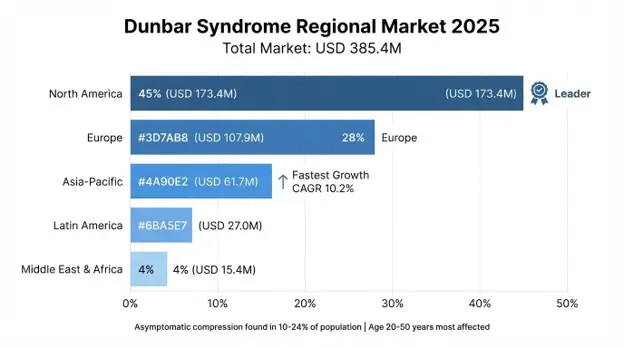
North America dominates the market in terms of market share owing to concentration of vascular surgery specialty expertise in leading academic institutions, favorable reimbursement for advanced imaging and robotic surgeries, and research using registries leading to outcomes that help shape global standards of treatments. The United States contributes the most in terms of market value due to presence of well-established referral centers undertaking the highest procedure volume worldwide.
The Asia Pacific region shows the highest growth, attributed to the increased number of training centers for vascular surgery, increasing availability of advanced cross-sectional imaging in large cities, and increased awareness levels in Japan, South Korea, China, and India. The Europe region shows consistent growth as more academic vascular centers in Germany, UK, and France are adopting standardized regional pathways, while Latin America and the Middle East & Africa regions have low market value and serve mostly through referral centers.
Therapeutic Insights: Surgical decompression is by far the major segment in treatment, because it forms the principal treatment modality comprising both ligament division and neurolysis of the celiac ganglion. Endovascular revascularization is a minor yet emerging segment employed in the treatment of residual stenosis after decompression, while conservative and pain management modalities help patients waiting for diagnosis or those who are not eligible for surgery.
Diagnostic Insights: CT angiography and duplex ultrasonography form the main diagnostic segments due to their availability and capability to capture the dynamics of respiratory-phase-induced compression, whereas MRI angiography and invasive angiography are needed for additional clarification or planning of surgical treatment.
End-User Insights: Hospitals and tertiary vascular clinics form the major end-user segment because of the need for multidisciplinary expertise and imaging facilities necessary for precise diagnosis and surgical treatment, whereas ASCs are slowly becoming relevant for certain low-risk laparoscopic cases.
Dunbar syndrome is an extremely fragmented and procedure-oriented market, as opposed to being product-driven, due to the uncommon nature of the disease and dominance of institution surgical skills over branded drugs. Competitiveness within this segment is observed between academic institutions, competing through referrals, robotics surgery platforms, endovascular devices makers, offering stents and balloons that work in the context of visceral arteries, and imaging systems providers facilitating the diagnosis process. Key differentiators are surgical results, range of services offered, and registry participation.
March 2026: A multination vascular surgery working group released new consensus guidelines for MALS imaging and patient inclusion criteria for surgery, which is a beginning in standardizing the care pathway.
January 2026: The developer of a popular robotics system announced further growth of training programs at academic medical centers for robotically assisted median arcuate ligament release procedures.
November 2025: An instrument set specific to laparoscopic median arcuate ligament syndrome decompression surgery with enhanced capabilities for retro crural dissection was granted approval, providing better tissue retraction and vessel protection during surgery.
September 2025: A multicenter outcome study found improved pain relief when celiac plexus neurolysis was consistently done along with the decompression procedure than just the decompression alone after one year of follow up.
You'll get the sample you asked for by email. Remember to check your spam folder as well. If you have any further questions or require additional assistance, feel free to let us know via-
+1 724 648 0810 +91 976 407 9503 sales@intellectualmarketinsights.com
12 Aug 2026
Intellectual Market Insights Research © 2026. All rights reserved.