Share this link via:

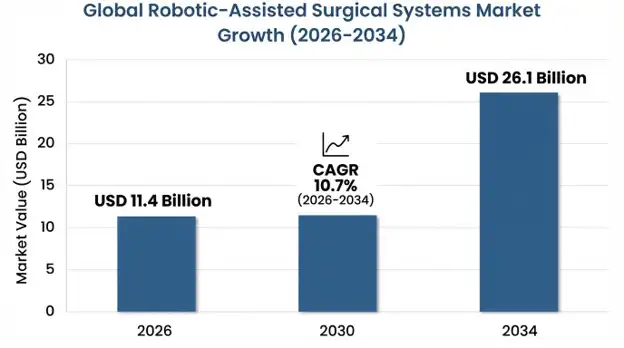
The global robotic-assisted surgical systems market size was valued at USD 10.2 billion in 2025 and is projected to reach USD 11.4 billion in 2026, expanding to USD 26.1 billion by 2034, growing at a CAGR of 10.7% during the forecast period (2026-2034).
Robotic-assisted surgical systems are a high-technology, computer-controlled electromechanical platform that uses 3-D computer-generated visualization, tremor filtration and precise motion control to enhance surgical capabilities during minimally invasive and complex surgeries. The systems combine high-definition three-dimensional visualization, articulated robotic arms with wristed instruments that offer seven degrees of freedom and more advanced software platforms that convert the surgeon's movements at a console into accurate micro-movements at the operating site. Robotic systems overcome the fundamental limitations of precision, consistency and reproducibility of clinical outcomes with conventional laparoscopy and open surgery by providing greater dexterity, improved ergonomics, and better visualization in anatomically difficult areas.
Modern robotic surgical technology encompasses a wide range of platforms, including multi-port, multi-trocar systems for procedures requiring multiple small incisions, next-generation single-port systems for single-incision or natural orifice surgery, orthopedic robotic systems that combine CT-based navigation with robotic milling for joint arthroplasty, neurosurgical robotic systems offering sub-millimeter accuracy for cranial and spinal procedures, and catheter-based robotic systems for remote navigation within the vascular system and cardiac chambers for single incisions or natural orifices specialized orthopedic robotic systems that combine computed tomography based navigation with robotic milling systems for joint arthroplasty; neurosurgical robotic systems for sub-millimeter accuracy for cranial and spinal surgery; and catheter-based robotic systems for surgical navigation remotely in the vascular and cardiac chambers. Advanced vision systems feature three-dimensional endoscopy, fluorescence imaging, augmented reality overlays, and integration of intraoperative imaging, and their software platforms increasingly integrate artificial intelligence analytics, digital case planning, workflow support, and connectivity that track the procedure for optimizing quality and enhancing training.
The clinical ecosystem of robotic-assisted surgery has progressed from simple mechanical support to increasingly full-fledged digital surgery platforms that combine preoperative planning, intraoperative guidance and postoperative analytics. Modern systems produce meaningful procedural information which can be used to measure surgeon performance, monitor quality and produce evidence for increased indications for clinical use. This technology addresses the needs of a growing patient population that demands minimally invasive surgical procedures for an increasing number of oncologic and degenerative conditions that will require surgical intervention, as well as a greater focus on functional outcomes, shorter hospitalizations, and patient satisfaction measures.
The commercial opportunity extends beyond capital equipment, but it's also the continuing revenue stream of instruments and accessories that have short lives, annual service contracts, software licensing, and full training programs. This razor-and-blade business model leads to long-lasting revenue relationships, where individual robotic systems will generate millions of dollars in recurring revenues for a service life of more than seven years. The clinical and economic benefits that support the investment in hospitals include shorter hospital stay, less blood transfusion, fewer complications in the wound, better functional recovery, and strategic differentiation in a competitive healthcare market.
| Report Coverage | Details |
|---|---|
| Base Year | 2025 |
| Base Year Value | USD 10.2 Billion |
| Forecast Value | USD 26.1 Billion |
| CAGR | 10.7% |
| Forecast Period | 2025-2034 |
| Historical Data | 2022-2025 |
| Largest Market | North America |
| Fastest Growing Market | Asia Pacific |
| Segments Covered | By Product Type, Application, Component, End-User |
| Region Covered | North America, Europe, Asia Pacific, Middle East & Africa, Latin America |
| Countries Covered | US, Canada, Mexico, UK, Germany, France, Italy, Spain, Netherlands, China, Japan, India, Australia, South Korea, Brazil, Argentina, UAE, Saudi Arabia, South Africa |
| Key Market Playes | Intuitive Surgical, Medtronic, Johnson & Johnson, Stryker, Zimmer Biomet, CMR Surgical, Asensus Surgical |
Get more details on this report - Request Free Sample
The primary driving force behind the implementation of robotic-assisted surgery systems is the continuous worldwide tendency towards minimally invasive surgeries which allow minimizing patient’s pain, reducing hospital stay time, and accelerating functional recovery in contrast to open surgeries. Robotic devices are currently the most advanced form of minimally invasive surgeries, providing features far beyond those provided by conventional laparoscopic surgeries due to better visualization, increased instruments’ flexibility, and accuracy of surgeries. The clinical data collected during the last two decades proves the statistically significant superiority of robotic-assisted surgeries over open surgeries in terms of blood loss (on average 40-60% less), reduced need for transfusions (65-80%), fewer conversions to open surgeries (70-85%), and shorter hospital stay time (35-50%).
Robotic-assisted radical prostatectomy in the field of urological surgery occupies a dominant share of the market, comprising more than 85% of all radical prostatectomies done each year in advanced countries due to benefits in the form of lower positive surgical margin rates (by 25-30%), faster recovery from urinary incontinence (2-4 months), and better sexual function outcomes (by 15-25%) when compared to open surgeries. In the field of gynecological surgery, robotic hysterectomy has been gaining popularity thanks to 45% lower risk of complications and 60% shorter recovery period in comparison with open abdominal hysterectomies.
Robotic surgical economic benefits increase as procedural volume improves cost efficiency by way of enhanced instrumentation usage processes, competitive pricing due to new systems entering the marketplace, and savings in healthcare expenses due to reduced readmission rates of 25-35% and reduced complication costs of 40-55%.
Orthopedic surgery is the fastest-growing application segment, which has been fueled by the high number of joint replacements worldwide that exceed 4.2 million surgeries per year, along with the proven clinical studies that demonstrate better results for robotic-guided surgeries when comparing alignment and positioning with traditional manual approaches. The biggest application in orthopedic robotics is the total knee arthroplasty with an annual number of procedures of 2.6 million worldwide, which offers an enormous market potential because of the link between prosthetic survivorship and positioning.
The conventional manual total knee replacement can meet the target alignment within the desired parameters in 75-80% of the patients, the outliers have faster polyethylene wear and loosening of the implant and hence the need for revision in 8-12% cases in the 10 years follow up period. The robotic aided system that uses preoperative CT scanning and intraoperative enforcement of haptic boundaries can meet the target alignment in 95-98% of the cases; thus, reducing the need for revision by 35-45%.
Orthopedic robotic platforms are based on two primary technologies: image-based systems, which use preoperative CT scans to create three-dimensional bone models for virtual implant planning, and imageless systems, which rely on intraoperative anatomical landmark registration without requiring preoperative imaging. which use images where the preoperative CT scan is used for three-dimensional bone modeling to achieve virtual implant planning and those which do not require images, whereby bone registration through anatomical landmarks is done during the surgical process.
The major factor restraining the wider adoption of robotic-assisted surgical systems lies in the fact that the considerable investment in system purchase, installation, and maintenance creates disparities between academic medical centers and community hospitals in terms of resource availability. Top robotic systems incur costs starting from USD 1.4M up to USD 2.3M per each system and an additional USD 110,000-175,000 annual costs for the service contract and USD 800-3,200 expenses on procedures performed due to instrument use.
The current situation is even more complicated because of the increased financial strain caused by the coronavirus epidemic on the budgets of hospitals that led to the introduction of limitations on capital expenditures and obligatory return on investment analysis for each piece of equipment. This problem becomes more complicated in countries where healthcare is funded mostly through public funding and technology adoption requires passing health technology assessment for cost-effectiveness comparing to traditional treatment options.
Significant growth opportunities exist in the development of robotic platforms for single-port procedures that allow complex minimally invasive surgeries using a single small incision and, hence, reducing the trauma from surgeries and increasing patient numbers who qualify for such surgeries. Single-port robotically assisted surgery is technologically advanced and requires special instruments with articulation capabilities to create triangulation during surgeries using the same entry point for the parallel placement of the instruments.
The Ambulatory Surgery Center (ASC) area of the industry is one that holds considerable promise because of the miniaturization of technology and competitive pricing from new competitors entering the market. In other words, procedures can be shifted from hospital operating rooms to lower-cost ambulatory surgical centers for qualified patients. Robotic-assisted procedures like hernia repair, cholecystectomy, and partial nephrectomy are safe enough to allow same-day discharge from the ASC.
Market fundamentals for robotic-assisted surgical systems are significantly altered by numerous new entrant platforms that challenge the existing dominant platforms for each surgical specialty. Expiration of patents on technologies critical for robotic surgery generated a competitive opportunity which has led to more than 16 platforms in the category becoming cleared for use between 2020-2025, thus creating intense pricing competition and fostering accelerated innovation cycles.
The differentiation of new entrant platforms is derived from their optimized designs for specific surgical procedures, smaller footprint to deploy in limited space scenarios, less expensive capital acquisition costs for community hospitals and ambulatory surgical centers and flexible architecture to enable gradual capability growth along with procedure volume.
The largest regional market share belonged to North America with revenues of USD 5.9 billion in 2025, with a further forecast of CAGR of 10.1% in 2034. Such dominance is caused by established expertise in robotic surgery, which are available in high-volume academic medical centers; complete insurance covering, which supports payments for robotic procedures; high prevalence of conditions that are treated using robotic surgery 292,000 prostate cancer cases per year and 820,000 joint replacement cases due to osteoarthritis per year and the development of technologies that are primarily created in North America.
The United States provides 88% of the total revenue from the region with Medicare and private health insurance coverage as the financial background for the use of robotic procedures. There are more than 4,200 robots installed in hospitals and surgical centers in North America, and there is an extensive network of credentialed surgeons with a number exceeding 16,500 practitioners.
Asia Pacific is the fastest-growing regional market with expected CAGR of 13.2%, forecasted to reach USD 2.7 billion by 2025. Growth in regional market is due to increased investments in healthcare infrastructure, increased surgeries due to aging population and rise in non-communicable diseases, government programs for adoption of medical technologies, and increased number of surgeon training programs to learn robotic surgery skills in underdeveloped regions.
China dominates the regional market with 43% market share due to government programs for modernization of healthcare facilities, which includes adoption of advanced surgical technologies, aging population requiring more orthopedic and oncological surgeries, and development of domestic companies in robotic surgery owing to the efforts made through industrial policies. Japan and South Korea exhibit high robotic surgery utilization rates per capita like Europe.
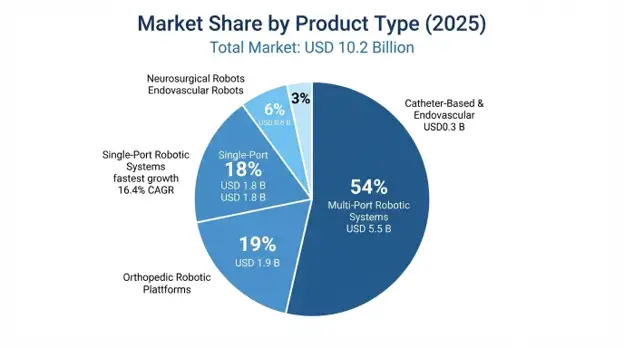
The Instruments & Accessories segment is the largest in terms of market share and will account for USD 5.7 billion by 2025 at a CAGR of 11.2% from 2026 to 2034, as it is the fastest growing segment among all. The Instruments & Accessories segment includes robotic instruments which are used on a one-time basis or have limited use, endoscopes, trocars, and instrument sets that are procedure specific. For example:
$$ ext {Annual Instrument Revenue} = 850 ext{procedures} imes ext {USD } 2,400 = ext {USD } 2,040,000$$
Robotic Systems account for 31% market share at USD 3.2 billion in 2025, encompassing complete surgical platforms including surgeon consoles, patient-side carts, vision systems, and integrated software reflecting capital equipment acquisition revenue from initial sales and system upgrades.
The General Surgery segment constitutes the largest share of USD 2.8 billion in 2025, growing with a 12.1% CAGR to 2034 due to increased applications of robotics in hernia repair, cholecystectomy, colorectal surgeries, and bariatric surgery where robotics have significant clinical benefits over traditional laparoscopy.
The Orthopedic Surgery segment is the fastest-growing one worth USD 2.4 billion in 2025, growing at a CAGR of 14.8% to 2034 due to high volumes of joint replacements along with strong evidence for the use of robotic guidance in enhancing function and accurate implant placement.
Hospitals represent the largest end-user segment, contributing to 73% market share amounting to USD 7.4 billion in 2025, due to high capital costs associated with purchasing robotic systems in institutions with enough procedures for the system purchase, infrastructure to conduct robotic surgery procedures, and established vendor ties to conduct training programs.
ASCs constitute 16% market share amounting to USD 1.6 billion in 2025 growing at 19.1% CAGR through 2034, constituting the fastest-growing segment due to procedure shift attributed to platform miniaturization and competitive prices.
The global robotic-assisted surgical systems market is moderately concentrated. with industry leaders sustaining their competitive advantages by virtue of a large installed base of customers, instrument ecosystem, clinical evidence database, and advanced surgeon training programs. Nevertheless, the competitive landscape is changing with the expiry of patents rising number of industry newcomers, and advancements in technology.
Competitive differentiation revolves around clinical evidence that shows an advantage in outcomes of procedures performed, versatility of the platform to cater to multiple specialties, innovation in instrumentation to cater to multiple procedures, digital surgery software and service programs.
March 2026: Next generation multi-port system with built-in fluorescence imaging and AI-based anatomical recognition launched by Intuitive Surgical for general, urological, and gynecological surgeries with implementation in 375 hospitals around the world.
February 2026: FDA approval for the indications of colorectal and thoracic surgeries has been obtained by J&J MedTech to increase addressable market for surgery.
January 2026: Fifth-generation orthopedic robotic technology is unveiled by Stryker Corporation offering improved haptic feedback, broader range of implant compatibility, and connectivity to outcomes registry.
December 2025: CMR Surgical performed its 12,000th surgery using Versius surgical system in 35 countries; Southeast Asia is included in the region of CMR Surgical’ s geographical expansion plans.
November 2025: European CE mark obtained by Medtronic in the field of urological and gynecological procedures on its new robot-assisted surgical system, Hugo, followed by its launch in Germany, France, and the U.K., with competitive pricing.
You'll get the sample you asked for by email. Remember to check your spam folder as well. If you have any further questions or require additional assistance, feel free to let us know via-
+1 724 648 0810 +91 976 407 9503 sales@intellectualmarketinsights.com
Intellectual Market Insights Research © 2026. All rights reserved.