Share this link via:

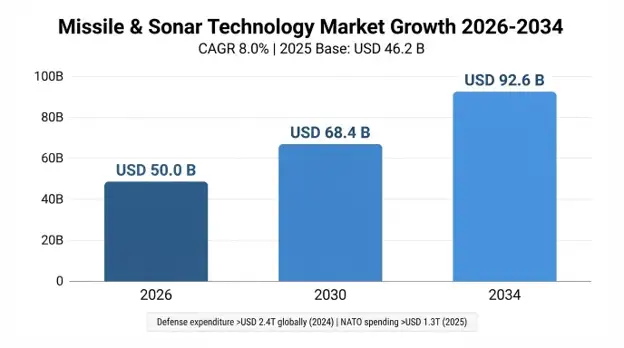
The global missile and sonar technology market was valued at approximately USD 46.2 billion in 2025 and is estimated to reach USD 50.0 billion in 2026, expanding to nearly USD 92.6 billion by 2034, registering a compound annual growth rate of around 8.0% during the forecast period of 2026 to 2034.
Missile and sonar technologies together form the offensive strike and underwater sensing mainstay of modern multi domain military operations. While missiles and sonar are different weapons, they are operationally dependent on one another: Sonar is used for safe navigation and threat detection before the launch of missiles, and missiles are used for anti-submarine warfare after the localization and identification of submerged threats. This tight coupling renders the linkage between the two procurement cycles, research budgets, and capability gaps often yield, which is why they are treated together in the market.
Missile technology ranges from tactical and anti-tank missiles to intermediate-range ballistic missiles and the newer hypersonic glide weapons and hypersonic cruise missiles which fly at speeds exceeding Mach 5. Precision engagement of man oeuvre or low observable targets has been achieved by modern guidance architectures that involve satellite navigation, in-flight datalink updates, active and passive radar or infrared seekers, and propulsion from solid fuel rockets to ramjet and scramjet systems capable of sustained high-speed flight.
Underwater sound propagation and the use of acoustic sensors, commonly known as sonar, is still the most common method for detecting, identifying, and tracking submarines and underwater objects when optical and radar sensors are not effective in underwater applications. Hull-mounted arrays are used by surface ships and submarines for wide area search; towed arrays offer improved passive detection range by isolating the array from platform self-noise; variable depth sonar overcomes the limitations of propagation over the thermal layer; sonobuoys and dipping sonar allow aircraft and helicopters to provide flexible and rapidly deployed acoustic coverage. As adversary submarines continue to get quieter with use of advanced acoustic quieting technologies, increasing use of machine-learning-based signal classification is helping operators distinguish between true submarine contacts and biological noise and clutter.
The Operational experiences of the recent conventional wars have shown high consumption rates of precision munitions; Great power competition in the world has intensified; the expansion of submarine fleets across the Indo Pacific region and the increase in defense spending globally have all boosted commercial and strategic significance. All these factors have combined to turn the tide of defense spending moderation of past years and keep existing and new defense powers with multi-year procurement programmed for both missile inventories and anti-submarine warfare (ASW) sensor networks.
| Report Coverage | Details |
|---|---|
| Base Year | 2025 |
| Base Year Value | USD 46.2 Billion |
| Forecast Value | USD 92.6 Billion |
| CAGR | 8.0% |
| Forecast Period | 2025-2034 |
| Historical Data | 2022-2025 |
| Largest Market | North America |
| Fastest Growing Market | Asia Pacific |
| Segments Covered | By System Type, Missile Type, Sonar Type, Platform, Technology, End-User, Region |
| Region Covered | North America, Europe, Asia Pacific, Middle East & Africa, Latin America |
| Countries Covered | US, Canada, UK, Germany, France, Italy, China, Japan, India, South Korea, Australia, Israel, Saudi Arabia, UAE, Brazil |
| Key Market Playes | Lockheed Martin, RTX Corporation, Northrop Grumman, BAE Systems, Thales Group, MBDA, L3Harris Technologies, Kongsberg Defence & Aerospace |
Get more details on this report - Request Free Sample
The ongoing competitive rivalry in the Indo-Pacific region, Eastern Europe, and the Middle East has resulted in the continuous purchase of precision strike weapons, air and missile defense systems, as well as anti-submarine warfare capabilities. The NATO countries have vowed to reach the benchmark of spending above two percent of their GDP on defense, while countries of the Indo-Pacific such as Japan, Australia, South Korea, and India are developing their missile and submarine fleets because of the military build-up in the region.
The increasing trend for modern naval and air operations is the integration of sonar, radar, and space-based sensor data into one solution and their delivery to missile systems almost in real time. The increasing use of these technologies has created the need for the development of datalink systems, open architecture combat systems, and machine learning based acoustic classification systems.
One of the primary factors limiting the expansion of the market environment includes a complex of strict control of exports and exceedingly high development expenses. Participation in the Missile Technology Control Regime and the presence of ITAR-type national legislation regulates the export of advanced guidance, propulsion, and sonar systems, prolonging the procurement process and limiting the opportunity to sell such technology to third parties even among the closest allies. At the same time, the introduction of new missile families or advanced sonar systems implies the necessity to have specialized testing facilities and carry out numerous tests both live fire and underwater, and conduct safety certificates with the duration of development usually surpassing 10 years and expenses amounting to several billion dollars.
Hypersonic weapon technologies present a significant opportunity as their counterparts do in the integration of missile and sonar loads aboard unmanned systems. Hypersonic gliding and air-breathing cruise missiles are being funded steadily by a few competent countries, which generates stable income for program partners. Unmanned surface and submarine vehicles armed with small sonar sensors and missile pods provide an affordable surveillance and attack capability extending beyond conventional manned craft.
Sensor fusion and AI decision support technologies are affecting not only the development of missiles but also the development of sonars since it is necessary to have systems that can share information on targets and sensor information in real time in the naval, air, land, and space domains. This technology for sonar involves the reduction of false targets using machine learning in the classification process due to the complex acoustic environment of the littorals.
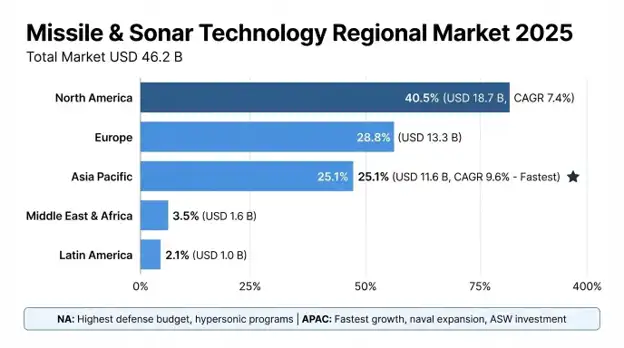
North America has the highest market share worth around USD 18.7 billion in 2025 with a forecast CAGR of 7.4% for 2034, bolstered by the highest global defense expenditure budget, well-established industrial base in missile seekers, propulsion, and towed-array sonar production, and constant development of sonar systems on submarines and surface combatants along with hypersonic strikes. Asia Pacific is the fastest growing region with a market value of around USD 11.6 billion in 2025 with a forecast CAGR of 9.6% for 2034, supported by the expansion of navies in China, active procurement actions in Japan, Australia, India, and South Korea, and extensive investments in anti-ship missiles, coastal defense systems, and anti-submarine warfare technology.
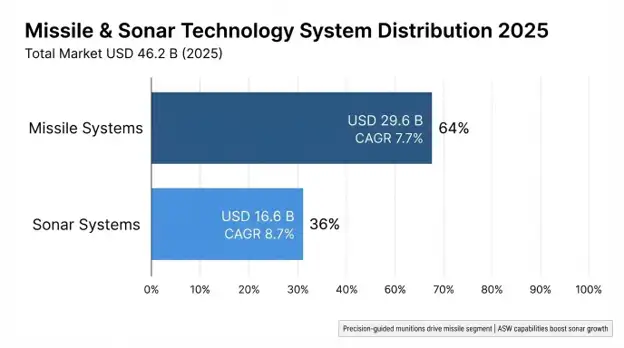
By System-wise, the largest share belongs to the Missile Systems segment, which commands around 64% of the market share worth USD 29.6 billion in 2025, growing at a 7.7% CAGR over the next decade due to the high cost per unit of the precision-guided munition systems and the need for replacement. The rest 36% is contributed by Sonar Systems segment, worth USD 16.6 billion in 2025 and growing at a 8.7% CAGR over the forecast period due to increasing investments in ASW capabilities in response to the increase in size and stealth of adversary submarines.
By platform, the largest share of the market goes to Naval/Maritime category, because only the surface combatants and submarines require both sonar detection as well as missile systems, while airborne platforms come second due to cruise missiles and dipping sonar.
By end-users, the market value is dominated by the defense ministries and armed forces through procurement from the government-to-government sales, with naval forces being the largest buyer among all services because of their dual application in maritime environments.
The global market for missiles and sonar technology is quite concentrated, with the leading five or seven prime suppliers commanding a large share of the total market value because of the need for classified technologies, integration capabilities, and resources needed for the development of sophisticated weaponry. Competitive advantage is based on the supplier's experience with weapons performance under live firing and detection tests, integration compatibility of weapons with platforms, sustainment services, and government program relationships.
February 2026: The Lockheed Martin company successfully tested a revolutionary technology of a cooperative anti-ship missile attack swarm, which uses artificial intelligence to exchange target information between several missiles in flight against layered air defense systems.
November 2025: The Thales Group company won a contract for the delivery of modernized variable depth sonar systems for new anti-submarine warfare frigates of the ally nation, having improved low-frequency detection capabilities.
August 2025: The RTX Corporation installed a software-defined acoustic processing retrofit on submarines, which accelerates the classification process by machine learning.
April 2025: The MBDA company conducted qualification firing of a long-range surface-to-air missile that was developed against a maneuvering threat.
You'll get the sample you asked for by email. Remember to check your spam folder as well. If you have any further questions or require additional assistance, feel free to let us know via-
+1 724 648 0810 +91 976 407 9503 sales@intellectualmarketinsights.com
12 Aug 2026
Intellectual Market Insights Research © 2026. All rights reserved.