
Top 20 Leading Companies in the Air Defense System Market Size, Trends, and Forecast Through the Next Decade
Author:
Intellectual Market Insights Research
Published Date:
10 Jul 2026
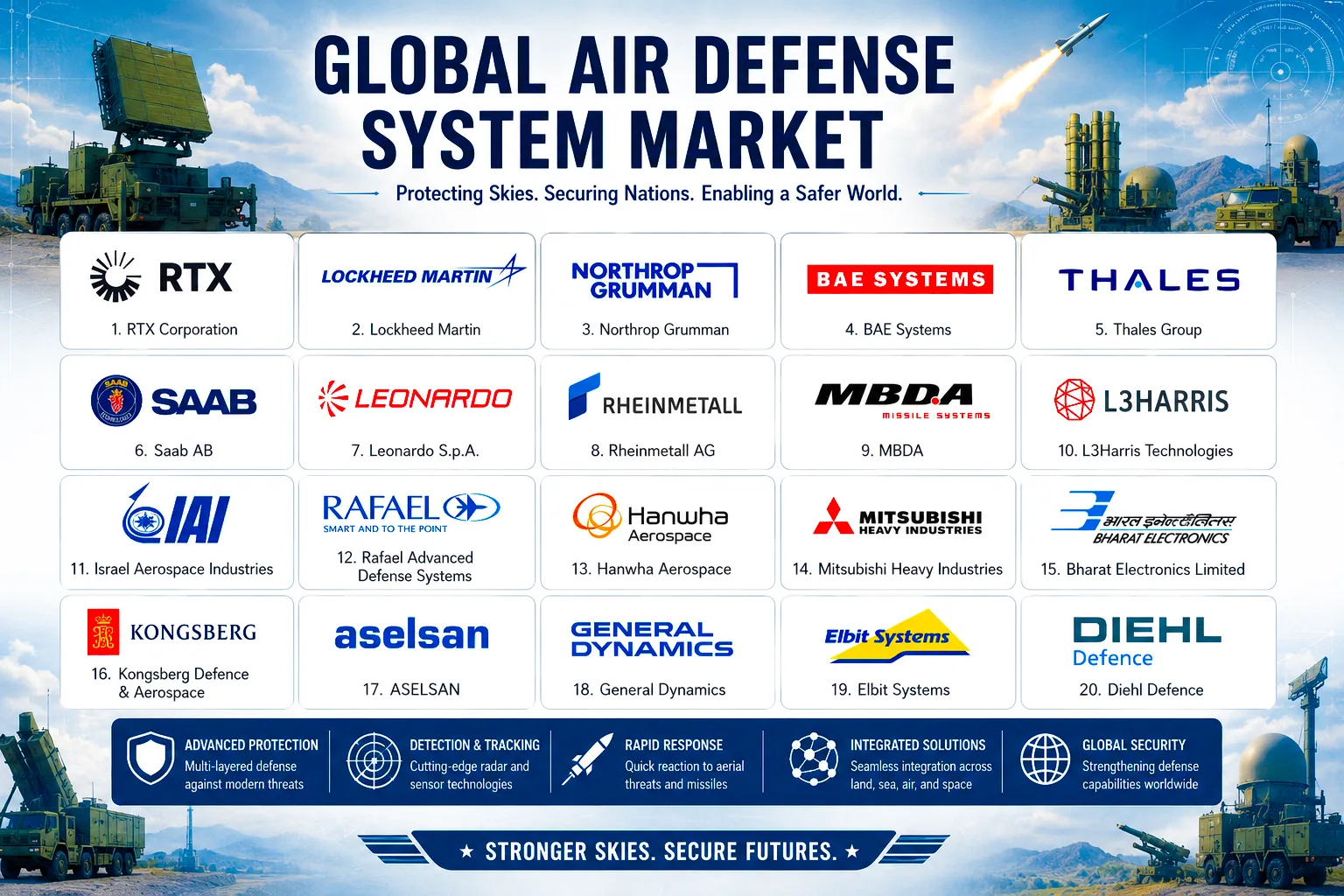
Air Defense System Market: Size, Trends, and Forecast Through the Next Decade
Introduction
An Air Defense System Missile Defense is a network of sensors, interceptors, and command infrastructure built to detect, track, and neutralize airborne threats before they reach their target. That definition once covered little more than anti-aircraft guns and early radar. Today it spans exo-atmospheric interceptors, swarming counter-drone lasers, space-based tracking layers, and AI-driven fire-control software that fuses data across dozens of sensors in milliseconds.
The market underpinning these systems is expanding for reasons that have little to do with routine modernization cycles. Conflicts in Eastern Europe and the Middle East have shown, in real time, how vulnerable both military forces and civilian infrastructure are to missiles, loitering munitions, and mass drone attacks. Governments that once treated air defense as a secondary budget line are now placing it near the top of national security priorities.
Three threat categories are driving this reprioritization. First, low-cost drones — from consumer-grade quadcopters to purpose-built loitering munitions — have proven capable of overwhelming legacy point-defense systems through sheer volume. Second, ballistic and cruise missile inventories are proliferating well beyond the handful of states that once possessed them. Third, hypersonic glide vehicles, which maneuver unpredictably during flight, are exposing gaps in defense architectures built for predictable ballistic trajectories.
Modern warfare has made air defense a precondition for freedom of maneuver rather than a defensive afterthought. Without credible air and missile defense, forces cannot mass, resupply, or operate fixed installations without unacceptable risk. This is why programs such as the United States' Golden Dome homeland defense initiative, NATO's integrated air and missile defense architecture, and the Indo-Pacific's rapidly expanding procurement pipelines have moved from planning documents to funded, multi-year programs.
Underneath the hardware, the more important shift is architectural. Militaries are moving away from single-tier, single-vendor systems toward layered, network-centric defense: short-range systems for drones and rockets, medium-range systems for cruise missiles and aircraft, and long-range, often space-cued, interceptors for ballistic and hypersonic threats — all sharing a common sensor picture through AI-enabled command-and-control software.
For manufacturers, investors, and procurement officials, this creates a market defined less by any single interceptor program and more by the software, radar, and integration layers that tie disparate systems together. The remainder of this report examines the market's size, its structural drivers, the segments and regions capturing the fastest growth, and the companies best positioned to benefit.
Air Defense System Market Overview
Market Definition. The air defense system market encompasses the hardware, software, and services used to detect, track, and intercept aerial threats, including manned and unmanned aircraft, ballistic and cruise missiles, hypersonic weapons, rockets, artillery, and mortars. It includes ground-based, naval, airborne, and space-enabled platforms, along with the radar, command-and-control, and fire-control subsystems that tie them together.
Scope. The market spans component categories (radar, missile systems, command and control, electro-optical/infrared sensors, launchers), platforms (land, naval, airborne), ranges (short, medium, long, and exo-atmospheric), and end users (defense ministries, homeland security agencies, and — in a small but growing segment — critical-infrastructure operators).
Ecosystem and Value Chain. The value chain runs from raw materials and specialized electronics (gallium nitride semiconductors, seeker heads, solid rocket propellant) through subsystem manufacturers, systems integrators, and prime contractors, and finally to government end users via direct procurement or Foreign Military Sales channels. Radar and seeker components represent a persistent bottleneck, particularly given constrained gallium nitride wafer capacity worldwide.
Industry Stakeholders. Key stakeholders include defense ministries and armed forces, homeland security agencies, prime contractors and their subcontractor networks, national research laboratories, export-control regulators, and multinational alliances such as NATO that coordinate interoperability standards across member states.
Market Maturity. Ground-based missile defense is a mature segment dominated by established platforms such as Patriot, S-400, and HQ-9. Counter-drone and directed-energy segments are comparatively early-stage, with rapid product iteration, lower barriers to entry for specialized firms, and significant near-term growth potential.
Technological Evolution. The center of gravity is shifting from platform-centric procurement (buying a single interceptor system) to architecture-centric procurement (buying an integrated network of sensors and effectors coordinated by common command-and-control software). This favors companies with strong software and systems-integration capabilities alongside traditional hardware expertise.
Market Size & Forecast
Estimates of the air defense system market vary meaningfully across research firms, largely due to differences in scope — some reports isolate ground-based missile defense, others include naval and airborne platforms, and still others fold in the broader integrated air and missile defense (IAMD) category. Taken together, independent market research published in 2025 and 2026 places the air defense systems market somewhere in the USD 17 billion to USD 68 billion range for 2026, depending on scope, with compound annual growth rates clustering between roughly 4% and 11% through the early-to-mid 2030s. The broader integrated air and missile defense category, which bundles sensors, interceptors, and command networks together, is estimated at close to USD 50 billion in 2026, rising toward the USD 85–90 billion range by the early 2030s under several forecasts.
Historical Trend. Growth through the early 2020s was steady but unremarkable, driven mainly by scheduled replacement of aging Cold War–era systems. That trend inflected sharply after 2022, as the Russia-Ukraine war and repeated missile and drone exchanges in the Middle East demonstrated both the necessity and the limits of existing systems.
Current Scenario. The present market is shaped by a small number of very large national programs. The U.S. Department of Defense's Golden Dome for America initiative alone requested roughly USD 17.5–17.9 billion in its FY2027 budget submission, with total program costs projected in the range of USD 175–185 billion through 2035 according to Congressional Budget Office and Army-provided estimates — and considerably higher over a twenty-year horizon. European NATO members have signed multibillion-dollar interceptor packages, including Poland's Patriot acquisition and Germany's Arrow 3 purchase, each valued in the billions of dollars.
Future Outlook. Forecasts consistently point to sustained double-digit or high-single-digit growth in the highest-value sub-segments — directed-energy weapons, command-and-control software, and space-based tracking — even where the overall market's blended CAGR is more moderate. Long-range and exo-atmospheric interceptor demand is expected to outpace short-range systems in dollar terms, even as short-range counter-drone systems UAV see the fastest unit-volume growth.
Investment Outlook. Capital is flowing toward companies with radar, sensor-fusion, and software-defined defense capabilities, alongside more traditional missile and launcher manufacturers. Export-oriented systems with combat-proven track records, such as Israel's Iron Dome and David's Sling, have seen strong recent order growth from regional buyers.
Market Attractiveness. The sector's attractiveness is reinforced by multi-year government budget commitments, high barriers to entry from export-control regimes and security clearances, and long product life cycles that generate recurring sustainment, upgrade, and munitions-resupply revenue well beyond the initial system sale.
Key Market Growth Drivers
Rising Defense Budgets. defense expenditure has continued its multi-year climb, with several major economies increasing budgets specifically to fund air and missile defense modernization. NATO members are moving toward and beyond alliance spending targets, and that increased topline is disproportionately benefiting air defense line items given recent combat experience.
Geopolitical Conflicts. Ongoing conflicts have provided a continuous, highly visible demonstration of both the value of air defense and the consequences of gaps in coverage, prompting even historically low-spending nations to accelerate acquisition timelines.
Missile Threats. The proliferation of ballistic and cruise missile technology to a wider range of state and non-state actors has expanded the addressable threat set that air defense systems must counter, driving demand for both quantity and sophistication.
Counter-Drone Demand. Low-cost drones and loitering munitions have proven capable of saturating traditional air defenses, creating urgent demand for scalable, cost-effective counter-UAS solutions that can be deployed at military bases, borders, and critical infrastructure.
AI-Enabled Defense Systems. Artificial intelligence is increasingly embedded in threat classification, sensor fusion, and engagement prioritization, shortening the detect-to-engage timeline that is critical against fast, maneuvering, or swarming threats.
Multi-Layered Air Defense. Nations are moving decisively away from single-tier defenses toward layered architectures that combine short-, medium-, and long-range systems, a shift that expands the addressable market for each individual layer rather than substituting one system for another.
Military Modernization. Broader modernization programs across land, sea, and air forces are being designed around integrated air defense from the outset, rather than retrofitting it onto legacy platforms.
Homeland Security Investments. Programs like Golden Dome for America reflect a strategic pivot toward defending domestic territory against peer-level missile threats, a mission that had previously been considered largely theoretical for the U.S. homeland.
Smart Radar Technologies. Active electronically scanned array (AESA) radar and next-generation sensors are extending detection ranges and improving classification accuracy against low-signature threats such as cruise missiles and stealthy drones.
NATO and Indo-Pacific Defense Initiatives. NATO's integrated air and missile defense system is linking national capabilities into a unified structure, while Indo-Pacific nations — Japan, South Korea, Australia, and India among them — are separately accelerating indigenous and imported air defense procurement in response to regional missile and drone threats.
Latest Industry Trends
- AI-Powered Command Centers. Command-and-control platforms are increasingly built around machine learning models that recommend or automate engagement decisions, compressing response windows against saturation attacks.
- Autonomous Interceptors. Development is underway on interceptors capable of limited autonomous target discrimination, reducing reliance on constant human-in-the-loop guidance during high-volume engagements.
- Hypersonic Defense. Programs specifically targeting hypersonic glide vehicle interception are moving from research to fielded capability, though technical hurdles around tracking maneuverable targets remain a significant constraint.
- Laser-Based Air Defense. Directed-energy interceptors such as Israel's Iron Beam promise a dramatically lower cost per engagement than kinetic interceptors, addressing the economics of defending against mass drone and rocket attacks.
- Directed Energy Weapons. Beyond lasers, high-power microwave systems are advancing toward operational deployment, with recent U.S. Navy trials demonstrating the ability to disable groups of drones at short range.
- Digital Battlefield Integration. Air defense systems are being designed for interoperability with broader battle-management networks rather than as standalone assets, reflecting a shift toward network-centric warfare doctrine.
- Cloud-Enabled Military Systems. Secure cloud infrastructure is enabling faster software updates, distributed sensor data sharing, and more resilient command architectures across dispersed defense networks.
- Sensor Fusion. Combining radar, electro-optical, infrared, and passive RF sensors into a single track picture is improving detection reliability against low-observable and small radar cross-section threats like drones.
- Next-Generation Radar. New radar systems designed to replace legacy Patriot-era sensors offer improved detection range, classification, and coverage against advanced and evolving threats, including hypersonic weapons.
- Space-Based Surveillance. Satellite tracking layers, including operational tranches of dedicated missile-tracking satellite constellations, are extending detection coverage well beyond the range of ground-based radar, particularly for hypersonic threats.
Market Challenges
High Procurement Costs. Modern interceptors and integrated systems carry substantial per-unit costs — some advanced interceptors run into the tens of millions of dollars each — creating budgetary strain even for well-funded militaries, particularly in high-volume engagement scenarios.
Long Procurement Cycles. Defense acquisition timelines, especially for complex, multi-year programs, can span a decade or more from requirement definition to fielded capability, creating a lag between emerging threats and available countermeasures.
Export Regulations. ITAR, MTCR, and comparable export-control regimes restrict the transfer of advanced air defense technology, slowing international sales and complicating co-production arrangements even among allied nations.
Cybersecurity Risks. As command-and-control systems become more networked and software-dependent, they also become more exposed to cyber intrusion, data manipulation, and jamming, requiring continuous investment in system hardening.
System Interoperability. Integrating legacy platforms from multiple vendors and eras into a single coherent architecture remains technically difficult, particularly across multinational coalitions with differing standards and classification levels.
Skilled Workforce Shortages. Specialized engineering talent in radar design, missile guidance, and software-defined defense systems is in short supply relative to demand, constraining production ramp-up across the industry.
Budget Constraints. Even amid rising defense spending, competing priorities — personnel costs, other weapons programs, and broader fiscal pressures — mean air defense funding is not immune to trade-offs.
Complex Integration. Fielding a genuinely layered defense requires coordinating sensors, interceptors, and software from different manufacturers and eras, a technical and contractual challenge that slows deployment timelines.
Market Opportunities
Emerging Economies. Nations in Southeast Asia, Latin America, and parts of Africa are beginning to invest in baseline air defense capability, representing a largely untapped procurement pipeline for cost-effective systems.
Asia-Pacific Modernization. Japan, South Korea, India, and Australia are collectively driving some of the fastest regional growth rates as they respond to regional missile and drone proliferation with both indigenous development and imports.
Counter-UAV Solutions. The counter-drone segment remains comparatively underserved relative to demand, creating room for both established primes and specialized newer entrants.
Portable Air Defense. Man-portable and vehicle-mounted short-range systems are seeing renewed interest for protecting maneuver forces and forward operating locations against drones and low-flying threats.
Naval Air Defense. Sea-based platforms are projected to grow faster than the market average as navies integrate ship-based interceptors and directed-energy weapons into broader fleet air defense.
Integrated Missile Defense. The shift toward architecture-level procurement favors companies that can offer sensor-to-shooter integration rather than standalone interceptors alone.
AI Software Upgrades. Retrofitting legacy systems with modern AI-enabled software offers a lower-cost growth path than full platform replacement, appealing to budget-constrained defense ministries.
Defense-as-a-Service. Emerging service-based models — leasing capacity, shared sensor networks, or contractor-operated systems — are beginning to appear as an alternative to outright ownership, particularly for smaller nations.
Public-Private Partnerships. Collaborative development arrangements between governments and industry are accelerating fielding timelines for next-generation interceptors and directed-energy systems.
Segment Analysis
By Component
Radar, missile systems, command-and-control systems, electro-optical/infrared sensors, and launchers make up the core component categories. Missile and weapon systems typically represent the largest revenue share, while command-and-control and fire-control software are consistently identified as the fastest-growing component given the industry's shift toward networked, AI-enabled architectures.
By Platform
Land-based systems hold the largest platform share, commanding well over half of total market value in most estimates, reflecting the dominance of established ground-based batteries like Patriot and S-400. Naval platforms are forecast to grow fastest as fleets integrate shipborne interceptors and directed-energy weapons. Airborne platforms remain a smaller but strategically important category tied to airborne early warning and control missions.
By Range
Long-range interceptor systems account for the largest share of market value, reflecting their high unit cost and strategic importance against ballistic and hypersonic threats. Short-range air defense (SHORAD) systems, while lower in dollar value per unit, are seeing the fastest unit-volume growth due to counter-drone demand.
By System
Missile defense systems dominate the market, commanding roughly half of total value across most estimates, given their central role in countering ballistic and cruise missile threats. Anti-aircraft systems and counter-rocket, artillery, and mortar (C-RAM) systems represent smaller but rapidly growing categories, particularly as C-UAS capability is increasingly bundled into new anti-aircraft system orders.
By Technology
Kinetic-kill effectors remain the dominant technology, underpinning proven systems such as PAC-3 MSE, THAAD, and SM-3. Directed-energy technologies — high-power microwave and laser systems — represent the fastest-growing technology category, driven by their favorable cost-per-engagement economics against mass drone threats.
By End User
National defense ministries and armed forces represent the overwhelming majority of end-user demand. Homeland security and critical-infrastructure protection represent a smaller but expanding end-user category, particularly in Gulf states and parts of Europe seeking to protect energy infrastructure and population centers.
Current Leader: Missile defense systems, land-based platforms, and long-range interceptors currently lead their respective segments, reflecting established procurement patterns built around legacy strategic threats.
Fastest-Growing Segment: Directed-energy weapons and counter-drone systems are consistently identified as the fastest-growing categories, driven by the urgent, cost-sensitive need to counter mass drone attacks that overwhelm traditional kinetic interceptors.
Regional Analysis
North America
North America remains the largest regional market, commanding roughly 34–47% of share depending on scope, anchored by sustained U.S. Department of Defense investment. The Golden Dome for America homeland missile defense initiative is the single largest program shaping regional demand, alongside continued Patriot, THAAD, and Aegis Ballistic Missile Defense modernization. Canada is separately accelerating defense spending to meet NATO targets. Leading manufacturers headquartered in the region include RTX, Lockheed Martin, Northrop Grumman, General Dynamics, and L3Harris. The region's future outlook centers on Golden Dome's multi-decade build-out and continued Patriot battalion expansion through the early 2030s.
Europe
Europe's air defense investment has accelerated sharply since 2022, driven by the war in Ukraine and NATO's push toward higher alliance-wide spending targets. Germany's special defense fund and Arrow 3 acquisition, alongside Poland's multibillion-dollar Patriot package, illustrate the shift toward layered, multi-tier defense across the continent. Key manufacturers include BAE Systems, Thales Group, Saab AB, Leonardo, Rheinmetall AG, MBDA, Kongsberg Defence & Aerospace, and Diehl Defence. NATO's integrated air and missile defense system is intended to knit these national capabilities into a coordinated alliance-wide architecture, a process expected to continue through the end of the decade.
Asia-Pacific
Asia-Pacific is consistently identified as the fastest-growing region, with CAGR estimates running ahead of the average. Japan, South Korea, India, and Australia are each pursuing a mix of indigenous development and imports in response to regional missile and drone proliferation. China's own missile defense investment represents a substantial share of regional demand in its own right. Leading regional manufacturers include Mitsubishi Heavy Industries, Hanwha Aerospace, and Bharat Electronics Limited, alongside continued imports of Western systems. Government-backed indigenous manufacturing initiatives, particularly in India and South Korea, are expected to reshape the regional competitive landscape over the coming decade.
Latin America
Latin America remains a comparatively small market today, with most nations prioritizing baseline capability upgrades over large-scale layered defense architectures. Growth is expected to be gradual, concentrated among a handful of countries modernizing aging Soviet- or Western-era systems, with demand skewed toward shorter-range and more cost-effective solutions.
Middle East & Africa
The Middle East is one of the most operationally active air defense markets ly, given recurring missile and drone threat exposure. Saudi Arabia's PAC-3 MSE and broader interceptor programs, alongside continued regional demand for Israel's Iron Dome and David's Sling systems, illustrate the urgency driving procurement in the region. Gulf states are allocating a meaningfully elevated share of defense budgets specifically to air defense modernization. Africa's market remains nascent but is expected to grow steadily as regional security concerns and counter-terrorism operations drive incremental investment. Israel Aerospace Industries and Rafael Advanced Defense Systems are the region's most prominent domestic manufacturers, alongside significant imports of U.S. and European systems.
Competitive Landscape
The air defense system market is moderately consolidated at the prime-contractor level, with a small number of large, vertically integrated firms — RTX, Lockheed Martin, Northrop Grumman, and BAE Systems chief among them — capturing the majority of large national program awards. Beneath this tier, a broader ecosystem of specialized manufacturers competes on niche capabilities: radar, seeker technology, directed-energy weapons, and counter-drone systems.
Innovation Strategies. Leading firms are investing heavily in software-defined defense architectures, AI-enabled sensor fusion, and directed-energy weapons as differentiators beyond traditional kinetic interceptor performance.
Mergers & Acquisitions. Consolidation continues selectively, particularly around companies with radar, electronic warfare, or software capabilities that complement existing missile and launcher portfolios.
Product Launches. Next-generation radar systems designed to replace legacy Patriot-era sensors, along with new counter-drone and directed-energy products, represent the most active area of new product introduction.
Partnerships. Cross-border co-development and co-production arrangements are increasingly common, particularly between U.S. and allied European and Asian manufacturers, as a way to navigate export-control constraints while meeting demand.
Government Contracts. Multibillion-dollar national programs — Golden Dome, NATO's integrated air and missile defense build-out, and Gulf state interceptor packages — represent the largest single source of revenue visibility for major contractors.
R&D Investment. Directed-energy weapons, hypersonic defense, and AI-enabled command-and-control represent the most heavily funded R&D priorities across the industry, reflecting where governments expect the next generation of capability to emerge.
Top 20 Leading Companies in the Air Defense System Market
- RTX Corporation
- Lockheed Martin
- Northrop Grumman
- BAE Systems
- Thales Group
- Saab AB
- Leonardo S.p.A.
- Rheinmetall AG
- MBDA
- L3Harris Technologies
- Israel Aerospace Industries
- Rafael Advanced Defense Systems
- Hanwha Aerospace
- Mitsubishi Heavy Industries
- Bharat Electronics Limited
- Kongsberg Defence & Aerospace
- ASELSAN
- General Dynamics
- Elbit Systems
- Diehl Defence
1. RTX Corporation
Headquarters: Arlington, Virginia, USA
Founded: 1922 (as Raytheon); RTX Corporation name adopted in 2023 following the merger of Raytheon Company and United Technologies in 2020.
Company Overview
RTX Corporation is one of the world's largest aerospace and defense companies, providing advanced technologies for defense, commercial aerospace, and intelligence applications. The company operates through three primary business segments: Raytheon, Pratt & Whitney, and Collins Aerospace. Within the air defense sector, Raytheon serves as the company's flagship defense business, delivering integrated missile defense systems, surveillance radars, command-and-control networks, and interceptor technologies used by military forces worldwide. RTX has established itself as a trusted partner for governments by combining decades of engineering expertise with continuous investments in next-generation defense technologies, enabling comprehensive protection against ballistic missiles, cruise missiles, hypersonic threats, drones, and aircraft.
Air Defense Portfolio
RTX possesses one of the industry's most comprehensive air and missile defense portfolios. Its offerings include the Patriot Air and Missile Defense System, NASAMS (developed jointly with Kongsberg), LTAMDS radar, GhostEye radar family, SM-series naval interceptors, and various command-and-control solutions. These systems support layered defense architectures capable of addressing evolving aerial threats across land, naval, and integrated joint-force operations.
Major Products
- Patriot Air and Missile Defense System
- NASAMS
- LTAMDS (Lower Tier Air and Missile Defense Sensor)
- GhostEye Family of AESA Radars
- Standard Missile (SM-2, SM-3, SM-6)
- AMRAAM Missile
- AIM-9X Sidewinder
- Command-and-Control Systems
Technologies
RTX specializes in AESA radar technology, artificial intelligence-enabled battle management, advanced interceptor guidance, multi-domain command-and-control networks, sensor fusion, electronic warfare, secure communications, and hypersonic defense solutions. Continuous R&D investments strengthen its leadership in next-generation missile defense.
Presence
RTX operates in more than 30 countries with manufacturing facilities, engineering centers, and customer support operations worldwide. Its air defense systems protect military forces across North America, Europe, the Middle East, Asia-Pacific, and Latin America. Long-term defense partnerships with NATO members and allied nations further expand its international footprint.
Defense Contracts
RTX regularly secures multi-billion-dollar contracts from the U.S. Department of Defense and allied governments for Patriot modernization, NASAMS deployment, AMRAAM production, LTAMDS radar procurement, and missile sustainment programs. Several NATO countries continue expanding Patriot and NASAMS deployments to strengthen regional air defense capabilities.
Financial Highlights
RTX reported annual revenues exceeding US$80 billion in recent fiscal reporting, making it one of the world's largest aerospace and defense companies. Defense programs account for a significant share of total revenue, supported by a robust order backlog and long-term government contracts.
Recent Developments
Recent developments include accelerated Patriot production, expanded NASAMS deliveries, LTAMDS operational testing, investments in hypersonic defense technologies, and increased international cooperation to strengthen integrated air defense networks. The company has also enhanced manufacturing capacity to meet growing defense demand.
Competitive Strengths
RTX's strengths include unmatched missile defense expertise, extensive combat-proven systems, strong government relationships, advanced radar technologies, service infrastructure, and continuous innovation. Its ability to integrate sensors, interceptors, and command systems into unified defense architectures provides a strong competitive advantage.
Strategic Focus
The company is prioritizing integrated air and missile defense, digital battlefield connectivity, AI-enabled decision support, interceptor modernization, hypersonic defense, and expanded international defense partnerships.
Future Outlook
Rising geopolitical tensions, increasing defense budgets, and modernization initiatives across NATO, Indo-Pacific, and Middle Eastern nations are expected to drive sustained demand for RTX's advanced air defense solutions. Continued investments in AI, sensor integration, and next-generation interceptors position the company for long-term leadership in the air defense market.
2. Lockheed Martin
Headquarters: Bethesda, Maryland, USA
Founded: 1995 (through the merger of Lockheed Corporation and Martin Marietta)
Company Overview
Lockheed Martin is the world's leading defense contractor and a major provider of advanced air and missile defense systems. The company develops integrated military technologies spanning missile interception, radar systems, command-and-control platforms, space-based defense, and next-generation combat capabilities. Its Rotary and Mission Systems and Missiles and Fire Control divisions play a central role in delivering sophisticated air defense solutions to the U.S. military and allied nations. Lockheed Martin's combat-proven technologies are designed to defend against ballistic missiles, cruise missiles, hypersonic weapons, unmanned aerial systems, and advanced airborne threats.
Air Defense Portfolio
Lockheed Martin offers a broad portfolio including THAAD, Aegis Combat System, PAC-3 Missile Segment Enhancement (MSE), Sentinel A4 radar contributions, and integrated battle management solutions. The company also supports multi-layer missile defense architectures combining land, sea, and space-based assets.
Major Products
- THAAD
- PAC-3 MSE
- Aegis Combat System
- Vertical Launch Systems
- TPY-4 Radar
- Integrated Battle Command Solutions
- Missile Launch Platforms
Technologies
The company excels in missile interception technologies, hypersonic defense, AI-enabled command systems, advanced sensors, digital engineering, cybersecurity, space-based missile warning, and integrated multi-domain operations.
Presence
Lockheed Martin serves more than 50 countries through defense exports, joint ventures, industrial partnerships, and technology collaborations. Its missile defense systems are widely deployed across the United States, Europe, Asia-Pacific, and the Middle East.
Defense Contracts
The company consistently receives large U.S. Department of Defense contracts covering THAAD production, PAC-3 interceptor manufacturing, Aegis modernization, missile integration, and international foreign military sales. Numerous allied governments continue procuring its missile defense technologies.
Financial Highlights
Lockheed Martin generates annual revenues exceeding US$70 billion, supported by a multi-year defense backlog valued at well over US$150 billion. Missile defense remains one of its highest-growth business segments.
Recent Developments
Recent initiatives include expanded PAC-3 MSE production, THAAD modernization, Aegis system upgrades, investments in hypersonic defense, and digital transformation programs to improve manufacturing efficiency and operational readiness.
Competitive Strengths
The company's strengths include extensive combat experience, technological leadership, strong U.S. government relationships, diversified defense capabilities, advanced missile technologies, and a large international customer base.
Strategic Focus
Lockheed Martin is emphasizing integrated missile defense, AI-enabled battlefield management, hypersonic interception, digital engineering, autonomous defense technologies, and closer collaboration with allied nations.
Future Outlook
Growing investments in missile defense modernization, increasing NATO defense spending, and rising Indo-Pacific security requirements are expected to sustain long-term demand for Lockheed Martin's integrated air defense solutions.
3. Northrop Grumman
Headquarters: Falls Church, Virginia, USA
Founded: 1994
Company Overview
Northrop Grumman is a aerospace and defense technology company specializing in advanced radar systems, missile defense, command-and-control, autonomous systems, and space-based defense capabilities. The company is recognized for developing highly sophisticated sensor technologies that enhance situational awareness and integrated air defense operations. Northrop Grumman plays an important role in U.S. missile defense initiatives through advanced battle management systems, early warning radars, and next-generation interceptor development.
Air Defense Portfolio
Its portfolio includes Integrated Air and Missile Defense Battle Command System (IBCS) support, advanced AESA radars, early warning sensors, missile defense command systems, airborne surveillance platforms, and counter-hypersonic technologies.
Major Products
- AN/TPS-80 G/ATOR Radar
- SABR AESA Radar
- Missile Defense Command Systems
- Integrated Battle Management Solutions
- Early Warning Sensors
- Counter-Hypersonic Technologies
Technologies
Northrop Grumman focuses on sensor fusion, AI-enabled command systems, advanced radar engineering, cyber-resilient defense networks, autonomous surveillance, space-based missile tracking, and multi-domain operations.
Presence
The company supports military customers across North America, Europe, Asia-Pacific, Australia, and the Middle East through defense contracts, industrial cooperation, and technology partnerships.
Defense Contracts
Northrop Grumman regularly secures U.S. defense contracts involving missile warning satellites, radar modernization, integrated command systems, and next-generation missile defense technologies.
Financial Highlights
The company records annual revenues exceeding US$40 billion, supported by strong demand across aerospace, defense electronics, and missile defense programs.
Recent Developments
Recent investments include next-generation radar development, expanded missile warning capabilities, digital engineering initiatives, AI-powered defense software, and hypersonic defense research.
Competitive Strengths
Its major strengths include advanced sensor expertise, space-defense leadership, strong cybersecurity capabilities, systems integration experience, and continuous technological innovation.
Strategic Focus
Northrop Grumman is prioritizing integrated air defense, space-based missile tracking, autonomous sensing, AI-enabled command networks, and digital battlefield integration.
Future Outlook
Increasing investments in missile warning, space defense, and multi-domain military operations are expected to support continued growth in Northrop Grumman's air defense business.
4. BAE Systems
Headquarters: London, United Kingdom
Founded: 1999
Company Overview
BAE Systems is one of Europe's largest defense companies and a leading supplier of advanced air defense technologies, combat systems, electronic warfare solutions, and integrated battlefield capabilities. The company serves military customers in over 40 countries and collaborates extensively with NATO allies on modern air defense programs.
Air Defense Portfolio
BAE Systems develops naval air defense systems, combat management systems, electronic warfare suites, radar technologies, and missile launch solutions supporting layered air defense operations.
Major Products
- Combat Management Systems
- Electronic Warfare Systems
- Naval Air Defense Solutions
- Radar Technologies
- Missile Launch Systems
- Battlefield Communications
Technologies
The company specializes in electronic warfare, cyber defense, sensor fusion, digital mission systems, AI-assisted threat detection, and advanced radar technologies.
Presence
BAE Systems maintains manufacturing, engineering, and support facilities across Europe, North America, Australia, Saudi Arabia, and other international markets.
Defense Contracts
The company participates in numerous NATO modernization programs and receives long-term contracts from the UK Ministry of Defence, U.S. Department of Defense, Australia, and Middle Eastern governments.
Financial Highlights
BAE Systems reports annual revenues exceeding £28 billion, supported by strong defense spending across multiple regions.
Recent Developments
The company continues investing in electronic warfare modernization, digital defense technologies, autonomous military systems, and advanced radar capabilities.
Competitive Strengths
Its strengths include diversified defense expertise, strong government partnerships, advanced electronic warfare technologies, and extensive international operations.
Strategic Focus
BAE Systems is expanding investments in AI-enabled defense, integrated air defense, cyber resilience, and next-generation electronic warfare.
Future Outlook
Growing NATO defense budgets and increased investments in integrated battlefield systems are expected to drive continued expansion.
5. Thales Group
Headquarters: Paris, France
Founded: 2000 (roots dating back to 1893)
Company Overview
Thales Group is a leader in defense electronics, radar technologies, integrated air defense systems, cybersecurity, and digital military communications. The company delivers sophisticated solutions that improve situational awareness, command efficiency, and airspace protection for armed forces worldwide. Thales combines decades of expertise in radar engineering, missile integration, and secure communications to provide highly reliable air defense solutions for both fixed and mobile military operations.
Air Defense Portfolio
Its portfolio includes Ground Master radar family, AirMaster systems, Crotale air defense solutions, integrated command-and-control platforms, air surveillance systems, and digital battlefield communications.
Major Products
- Ground Master Radar Family
- AirMaster Surveillance Radar
- Crotale Air Defense System
- Command-and-Control Solutions
- Air Surveillance Systems
- Secure Military Communications
Technologies
Thales develops AESA radar technologies, AI-assisted threat detection, electronic warfare, secure communications, cyber defense, sensor fusion, and integrated command networks.
Presence
The company operates in more than 65 countries with manufacturing facilities, engineering centers, and customer support organizations serving military forces across Europe, Asia-Pacific, Africa, the Middle East, and the Americas.
Defense Contracts
Thales regularly secures contracts from NATO members, European defense agencies, Middle Eastern governments, and Asia-Pacific customers for radar modernization and integrated air defense projects.
Financial Highlights
Thales generates annual revenues exceeding €20 billion, supported by diversified aerospace, defense, cybersecurity, and digital identity businesses.
Recent Developments
Recent initiatives include the expansion of the Ground Master radar family, investments in AI-powered surveillance, enhanced cybersecurity solutions, and next-generation integrated air defense platforms.
Competitive Strengths
Its competitive advantages include world-class radar expertise, strong cybersecurity capabilities, advanced electronics, diversified defense offerings, and a broad international customer base.
Strategic Focus
The company is investing heavily in digital air defense ecosystems, AI-enabled surveillance, electronic warfare, secure communications, and integrated command-and-control solutions.
Future Outlook
With rising demand for advanced radar systems, NATO modernization programs, and increasing investments in integrated air defense worldwide, Thales is well positioned to remain one of the leading suppliers of next-generation air defense technologies.
Recent Industry Developments
The most consequential recent development is the United States' Golden Dome for America initiative, announced via executive order in September 2025 and funded through the FY2027 budget submission at roughly USD 17.5–17.9 billion, with total program costs estimated between USD 175 billion and well over USD 1 trillion depending on scope and time horizon. The program is designed as a "system of systems" integrating THAAD, Patriot, Aegis Ballistic Missile Defense, Ground-Based Midcourse Defense, and emerging space-based interceptor concepts into a unified homeland architecture, with the U.S. Army expanding Patriot battalions and integrating the Integrated Battle Command System and Lower Tier Air and Missile Defense Sensor radar as core components.
In Europe, NATO members have continued to sign large interceptor packages in direct response to the war in Ukraine, including Poland's multibillion-dollar Patriot acquisition and Germany's Arrow 3 purchase from Israel Aerospace Industries and Boeing, alongside Germany's broader special defense fund supporting continued procurement of air defense systems and ISR platforms.
In the Middle East, Saudi Arabia has pursued a substantial PAC-3 MSE package, and regional buyers have continued placing multi-battery orders for Israel's Iron Dome and David's Sling systems. Kuwait received approvals for Patriot missile upgrades and sustainment support during 2025 and 2026.
Directed-energy weapons have advanced from prototype toward operational testing, with a U.S. Navy at-sea trial of a high-power microwave system in early 2026 reportedly disabling groups of small drones at short range with a high success rate — a milestone frequently cited as evidence that directed-energy counter-drone systems are approaching deployable maturity.
Frequently Asked Questions
1. How big is the Air Defense System market? Estimates vary by scope and methodology, with independent research placing the market anywhere from roughly USD 17 billion to USD 68 billion in 2026, and the broader integrated air and missile defense category near USD 50 billion.
2. What is the projected CAGR for the Air Defense System market? Published forecasts range from roughly 4% to 11% depending on the segment and scope analyzed, with directed-energy weapons and counter-drone systems consistently forecast at the high end of that range.
3. What is driving growth in the Air Defense System market? Rising defense budgets, ongoing geopolitical conflicts, missile and drone proliferation, and large national programs such as Golden Dome and NATO's integrated air and missile defense build-out are the primary growth drivers.
4. Which region leads the Air Defense System market? North America holds the largest share, driven by sustained U.S. Department of Defense investment, though Asia-Pacific is consistently forecast as the fastest-growing region.
5. What are the biggest challenges facing the market? High procurement costs, long acquisition cycles, export-control restrictions, cybersecurity risks, and system interoperability across multi-vendor architectures are the most cited challenges.
6. What opportunities exist in the market? Emerging economies, Asia-Pacific modernization, counter-UAV solutions, naval air defense, and AI-enabled software upgrades to legacy systems represent the most significant near-term opportunities.
7. Which segment holds the largest market share? Missile defense systems hold the largest share by system type, and land-based platforms dominate by platform, though both are seeing relatively slower growth than counter-drone and directed-energy segments.
8. Which segment is growing the fastest? Directed-energy weapons and counter-drone systems are consistently identified as the fastest-growing categories.
9. Who are the leading companies in the Air Defense System market? RTX, Lockheed Martin, Northrop Grumman, BAE Systems, and Thales Group are among the largest players, alongside specialized manufacturers like Rafael, Israel Aerospace Industries, Diehl Defence, and Rheinmetall.
10. What is Golden Dome for America? Golden Dome is a U.S. homeland air and missile defense initiative announced in 2025, integrating existing and emerging interceptor, sensor, and command systems into a unified national architecture, with FY2027 budget requests of approximately USD 17.5–17.9 billion.
11. How are drones changing the air defense market? Low-cost drones and loitering munitions have exposed gaps in traditional point-defense systems, driving urgent demand for scalable, cost-effective counter-UAS solutions, including directed-energy weapons.
12. What role does AI play in modern air defense? AI is increasingly used for threat classification, sensor fusion, and engagement-decision support, shortening detect-to-engage timelines critical against fast or swarming threats.
13. What is the difference between missile defense and air defense? Air defense is the broader category, encompassing systems that counter aircraft, drones, rockets, and missiles; missile defense refers specifically to systems designed to intercept ballistic and cruise missiles.
14. Why is directed-energy technology gaining attention? Laser and high-power microwave systems offer a dramatically lower cost per engagement than kinetic interceptors, which is critical for defending against high-volume drone and rocket attacks economically.
15. What is NATO's integrated air and missile defense system? It is NATO's effort to link individual member states' air defense capabilities into a single, coordinated alliance-wide architecture with shared sensor data and engagement coordination.
16. How is the Middle East shaping the market? The Middle East is one of the most operationally active regions ly, with recurring missile and drone threat exposure driving elevated defense budget allocation specifically toward air defense.
17. What is the significance of hypersonic defense? Hypersonic glide vehicles maneuver during flight, unlike traditional ballistic missiles, making them significantly harder to track and intercept and driving dedicated investment in new detection and interception capability.
18. Are export controls a major constraint on the market? Yes. ITAR, MTCR, and similar regimes restrict technology transfer, slowing international sales and complicating co-production agreements even among close allies.
19. What is the outlook for naval air defense? Naval air defense is forecast to grow faster than the broader market average as navies integrate shipborne interceptors and directed-energy weapons into fleet defense.
20. How significant is the counter-drone segment? It is one of the fastest-growing segments in the market, driven by the proliferation of low-cost drones capable of overwhelming legacy defenses.
21. What is the investment outlook for the sector? Multi-year government budget commitments, high barriers to entry, and recurring sustainment revenue make the sector attractive to long-term investors, though procurement cycles remain long.
22. Which countries are increasing air defense spending fastest? The United States (via Golden Dome), Germany, Poland, Saudi Arabia, and several Asia-Pacific nations including Japan and South Korea are among those increasing air defense spending most rapidly.
23. What is the role of space-based systems in air defense? Satellite tracking layers extend detection coverage beyond ground-based radar range, particularly valuable for tracking hypersonic threats during their boost and midcourse phases.
24. How reliable are current market size estimates? Estimates vary considerably across research firms due to differing scope definitions, so figures should be interpreted as directional ranges rather than precise consensus values.
25. What does the future of the air defense industry look like? The industry is moving toward integrated, software-defined, multi-layered architectures that combine kinetic and directed-energy interceptors under AI-enabled command-and-control systems, a shift that favors companies with strong systems-integration and software capabilities alongside traditional hardware expertise.
Conclusion
The air defense system market is being reshaped by a convergence of forces rarely seen together: proliferating missile and drone threats, landmark national programs like Golden Dome, an accelerated NATO modernization drive, and a technological pivot toward AI-enabled, layered, and increasingly directed-energy-based architectures. While market size estimates vary across research methodologies, the underlying growth trajectory is consistent — sustained, multi-year investment across nearly every major defense-spending region, with the fastest gains concentrated in counter-drone, directed-energy, and command-and-control software segments rather than legacy kinetic interceptors alone.
For manufacturers, this is a market that rewards systems-integration capability as much as raw interceptor performance. For investors and procurement decision-makers, it offers a rare combination of long program horizons, recurring sustainment revenue, and near-term catalysts — from Golden Dome's budget ramp to NATO's interceptor packages — that are already translating into firm contract awards rather than speculative forecasts.
For organizations that need to move beyond directional estimates and into program-level detail — contract-by-contract breakdowns, company-level revenue attribution, and granular segment forecasts by country — IMIR's full Air Defense System Market report offers the depth required to support procurement strategy, competitive benchmarking, and investment decisions with confidence. Explore IMIR's comprehensive Air Defense System Market report to access the complete data set, custom regional breakdowns, and ongoing analyst support.